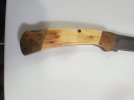
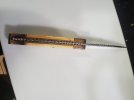
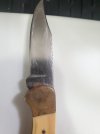
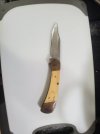
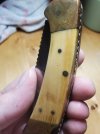
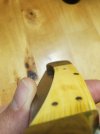
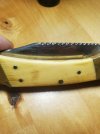
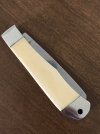
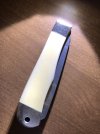
Is this an owner-customzied Buck 112?

Definatly an interesting knife. It looks in good shape for a two dot. I'd polish the brass, oil the handle , sharpen the blade and put it on your belt. It's got a lot of life left.
I plan to keep and use it. I may leave the patina on the brass though.

I'm just curious how it came to have the bone scales and file work on the spine. I'm almost certain they were customizations by a previous owner.
 
The file work looks like a custom, not from Buck.

The pictures aren’t clear enough to tell for sure but those might be mammoth scales, not bone. Can you see schreger lines? They are frequently more visible if you look down the scale from an angle with the light source above and behind it. Do you have clear closeup pictures?
 
I plan to keep and use it. I may leave the patina on the brass though.

I'm just curious how it came to have the bone scales and file work on the spine. I'm almost certain they were customizations by a previous owner.
That 112 has a lot of character. I think it was customized by someone, other than Buck, with good skills. Enjoy that handsome 112! :thumbsup:
 
The file work looks like a custom, not from Buck.

The pictures aren’t clear enough to tell for sure but those might be mammoth scales, not bone. Can you see schreger lines? They are frequently more visible if you look down the scale from an angle with the light source above and behind it. Do you have clear closeup pictures?
It was in the back of my mind :thumbsup:
 
I plan to keep and use it. I may leave the patina on the brass though.

I'm just curious how it came to have the bone scales and file work on the spine. I'm almost certain they were customizations by a previous owner.
Definitely leave it, that's some beautifully aged brass.
You can buy a shiny new 110 everyday, but this has the kind of patina they're poorly trying to replicate on every plated and faux aged pot metal drawer pull you can buy.
 
The file work looks like a custom, not from Buck.

The pictures aren’t clear enough to tell for sure but those might be mammoth scales, not bone. Can you see schreger lines? They are frequently more visible if you look down the scale from an angle with the light source above and behind it. Do you have clear closeup pictures?
I'll try that in the morning
Definitely leave it, that's some beautifully aged brass.
You can buy a shiny new 110 everyday, but this has the kind of patina they're poorly trying to replicate on every plated and faux aged pot metal drawer pull you can buy.
Yeah, definitely leaving the patina. Just has too much character to get rid of.
 
The file work looks like a custom, not from Buck.

The pictures aren’t clear enough to tell for sure but those might be mammoth scales, not bone. Can you see schreger lines? They are frequently more visible if you look down the scale from an angle with the light source above and behind it. Do you have clear closeup pictures?
I'm not sure if I'm doing the lighting correctly, but I can't see schreger lines. Admittedly, I've never looked for them before.
I did look at the scales using a magnifier and they don't appear to be porous, which usually means it's not bone.

Below are some images
20260320_144658.jpg20260320_144614.jpg20260320_144538.jpg
 
I'm not sure if I'm doing the lighting correctly, but I can't see schreger lines. Admittedly, I've never looked for them before.
I did look at the scales using a magnifier and they don't appear to be porous, which usually means it's not bone.

Below are some images
View attachment 3138265View attachment 3138266View attachment 3138267
There are definitely schreger lines, they are especially visible in the darker area by the rocker pin.

Here is an example of mammoth in which, under normal direct lighting and viewing it directly, the schreger lines are not visible:

IMG_5181.jpeg

But viewed obliquely with a light source that is behind it the schreger lines become visible (you may need to zoom to really see them). Note also that the bark of the tusk does not have schreger lines, they are only seen in interior ivory.
IMG_5182.jpeg
 
There are definitely schreger lines, they are especially visible in the darker area by the rocker pin.

Here is an example of mammoth in which, under normal direct lighting and viewing it directly, the schreger lines are not visible:

View attachment 3138341

But viewed obliquely with a light source that is behind it the schreger lines become visible (you may need to zoom to really see them). Note also that the bark of the tusk does not have schreger lines, they are only seen in interior ivory.
View attachment 3138342
Ohhhhhh....got it. I thought they had to be going the other direction.

That's awesome. That makes me love this little knife even more.

Is there any special care to be taken with mammoth scales?
 
Last edited:
Ohhhhhh....got it. I thought they hard to be going the other direction.

That's awesome. That makes me love this little knife even more.

Is there any special care to be taken with mammoth scales?

I would treat it the same as similar bone scales. Ivory is tough material, although yours has cracks. Billiard balls used to be made of ivory (Asian elephant ivory, while piano keys were made from African elephant ivory).

Also note that yours could be either mammoth or mastodon, but since there is a lot more mammoth of this quality, it is most likely mammoth. The only way to tell for sure would be to look at the schreger line intersection angles on the cross cut, and for your knife it would require taking the scales off. Mammoth typically has around a 90 degree or less intersection, while mastodon, like modern elephant, has about a 120 degree intersection. See page ten of this document:


The number of elephants killed for billiard balls is staggering - at one time it was 12,000 elephants per year just to supply the British market.

 
Last edited:
I would treat it the same as similar bone scales. Ivory is tough material, although yours has cracks. Billiard balls used to be made of ivory (Asian elephant ivory, while piano keys were made from African elephant ivory).

Also note that yours could be either mammoth or mastodon, but since there is a lot more mammoth of this quality, it is most likely mammoth. The only way to tell for sure would be to look at the schreger line intersection angles on the cross cut, and for your knife it would require taking the scales off. Mammoth typically has around a 90 degree or less intersection, while mastodon, like modern elephant, has about a 120 degree intersection. See page ten of this document:


The number of elephants killed for billiard balls is staggering - at one time it was 12,000 elephants per year just to supply the British market.

Thanks for the info! Much appreciated!

It's sad what mankind did to elephants. They're wonderful, intelligent animals.
 
Back
Top