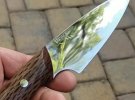
I've got a little etching challenge and need some help

Joined
Jan 10, 2015
Messages
1,673
I have just started buffing my blades out to a more or less mirror finish. The challenge I have is that my etch tends to leave a haze around the etch. When I buff that out the black is removed from the etch. Can't figure out how to get rid of the haze, or buff it out without removing the black.
Anyone solve this?
What am I doing wrong on the etch?
 
A photo would help a lot.

First, the dip in FC most folks call an etch is really just an oxide patina. It doesn't etch the steel much, and it doesn't penetrate the surface at all. It is a surface oxide that will rub or buff off pretty easily. The term etch has stuck, so that is what we call it.

In my experience an etched finish and mirror polish don't go together. If the etch doesn't have something to be down in, it will just rub off the smooth surface. I find a clean 400 grit holds an etch better.

Also, some etches actually "bite" more than others. HCl ( muriatic acid) solutions will not be as black, but will "bite" the steel and leave a frosted dark gray look. You could follow that with an FC etch to get it blacker.
 
Thanks Stacy. I do get a deep etch. Sounds like I may just be out of luck on blacking it, but I would be interested to hear other's experience.
I'm not devastated if my etch has a mirror finish. It's not bad looking.

Etch1.jpg
 
If I'm understanding the issue it's your Makers Mark Etch? When you apply the acid with your etching tool it generates HEAT so the longer it's in contact with the metal the more heat to the area surrounding the Mark. Try shorter contact time with the stencil and you will probably have to Touch...Remove...Touch...Remove and allow a short time between touches to find the right amount of time like 2-3 seconds between touches. Buff out a piece of scrap to test better than ruining a finished blade.

Mike
 
That sounds pretty reasonable Mike. I'm probably terrible for long touches. I'll see if I can try the shorter touching sessions and see how it goes.
So you are saying I can buff out the blade to finish, then try this shorter time touch method and not have to clean up the etch?

I suppose I could also use a dremel buffer to clean up a little bit if need be without hitting the black. This sounds promising!
 
after your stencil it taped in place, put a drop of windex on your makers mark on the stencil. this drop will go through your mark, and between the stencil and blade. ( your etching solution usually does this, and thats what causes the haze). the windex will keep the etchant from getting in there and causing haze. if there is still haze, remove it with 3000 grit and rebuff. sanding with the 3000 grit greatly reduces the time needed on the buffer and this helps preserve the black at the bottom of the mark.
 
So you are saying I can buff out the blade to finish, then try this shorter time touch method and not have to clean up the etch?
YES......also if there is haze check your stencil. Any minor clean up can be done with Semi-Chrome polish and a Q-Tip.

Just read John's Post never tried that but now I want to check it out....I've done quite a few Mirror polished over the years and had to adjust my technique to solve that haze issue it's all about solving mysteries!!!
 
after your stencil it taped in place, put a drop of windex on your makers mark on the stencil. this drop will go through your mark, and between the stencil and blade. ( your etching solution usually does this, and thats what causes the haze). the windex will keep the etchant from getting in there and causing haze. if there is still haze, remove it with 3000 grit and rebuff. sanding with the 3000 grit greatly reduces the time needed on the buffer and this helps preserve the black at the bottom of the mark.

I was thinking about something like that. What I was thinking was oil to seal it, but that would probably ruin the etch, so I never tried it. Thanks for the suggestion John. I'll give this a shot as well.
 
Have you tried using Flitz to see if it will remove the haze? How about some polishing paper?
 
OK, now I know it is your makers mark etch withn then haze.

1) The pad has to be barely damp ... not wet ... with thenelectrolyte.
2) The voltage needs to be lowered if you are getting "over-etch" (haze).
3) As siad, try the press, lift, press lift, technique.
4) Don't press too hard.
5) Generally a little rub with Flitz will take away the haze,
 
These are all good suggestions. I haven't experimented a lot with it on a buffed blade. I just started buffing. I have always to date gone up to 1200 hand rubbed. It is pretty easy to go over the etch on this finish when done to remove any imperfections. Using a flat bar it doesn't dig into the black etch.
So this is all new to me.
I have a big AEBL chef that I haven't ground yet. It is just a big Gyuto shaped bar. I plan to sand (not grind) the blade edge side down to finish and buff it out. Then I can test out some various methods as you all have been kind enough to suggest. When I grind that one all the practice etches will be removed.
I'll post some pics and explanation of what I do with each attempt and the results.

The plan:

1. Etch as I would normally to compare

2. Etch with shorter touches,

3. Etch with windex, but otherwise as I normally would

4. Etch slightly drier, but otherwise as I normally would
 
Last edited:
Back
Top