Japanese kitchen knife question

Joined
Jul 31, 2015
Messages
3,118
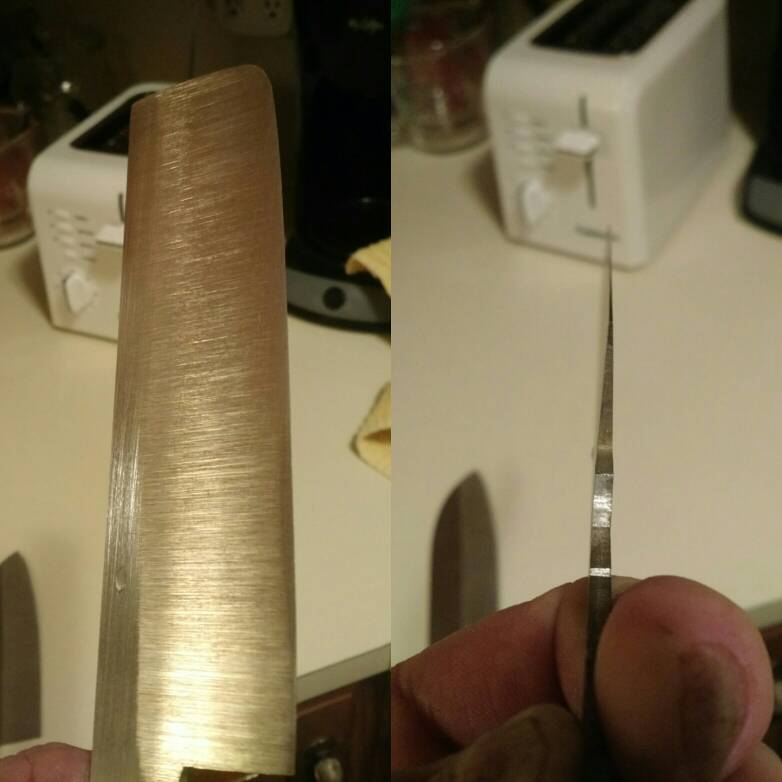
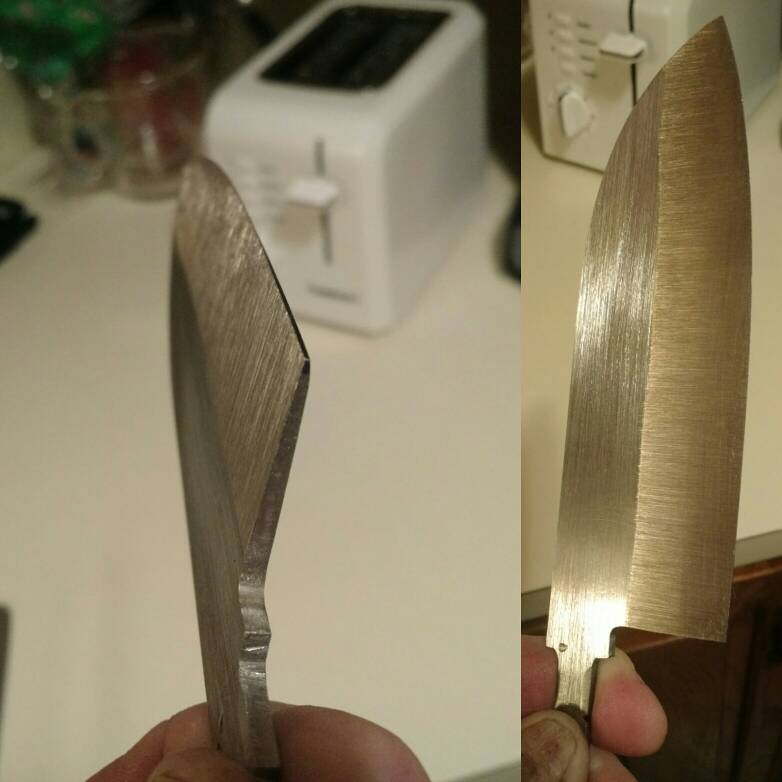
So I am making a backup for my KITH knife. One of these two. I know the santoku is fairly thick from spine to tip, the nakiri, not so much? I am hoping I can get away with at least some pre HT grinding as I don't have variable speed, nor an active cooling system yet. Would this be advisable with AEB-L? If so, how far would you take it? Stock is .118.
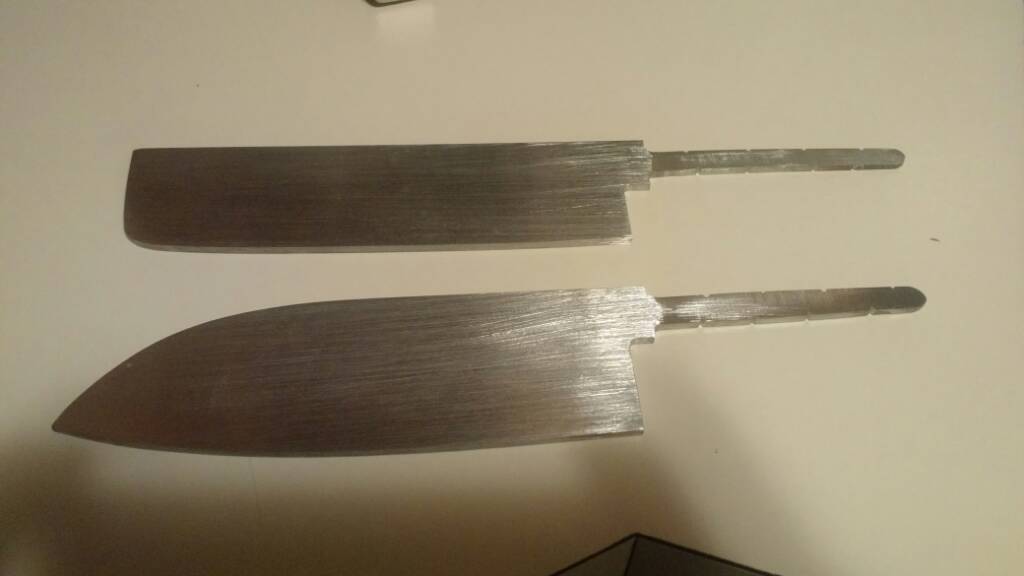
025415b3247bde9dd86404a7902cce4e.jpg
 
I grind all my kitchen knives after HT. I do have variable speed and will say even on slowest speed they still get super hot when closing down on final dimensions. I keep a bucket of ice water with dish soap/windex or something in it and by the time I'm done grinding a few knives im standing in a puddle. Also not 100% on santoku (the ones i own are super thin at the edge and distal taper starts about 2/3rds way down the spine) but nakiris are the THIN THIN THIN! If I am using VSM belts i use a fresh belt for each side of the knife, cubitron or blaze belts could probably doa whole blade with 1 belt.
Not sure about pre HT dimensions but I would leave a bit of meat on the tip if you do grind pre HT. I'm sure more experienced members will chime in.
-Trey/Comet
 
.118 is very thick for a kitchen knife. I use AEB-L in .060 -.070" on kitchen blades. I grind post-HT.

Santoku and nakiri are thin slicers, not thick choppers. I would normally suggest getting thinner steel, but these are already profiled.

With a blade as thick as yours, I would pre-bevel to an edge of .030" before HT. Distal taper the santoku, but a nakiri would be strange with a distal taper, so just make it a FFG. If you have the ability to put a full urasaki on the back of the nakiri, that will kelp.
 
.118 is very thick for a kitchen knife. I use AEB-L in .060 -.070" on kitchen blades. I grind post-HT.

Santoku and nakiri are thin slicers, not thick choppers. I would normally suggest getting thinner steel, but these are already profiled.

With a blade as thick as yours, I would pre-bevel to an edge of .030" before HT. Distal taper the santoku, but a nakiri would be strange with a distal taper, so just make it a FFG. If you have the ability to put a full urasaki on the back of the nakiri, that will kelp.

I was looking at some specifications of these types of knives on chef knives to go to get an idea. The Nakiri I was looking at here: http://www.chefknivestogo.com/hinourasantoku.html is 3mm at the spine. and the Santoku : http://www.chefknivestogo.com/gibl2sa16.html at 3.5mm. That also jives with a Santoku I currently own and really like. I did notice some of the Nakiri were in the 1.4mm range, but I went with thicker as I was dreading the warp at that thinness.
 
Yes, you do see them thicker, but that is usually in a Hitachi carbon steel. Stainless blades are usually thinner.
 
Those knives are also forged so the spine thickness us misleading. I have a Kurosaki nakiri that is 3.5mm at spine above choil but almost immediately tapers down to 1.5mm for the length of the blade.
 
So since these are already profiled, any input on if i can do any pre-HT grinding on them? I'm thinking yes?
 
The biggest factor in getting a good cutting chef knife is thickness of the steel behind the edge and the shape of the bevel faces. I was in a pass around on another forum and got to try a Kato gyuto. It was .17 thick (maybe thicker) at the spine above the heal and only had distal taper the last third of the blade toward the point. That knife could cut circles around any kitchen knife I had made or tried at the time.

Here are a few pics of what they look like, check out the choil shot, not mine just found on the internet as an example.

http://www.kitchenknifefora.com/attachments/yf_jns_g240_33_choil-jpg.3724/

My comments are regarding gyuto/ chef knives in general, not task specific knives like the nikiri.
 
Last edited:
The name "nakiri" means "thin blade" it is used for cutting up onions and soft things of various sizes where your curled fingers can touch the blade in all positions and feel it, so that you can cut at a very fast speed without hurting the finger tips. That is why they are shaped like that. Relatively speaking no weight is necessary because it is all for easy cutting. It will be non-traditional to have a thick blade nakiri. I am not contributing to the specifics of the thickness just general comments.
 
You can do substantial grinding pre-HT, but as Stacy notes, keep it to .030 thickness to save yourself warping grief.
If you grind the bevels significantly you might also get a slight arch top to bottom. It isn't much and you can just grind it out.
Note that AEBL is going to bend on you in the grind. To keep it to a minimum grind each side a bit then switch. In the end it should all come back to straight, but you can straighten as needed.
Post HT grinding, keep a spray bottle handy and use fresh belts.
 
The name "nakiri" means "thin blade" it is used for cutting up onions and soft things of various sizes where your curled fingers can touch the blade in all positions and feel it, so that you can cut at a very fast speed without hurting the finger tips. That is why they are shaped like that. Relatively speaking no weight is necessary because it is all for easy cutting. It will be non-traditional to have a thick blade nakiri. I am not contributing to the specifics of the thickness just general comments.

Nakiri means "vegetable/greens slicer." You're thinking of the usuba, which means "thin blade." Nakiri is the double beveled (v grind) version of the usuba, which is a traditional, single beveled blade with hollow back (urasuki). But the two are used very differently! Nakiri are definitely more suited for the home kitchen and typical knife user.
 
been making kitchen knives for years in all mannerr of shapes almost all of them have started life as .103-.113 stock. i grind about half an inch tall bevel pre HT jsut to help cut down on stripping grit right off the belts post HT.
fulll flat grind to near 0 edge and put a bit of distal taper on the blade for the nakiri and almost the same for the santuko but before you get to 0 edge convex it in slightly to help with stiction
 
been making kitchen knives for years in all mannerr of shapes almost all of them have started life as .103-.113 stock. i grind about half an inch tall bevel pre HT jsut to help cut down on stripping grit right off the belts post HT.
fulll flat grind to near 0 edge and put a bit of distal taper on the blade for the nakiri and almost the same for the santuko but before you get to 0 edge convex it in slightly to help with stiction
That's exactly the type of info I needed. Thanks!
 
going to go ahead and wish you lick but that looks thin for pre HT. i have a feelig your edgeis going to ripple up on you. migt have enough thickness to grinde it all clean to . like i said fingers crossed
 
Back
Top