
Just broke a blade...help...

Joined
Oct 27, 2005
Messages
2,527
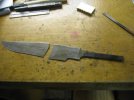
I just broke a 52100 bowie blade. It was my best grind and best design to date. I'm really bummed. :grumpy:

It was definitely hard after quench (a file skated off it nicely) and I tempered at 410 degrees F. twice (2 hours each temper cycle). I did a brass rod test, and didn't note any chipping, but yet it broke when I was driving the guard on. It may have moved in my vice and put pressure along the edge against the vice when I was driving the guard on.

I'm wondering if I didn't temper it at a hot enough temperature, or if having pressure against a point on the edge during driving the guard on is enough to break a properly heat treated blade.

Any help would be greatly appreciated!!
 

Attachments

  • IMG_1606.JPG
    IMG_1606.JPG
    43.9 KB · Views: 279
p.s.
This is the most disappointed I've ever been about a blade going into the scrap pile...I took vacation this week to work on knives, and this just ruined my week.
 
Scott, I feel your pain. I would suspect a micro crack occurred when you quenched. The temper cycles you did should have worked fine. Driving the guard on most likely completed the fracture. Did you look at the break? If your seeing a darker area where the break was thats thats a good sign there was a crack.
 
Did you do multiple quenches ? If the fracture surface was coated with very dark oxide then there would be a fracture in an initial quench and the last hardening oxidized the crack.
 
That is a darn shame, these things do happen though, don't take it too hard, Ace the next one Scott. It is always better to break it in the shop, than to have one blade fail a customer.
I would like to see the broken areas under a microscope., Check everything as close as you can. You will find the problem.
 
If you are going to have a metallurgist look at the break to see what went wrong do not touch the broken edges or try fitting thm back together. I was having issues with epees breaking at one point and the metallurgist I was going to have analize the breaks told me that anything touching the breaks messes up information. he told me to pack the broken ends in such a manner that they would not touch anything. he said if anything put a cotton ball over it.

-Page
 
Sunshadow,that's very true .However years of experience [even in Syracuse !] has shown that people think they can understand things better if they touch it ! So the nice clean fracture surface quickly becomes damaged !!
 
I'm sorry that happened to ya, brother. That really does stink. I'm thinkin' that it must have cracked during the quench.
- Mitch
 
Hi . As others have said, it could have been a micro fracture during forging or even quenching......

If your quench /harden was efficient then in my experience, a temper of 410 F is a bit on the low side and your blade may still have been a bit harder than you expected ...... On my blades I would still be getting a hardness of around Rc63 or higher at that temperature which is too hard for a working knife ( register around Rc67 at full hardness)........

I temper between 450 and 500F x 3 and get a Rc of around 59/60 (results from a calibrated bench hardness tester in my shop).

Have you done any accurate hardness checks on some test pieces to see where you are?
 
The fracture during quench was also my first gut feeling when I read the post.

I'm definately bummed for you. That was a fine looking blade!

--nathan
 
That sucks man, I feel your pain. I know this sounds silly but after the blade finishes cooling after the quench I hit the anvil with them to listen for cracks and stuff.
 
What kind of temperatures did you go for per to quenching?
Was it forged or stock removal?
Was it a hard edge and soft back?

Tempered the blade twice and still had a blade to hard tells me that it was to harden before you quench.
Boy I am sorry that happened, because I know all the work that went into it up to that stage. Keep us posted on your findings.
 
Are you doing an edge quench? I have had 4 or 5 blades crack, but never had one break all the way through like that. I traced my cracking problems to two areas. One was having the blade too thin when I performed the quench and the second was having vertical scratches in the blade when quenching.

The procedure that seems to work best for me is to edge quench when the blade temp is just above the non-magnetic stage, and I have sanded the blade smooth (worn 400 grit) and I also leave the blade thicker than I want it and thin it more after I temper...

Hope this helps...

Sorry about your blade, It looked nice
 
What quenching fluid do you use?
What grit did you have when quenched?
Is it edge quenched?
Did you normalize it? How?
Did you hammer on it too cold?
Did you grind it too thin before quenching?
Did you wait too long before tempering?

Any or all these things come to mind. My gut says it was cracked before it went into the tempering oven.

Good learning experience for sure. You will figure it out. Shows good charactor to go public with it.
 
What does the grain look like at the break? Is all the metal clean, or is there some discoloration near the blade surfaces that might indicate a crack before the break?
 
Scott, If you still have the pieces and you would like me to take a look at them your more than welcome to come over. I should be in my cave the next few months.
 
Wow. I'm overwhelmed by this response. Thanks everyone.
  • It's forged.
  • Normalized three times, then fully annealed prior to grinding.
  • I don't think I hit it too cold. I'm pretty anal about proper forging temperatures.
  • Was at 400 grit and the cutting edge was the thickness of a dime when I quenched.
  • I held it at just above non-magnetic for one minute then quenched.
  • It is a thin blade for a bowie. 1/8" thick at the ricasso.


  • Based on Raymond Richards ealiest reply, it seems to have had a microcrack. There is a very dark section at the edge that is about 1/8" long up the break and then fine light grey color the rest of the way. I'm taking it to Ray's shop later today per his invitation.
 
Back
Top