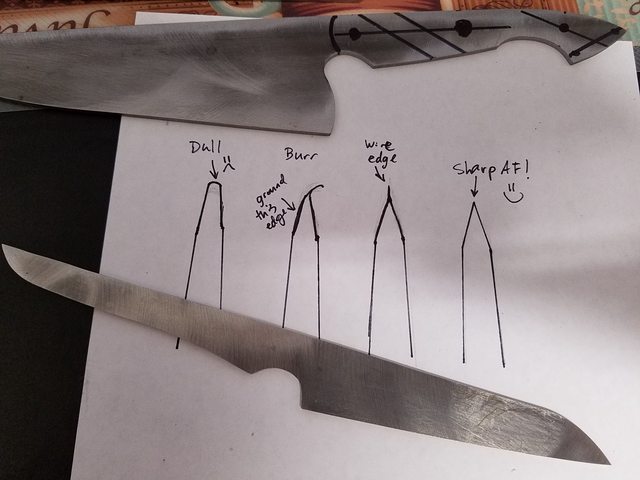
The edge in the photo looks far too fat. I put an edge like yours on a axe. If you can see that line above the edge, it is too fat/thick and too convex. The bevel should curve continuously from a flat to the edge when done right.
A convex edge is more properly thought of as a convex bevel ... it is a curve to the edge, but the bevel still has to be fully tapered before you do the convex curve.
I would regrind your knife's bevels far thinner toward the edge and then convex to zero. After adding a small secondary, I bet it is a lot sharper.
I'll try and explain it in words, but seeing one in your hand makes it clearer:
The blade should start out as an FFG right down to the edge. The edge is left a bit thicker than normal, around .030-.040", depending on blade size and use.
Then the blade is convexed to the edge until the edge is sharp. The convexing can be done on the slack belt where it will happen pretty much automatically, or on stones by sharpening with a rocking motion. The convex is worked well back up the bevel, not only at the edge where it would leave a grind line that shows.
Once done, the cross section of the blade will start flat and end in a slight curve toward the edge. You control the degree of convex by raising the spine higher or down to just barely touching. The edge will have more arc (raise spine higher) if it will be doing hard chopping (like a camp knife), and less arc if extreme sharpness is desired (like a wakizashi). What the convex edge does is put a little more "meat" behind the edge compared to a FFG, to make a stronger edge. On slicers ( Yanagi-ba, etc.) this is virtually as sharp as a normal FFG, but more durable. On camp choppers and knives that will be abused, it helps keep the edge from chipping out so bad. On high sharpness blades, the convex to zero is then polished on a felt board with rouge, and it is done. In others that are more rugged, a tiny micro-bevel is added on a stone or with an edge sharpening system like the Sharp maker, edge-pro, or Lansky.
The technique of slack grinding is best done on the belt with a 3 to 6"contact wheel. It is done on the 1-2" section just before the belt meets the wheel.
I use Rob Frink's rotary platen ( Beaumont) for the job because that is the task it does best. It forms the convex as I shape the bevels.
Alternately, you can use a platen padded with graphite backing. This will give a slight convex to the blade. You need to "break in" the graphite so it wears away in the middle giving some curve to it. The best way to do that is to use the platen for hogging and profiling for a while. It will quickly dip in toward the middle. At this point it becomes a convexing platen.
To do it on the belt grinder, just place the bevel on the belt as if you were trying to grind the flat. The edge will grind in a curve. If you left the blade flat on the belt, the spine would also have a bit of a curve toward it, so you need to slightly life the spine off the belt. About 1/4" to 1/2" is right. This will make the belt remove metal along the edge in a very shallow arc.
On stones, the blade is placed flat on the far end of the stone, with the spine toward you. Lift the spine just off the surface and then as you draw back lift it higher until you get to the desired edge angle. On most knives that means starting out at flat and raising the spine about 1/2". When both sides are done with that amount of lift, the edge will be the convergence of the two bevel arcs, forming a convex angle of about 25-30° ( if it was a FFG to zero, it would be about 20°). This will make a good sharp edge. Lifting the blade spine .75" will make a 35-40° convex edge for rough use blades (equivalent to a 30° FFG).
Adding a micro-bevel at any desired angle will make the blade keener if a lower angle is used, or tougher if the micro-bevel is higher.