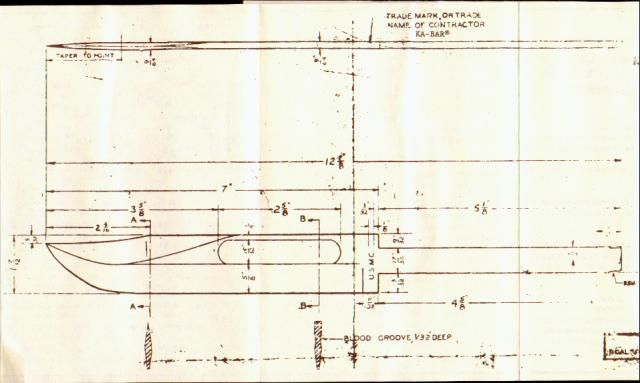
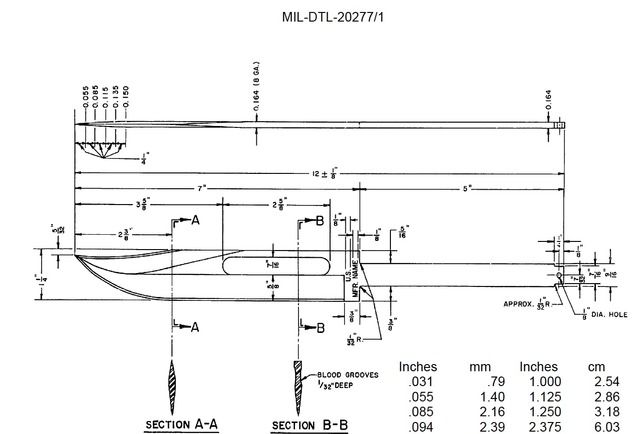
The metal under the stacked leather handles of the WW2 versions, regardless of which manufacturer made it, conformed to the specs exactly as shown in the specs drawing sactroop posted.
Notice the drawing even specifies the thickness of the blade tip at 1/4" intervals, before settling out at a single thickness for the balance of the knife. The military is real picky about things meeting the specifications. There was an whole passel of folks whose job was to take random samples coming off the assembly lines and compare them to the specs, including destructive examination (removal of the handles for metal inspection). Any apparent visual alignment variations come from the way in which the stacked leather was sanded down after installation.
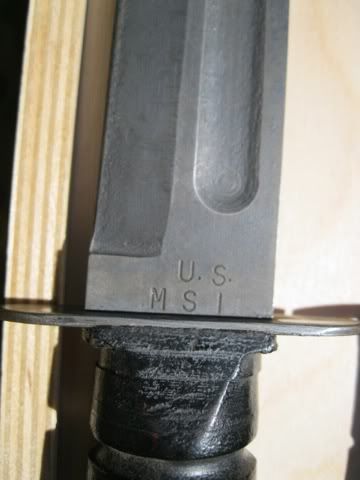
What's really cool about spec drawings like this is you can easily determine fakes/reproductions using them. Note that even the USMC stamp has specifications for font height/etc. 1 of the 2 easiest ways to spot a non-WW2 Kabar brand 1219C2 is to look at the USMC stamp - the stamp of the WW2 version is smaller, thinner legged and less deeply stamped when compared to any post-1975 Kabar 1219C2. The second is to look at the pommel. If the Kabar 1219C2 in question has a 3/8" thick PINNED pommel, it is a modern version. The WW2 thick pommel versions were peened on, with either a round or "square" peened tang.
I need to get my act together and finish up my "How to identify a real WW2 1219C2 for dummies" article.