Keeping V Edge : Waterstone or Arkansas?

By vendor do you mean the middle man or the actual manufacturer? I orginionaly started with Arkansas stones and eventually went to syn. Jap stones. Brand wise each brand has different characteristics and adv/dis. I like naniwa stones and chosera albeit expensive. A nice starter stone are the kings if you only want to get your feet wet.
I would reccomend a seller but afraid of deal spotting, the more experienced posters could probably tell you.
 
I was looking at DMT FWFC Diafold Sharpener kit with Magna-Guide, however it's very expensive. I'm not sure if there is a cheaper guided system available. I'm not sure I want to convex. Anyone know?
 
In addition, if I went with Diamond Stones that are full size are there any alignment kits people use to keep a 20 degree edge with these?
 
I was looking at DMT FWFC Diafold Sharpener kit with Magna-Guide, however it's very expensive. I'm not sure if there is a cheaper guided system available. I'm not sure I want to convex. Anyone know?

In addition, if I went with Diamond Stones that are full size are there any alignment kits people use to keep a 20 degree edge with these?

On both counts, the DMT Aligner and/or Magna-Guide will serve well. I know it may seem expensive, but it's worth every penny, so far as I'm concerned. If you prefer to use larger bench hones, the Aligner clamp works very well with them, and it's inexpensive (~ $12). If you still want something portable for field use, the Aligner clamp, Magna-Guide and a C/F Dia-Fold (blue/red) is a very versatile combination.

http://www2.knifecenter.com/item/DMTABG/DMT-ABG-Aligner-Blade-Guide-Knife-Clamp

http://www.knifecenter.com/kc_new/store_detail.html?s=DMTDMG

http://www2.knifecenter.com/item/DM...se-Limited-Time-FREE-Serrated-Knife-Sharpener
 
Last edited:
I purchased the Lansky Diamond Stone Kit and tried it out tonight. The spec's for the Ka-Bar BK2 indicate it has a 20 degree edge, however when using the Lansky the edge appeared to be like 30 degrees! I have attached pictures showing the setup.

I'm wondering if the thickness of the spine is changing the angle. Does anyone know?


Generally speaking, you can take manufacturer's specs for edge angles with a grain of salt. The spine thickness could be affecting things also- I'm not sure how that system calculates the angle. But it doesn't matter, really; just focus on matching the angle as it is in reality. Try to record the angle you end up using and where you clamped the blade at, so that you can repeat the setup again. Then you can fine tune the edge angle based on how the knife performs in use.
 
Keep in mind, the 'spec' angles as marked on the Lansky clamp (or Gatco, or DMT, or etc.) won't likely be accurate anyway. I recently starting taking some measurements of blade-in-clamp, and using trig functions to calculate actual angle. One thing that surprised me, the marked angles on the Lansky clamp are based on the hypothetical 'edge' of the blade being flush to the front of the clamp. If the blade extends even slightly beyond that (as it must, in order to actually reach it with the hones), the actual angle will be less than what is marked. I've been using my Lansky on several traditional pocketknives lately. Most of the blades are ~ 1/2" - 5/8" wide, and I use the small notch in the end of the clamp to hold these blades. That means my edges are roughly ~ 3/8" or so beyond the clamp's front edge. As it turns out, the actual angle produced on these blades, when using the '17' setting (lowest), is closer to 15 degrees per side, or slightly less. The same generally holds true with the clamp's other settings. With blades that are very wide at all (3/4" up to something like a large chef's knife or meat cleaver at 2-1/2" or more), the actual angle will be much, much lower than indicated by the clamp's markings.

So, long story short, if you really are concerned about hitting a specific angle measurement, you'll need to measure and/or calculate for it. Relying solely on the clamp's marked settings will lead you astray.

 
Thanks. I'm wondering if it would have better to purchase a stone and sharpen by hand. Getting the angle correct seems very complex. Even if I had the angle correct for placement of the rode, the sharper's angle holes would likely be off.
 
Thanks. I'm wondering if it would have better to purchase a stone and sharpen by hand. Getting the angle correct seems very complex. Even if I had the angle correct for placement of the rode, the sharper's angle holes would likely be off.

I wouldn't worry about it too much. The first time sharpening a knife from the factory always takes a bit more time and effort. Also, one can pretty much guarantee they can sharpen at a more acute angle and get better cutting efficiency without sacrificing durability (up to a point). As with freehand, you should always start out on a cheap knife - do not put good cutlery to a stone, guided or otherwise without some practice (from several personal disasters).
 
Keep in mind, the 'spec' angles as marked on the Lansky clamp (or Gatco, or DMT, or etc.) won't likely be accurate anyway. I recently starting taking some measurements of blade-in-clamp, and using trig functions to calculate actual angle. One thing that surprised me, the marked angles on the Lansky clamp are based on the hypothetical 'edge' of the blade being flush to the front of the clamp. If the blade extends even slightly beyond that (as it must, in order to actually reach it with the hones), the actual angle will be less than what is marked. I've been using my Lansky on several traditional pocketknives lately. Most of the blades are ~ 1/2" - 5/8" wide, and I use the small notch in the end of the clamp to hold these blades. That means my edges are roughly ~ 3/8" or so beyond the clamp's front edge. As it turns out, the actual angle produced on these blades, when using the '17' setting (lowest), is closer to 15 degrees per side, or slightly less. The same generally holds true with the clamp's other settings. With blades that are very wide at all (3/4" up to something like a large chef's knife or meat cleaver at 2-1/2" or more), the actual angle will be much, much lower than indicated by the clamp's markings.

So, long story short, if you really are concerned about hitting a specific angle measurement, you'll need to measure and/or calculate for it. Relying solely on the clamp's marked settings will lead you astray.

Excuse my dusty geometry knowledge. Do you recall the formula to calculate the angle based upon blade distance from the side holding the rod (through the hole)?

Thanks
 
Excuse my dusty geometry knowledge. Do you recall the formula to calculate the angle based upon blade distance from the side holding the rod (through the hole)?

Thanks

My fuzzy geometry knowledge is as follows. This is a triangle. The angle desired is 20 degrees. The distance of the edge of the knife I measured is about 11 cm. What I'm looking for is the height required (above the edge) to place the rod into.

This is tan(20) = height / 11 cm, which is tan(20) * 11 = height, which equals 4 cm.

Does this look correct?

Thanks
 
My fuzzy geometry knowledge is as follows. This is a triangle. The angle desired is 20 degrees. The distance of the edge of the knife I measured is about 11 cm. What I'm looking for is the height required (above the edge) to place the rod into.

This is tan(20) = height / 11 cm, which is tan(20) * 11 = height, which equals 4 cm.

Does this look correct?

Thanks

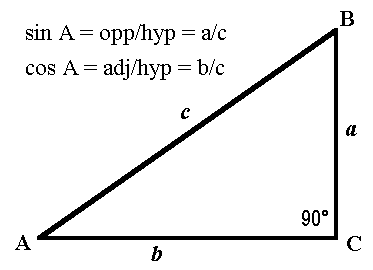
I've been taking the lazy way out, and using a web-based calculator ( http://www.csgnetwork.com/righttricalc.html ). Plug in two known values, and it will calculate the rest of the unknowns. The image below is the model from that site. With the numbers you've given, 4 cm seems to be correct for the height (vertical side 'a' shown below). I'm assuming(?) the 11 cm distance is the 'bottom' side of the right triangle (side 'b' shown below), measured from the back of the clamp to the knife's edge, with the desired 20 degree angle shown as 'A' below.

righttri.gif
 
Last edited:
Thanks, yes about 4 cm looked correct. It's slightly +/- depending on where you gauge the middle of the spine edge is. Unfortunately, the Lansky only has 5 degree increments and therefore it will be difficult to retain the original factory 20 degree edge exactly.

I'm returning the Lansky system because it's jig has very course degree resolution settings. The WickedEdge or EdgePro systems looks like they are more accurate, however they are almost $300 - $400! I'm not even sure the EdgePro Apex can handle the BK2. Then there is a Tormek T-7 motorized sharpener which is $600! It looks like anything under $200 is going to be Spyderco Sharpmaker or Arkanas TriHone, both which are generally free handed sharpening systems.

Any suggestions?

Thanks again
 
Last edited:
By the way... it's been two days since I both emailed and faxed Lansky about issues sharpening the BK2. They have not contacted me back yet. I suspect they will not either.
 
Thanks, yes about 4 cm looked correct. It's slightly +/- depending on where you gauge the middle of the spine edge is. Unfortunately, the Lansky only has 5 degree increments and therefore it will be difficult to retain the original factory 20 degree edge exactly.

I'm returning the Lansky system because it's jig has very course degree resolution settings. The WickedEdge or EdgePro systems looks like they are more accurate, however they are almost $300 - $400! I'm not even sure the EdgePro Apex can handle the BK2. Then there is a Tormek T-7 motorized sharpener which is $600! It looks like anything under $200 is going to be Spyderco Sharpmaker or Arkanas TriHone, both which are generally free handed sharpening systems.

Any suggestions?

Thanks again

You can use the width of the blade to some advantage. By either moving the blade further into the clamp or further out, combined with utilizing one of the settings to get close initially, you should be able to get very close to your 20 degree target. This is usually much easier to do with large blades, due to the greater available clamping area. (Edit: see the example calculation below)

How wide is the BK2's blade (spine to edge)? And how thick is the spine? I might fiddle around with some calculations, to see what might work.

Also need to keep in mind, the actual edge angle on your knife might not even be 20 per side (unless you've already measured it?). Most manufacturers have a 'spec' that they aim for, to get it in the ballpark. But, since most knives are finished & sharpened by hand, no two knives will likely be at exactly the same angle.

A relatively simple way to get it close, is to mark the edge of the blade with a Sharpie, then set it up in the clamp with your finest-grit hone & rod in place (maybe start at one of the higher angle settings, like 25). This is much easier to do if you put the lower half of the clamp in a vise or some other steady hold. Move the blade in/out of the clamp's jaws a little bit, and see how the hone makes contact with the bevel. When it looks fairly flush, rub very lightly with the hone on the darkened edge bevel, and see where the ink comes off. Adjust the position of the blade in/out, until the ink is being removed across the full width of the edge bevel.

Edit:
An example.

I've been looking at my Lansky clamp; it has 4 marked settings, at 17/20/25/30. The length of the clamp, from back to front edge, is ~ 3-1/2". The height of the bottom edge of the slot at the '25' setting, above the flat inside face of the clamp, is 1-1/2". Assuming a 1/4" thick blade in the clamp, half of it's thickness (1/8") would be added to the height, making the vertical side of the triangle 1-5/8" high. If the blade is wide enough to extend it's edge 1" beyond the front edge of the clamp, the length of the base of the triangle will be 4-1/2", to the very edge of the blade. Using these numbers to calculate the real angle, it works out to 19.86 degrees in the '25' setting on the clamp (results from the web calculator referenced earlier).
 
Last edited:
Full convex on a thick blade? Get a work sharp, youll either have a nice convex or no blade left at all in about 10 minutes lol.
 
I tried the Spyderco TriBlade system tonight. The triblade comes preconfigured with 30 and 40 degree angles. It appears achieving a 20 degree angle on the BK2 is pretty much sharpening almost against the thicker part of the knife (second angle in).

I have the blade sharp enough to cut paper by sliding it a bit, however it doesn't slice right through when swiped. I'm wondering if I need a leather strop as well?

Thanks
 
I tried the Spyderco TriBlade system tonight. The triblade comes preconfigured with 30 and 40 degree angles. It appears achieving a 20 degree angle on the BK2 is pretty much sharpening almost against the thicker part of the knife (second angle in).

I have the blade sharp enough to cut paper by sliding it a bit, however it doesn't slice right through when swiped. I'm wondering if I need a leather strop as well?

Thanks

A strop is always good, generally speaking. I think in this case, most of the ease of cutting will be impacted by the thick blade and relatively wide edge angle of your knife. When slicing through paper especially, thinning out the edge angle and maybe even the blade's primary grind makes a much bigger difference than trying to put a shaving-sharp edge on a relatively thick & obtuse edge profile.
 
Back
Top