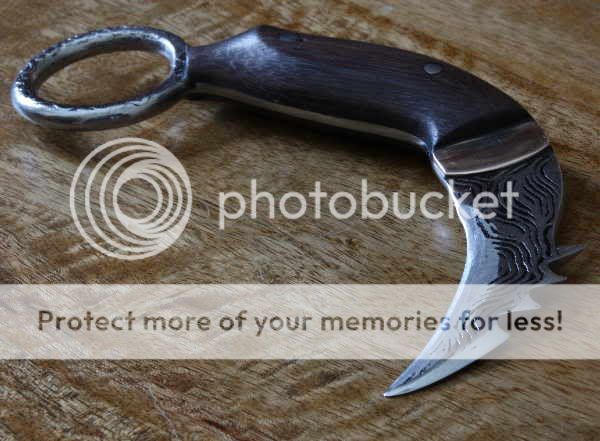
Kerambit??

Joined
Jan 28, 2006
Messages
7,035
Ok, everybody seems to drool over the kerambit.

I don't really get it. What's the mystique, what am I missing?

Is there something they are particularly good at?

Is there a special way of wielding it?
 
Ok, everybody seems to drool over the kerambit.

I don't really get it. What's the mystique, what am I missing?

Is there something they are particularly good at?

Is there a special way of wielding it?

No mystique, they just look nice.
They're good at pulling cuts.
Most karambits have a longer, ergonomic handle (as opposed to the HI version), allowing a comfortable reverse grip.
 
What's the significance of the ring?
Is it supposed to be wielded in a reverse or forward grip?

Well I know that in one of the Filipino martial arts, one may spin it out of a reverse grip into a ring-grip, where you grasp it predominantly by the ring. I think it has something to do with closing distance on vital striking points when your reverse grip just can't reach that far, but what do I know?
Everytime I see a karambit, it's wielded in reverse grip, but I'm sure it can be used both ways.
 
The karambit exceeds at cutting soft tissue. The curve causes the material being cut to gather together, so it cuts beyond its length into flesh.
The ring allows for spins, but also aids in retention, so the knife is hard to disarm.
I think it also does unusually as a sneak weapon.
 
The kerambit seems to be a very versatile, wicked weapon in the right hands.
I have one, but don't carry it concealed. VA carry permits do NOT permit concealed knives, only handguns, go figure.

I also learned a long time ago, never get in a knife fight if you aren't willing to get cut.
 
I have no idea how to use a Kerambit. However, my HI 'bit is my number one concealed carry fixed blade for personal protection and emergency use. I don't use the ring for anything, except it does balance the blade back into a nice neutral grip when held forward or reverse.

I absolutely adore mine:)
 
The Silat system I train in has quite a bit of kerambit technique. This style of knife was popular with the tacti-cool crowd a couple years back. However, the way the weapon is used in Indonesian Silat is quite different from the modern flashy type stuff you see on youtube. BTW, the kerambit is not really an indiginous Philipino weapon and I have not really seen any actual FMA system use this weapon other than to adapt existing blade concepts to fit the weapons attributes. In our Silat system, the kerambit is smaller than what is commonly seen in the US, is always used in the reverse grip with the index or middle finger through the ring and techniques tend to be short fast hooking and upper cut type strikes targeting soft tissue of the stomach, groin, neck, and inner forarms. The weapon is always used defensively and usually as a surprise weapon that is already in the hand or secreted in the sarong.
 
Last edited:
So it's really a secondary weapon for keeping the other guy busy and/or fending off his attack to bring another weapon to bear on him?

Doesn't having a finger through the hole put that finger at more risk of being broken?


Crap, if I keep this up, I'm going to end up buying one. . .
 
So it's really a secondary weapon for keeping the other guy busy and/or fending off his attack to bring another weapon to bear on him?

Doesn't having a finger through the hole put that finger at more risk of being broken?

Actually its used for quick self defense often against an unarmed attacker, and is mostly carried concealed. One must understand that in many parts of Indonesia and the PI people do not go around carring large knives, spears, or swords. It would be used in almost the same manner one would use an EDC self defense folder or neck knife in our society. It is a very short range defensive weapon. If you were grabbed or attacked you would just close in and start hooking into the body, add a couple of quick uppercuts and then effect an escape. Depending on any number of factors your opponent could suffer moderate to sevre tissue damage to actual disenbowelment. People in Indonesia dont wear alot of heavy clothing so a larger knife is'nt always needed. The kerambit is a simple weapon used in a simple but direct manner. As far as having your finger broken, it might be possible during a disarm but given a solid reverse grip and used in the fast techniques described this little weapon is very hard to disarm. The kerambit I use has a handle about 3.5" not counting the ring and a blade about 2.75" with a short sharpend clip about 1/2" from the point. The ring is just welded to the shank which is wrapped with rattan (I think). It is rather crude overall.
 
...BTW, the kerambit is not really an indiginous Philipino weapon and I have not really seen any actual FMA system use this weapon other than to adapt existing blade concepts to fit the weapons attributes...

Kun Tao, Silat, Spanish sword techniques, American boxing, and other arts all influenced many of the FMA systems, to include Albo Kali Silat. Some FMA systems have long incorporated Sangut (a Filipino "karambit" with a cord finger ring rather than a metal, integral ring) into their systems and others have adopted the more "Indonesian Style" karambit with the metal ring. Some use of existing reverse grip (pakal edge out) methodology is made when teaching karambit, but, in reality, the FMA elbow techniques, along with some reinforced punches, are often the best teachers of karambit motions. As in any weapon, the karambit can be defensive or offensive.

In many systems, the karambit is moved from reverse grip to extended forward grip and ripping draw cuts are conducted. In Albo Kali Silat, as in some other systems, there is limited use of the full spin of the karambit, while other systems do not spin the karambit, but only extend it.

Review the following link and scroll down to the article on the Sangut if you are interested in this Filipino weapon:

http://www.silkensteel.com/TnT_Arnis/2006/pdf/Vol3_No1.pdf

As for a primer on karambit use, may I suggest you go to this page on the Albo Kali Silat website, then follow the links to the webpages (and videos) that explain the basic, intermediate, and advanced karambit levels and mechanisms of use in Albo Kali Silat:

http://www.albokalisilat.org/beginner.html
(click the "Intermediate," "Advanced," etc. tabs under the video to navigate to the next page and video)

I hope this helped. Feel free to contact me with questions.

 
Last edited:
No mystique, they just look nice.

I'll say! :D

Kerambit20090326c_sm.jpg


I know jack about Silat and FMA, and I'm unlikely to need it for SD, but I'll be darned if I didn't get a hankerin' for one!
 
There are some beautiful photographs of karambits in this article from the Russian knife magazine, Prorez. I was interviewed regarding the combative use of the karambit and provided the action series photographs, but the photos provided by Dmitry (the author of the article) of some of the Indonesian blades are simply stunning. If you read Russian, I am told that the article is pretty good too.

http://www.albokalisilat.org/magazine.html

Click on the image of the article to download the PDF and view the article.
 
KaliGman, I appreciate your comments. However, from what I have seen of sangut techniques, the sangut is'nt used qute the same as the kerambit is used in Indonesian Silat. The sangut I've seen in the PI do not really resemble a kerambit. The sangut I have is more akin to a fixed blade hawkbill utility knife and is used both in a regular grip and reverse grip. In my silat experience, the kerambit is only used in reverse grip. I would also like to add, I have only seen the kerambit used in FMA systems in the US, not in the PI. It is also my opinion, and just that, that the use of the kerambit in the twirrily flashy what it is sometimes used here is a modern adaptation and the weapon in not used this way in actual Indonesian Silat.
 
Back
Top