
- Joined
- Sep 4, 2004
- Messages
- 1,670
First off, a photo:
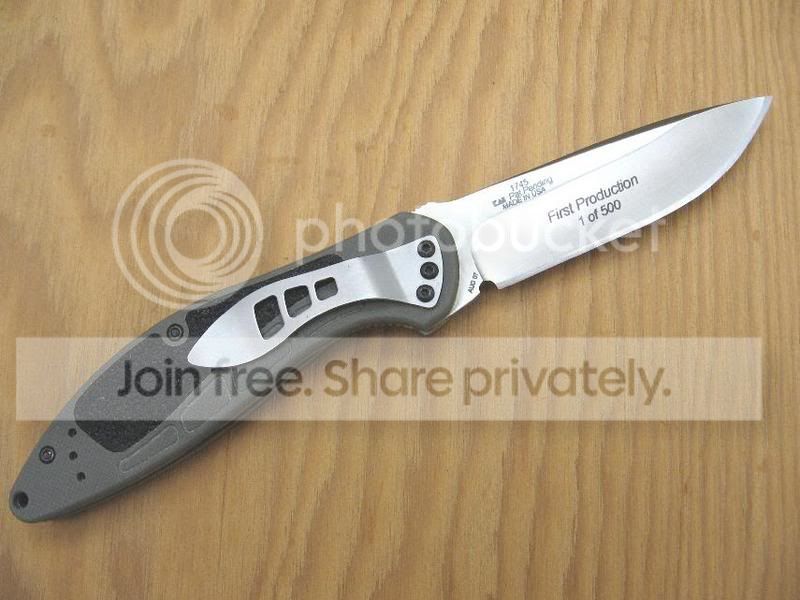
The ENER-G II is a 3.5" blade liner lock folder from Kershaw, featuring a new opening mechanism called a "pseunetic" flipper. With gray G10 handle scales, beefy .070" steel liners, and using Sandvik 13C26 steel for the blade, the ENER-G II is somewhat similar in construction to Kershaw's Junkyard Dog II (JYD2) which has been reviewed and discussed frequently on these forums over the past several months, e.g.:
http://www.bladeforums.com/forums/showpost.php?p=4484109&postcount=1
Unlike the JYD2, the ENER-G II's unique flipper mechanism is separate from the blade, laying flat just behind the blade thumb ramp when open, complimenting the ENER-G's slimmer overall profile. The blade is hollow ground, and IMO is unusually attractive with an extended swedge running most of the length of the blade, and a gradual drop point. Trac-Tec inserts in the handles give a very nice grip texture, not too rough to be uncomfortable on bare hands. Here it is pictured below along with my JYD2 (JYD2 has had blade reduced from the factory length of about 3.75" to 3.5" OAL, spine lowered, and satin finished):
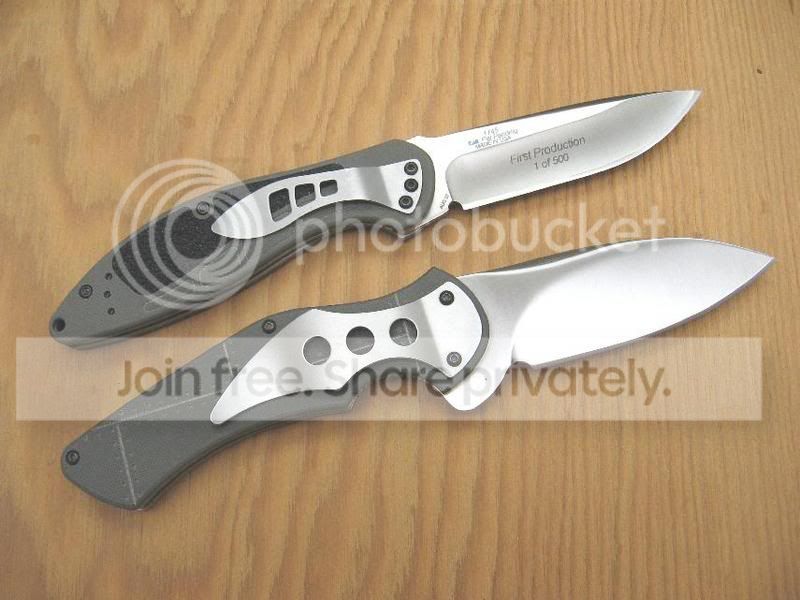
The pseunetic flipper was found to be very effective, and it's usage seems more natural and moderately more "snappy" than the fixed flipper on the JYD2. I found it interesting that tightening the pivot just to the point where the blade isn't quite able to move freely from gravity alone when all pressure from the lock is removed, actually seems to make the flipper action more brisk and positive.
Again comparing to the JYD2, extra relief has been cut into the left side of the ENER-G's handle, making release of the liner lock and closing with one hand much easier. The ENER-G deploys, closes, and generally handles very well when wearing gloves, and again is nicely grippy with its Trac-Tec inserts, making it a knife well worth considering for hunting, fishing, and general outdoor use.
The clip is nicely discreet, yet seems quite strong; it took a good deal of force/flexing to reduce the tension to make pocket clipping easier. Thanks to the Trac-Tec inserts and probably the handle shape as well, the ENER-G II carries unusually well in the front pocket, unclipped, and tends to stay in place in the pocket much better than most folders I've owned.
As the photo above shows, the handle design is quite different from the JYD2, yet ergonomics of both are excellent for my hand. The ENER-G handle however clearly seems more versatile for a variety of grips.
Geometry of the factory edge on my ENER-G II, taken at two different points along the blade edge, measured as follows:
1) .22 thick, .44 bevel = 14.5 deg./side
2) .24 thick, .42 bevel = 16.6 deg./side
I consider this very acceptable for a factory edge, and users with Sharpmakers or similar should be able to sharpen and maintain with little problem.
The factory edge was decently sharp, push cutting newsprint at about 2.5" from point of hold. With only about a minute's work on crocksticks at 20 deg./side I was able to refine the edge to where it would pushcut newsprint at over 4" from point of hold ... to me this is pretty revealing, and says the heat treat on the blade is good, and the factory edge was applied well and with care.
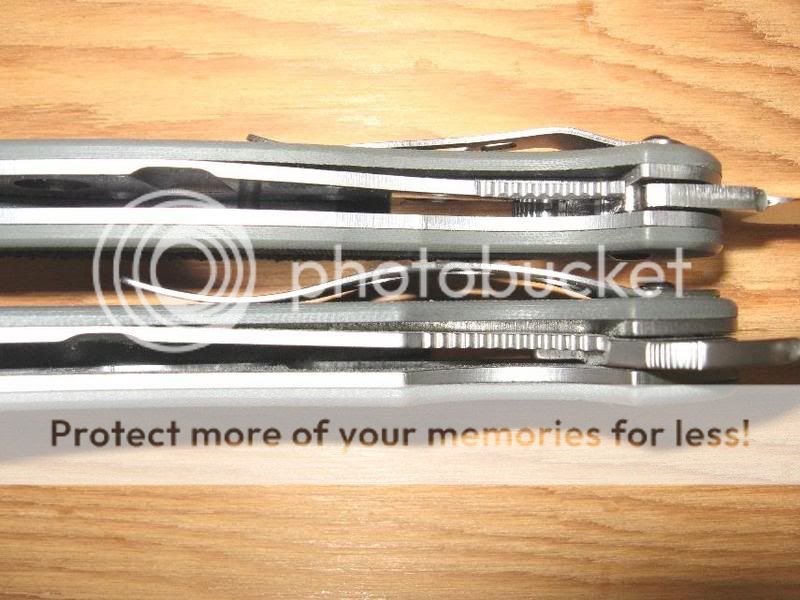
The liner lock passed my twofold safety test consisting of spine whacks and flex/torsion testing of the lock and pivot area with the blade held fast in a vise. Spine whacks in fact cause the liner to engage a bit more deeply, yet showing no signs of "stickiness" when releasing afterwards. No lock play whatsoever was observed during the flex/torsion test. To me this reflects not only good engineering but high quality manufacturing.
Picture of ENER-G II (top) and JYD2 (bottom) lock and pivot areas:
Following initial overview and tests, I reprofiled the edge of the ENER-G II down to 8 deg/side (note wide edge bevel shown in above photos.) This is more acute than I usually choose for a utility folder, but with 13C26's exceptional edge stability and toughness I decided this wouldn't be a problem, and suits the knife's hollow grind. Blade thickness behind the primary bevel runs .021"-.022", so it should still be quite durable for utility and reasonably hard use.
Applying a microbevel of 15 deg./side with a fine ceramic Crocksticks sharpener, an edge was easily achieved capable of push cutting newsprint at over 4.6" from point of hold -- definitely what you'd call in the "spooky sharp" range, and even more impressive considering that the piece of paper used was only 5" wide. This kind of sharpness, plus surprising ease of sharpening, is consistent with my experience with the JYD2, and as reported by others here using Kershaw's 13C26.
I've yet to have the chance to do any significant work with the knife, but am very much looking forward to it and hope to post more results before long.
IMO the ENER-G II is a very solid offering. And BTW, neither the promotional photos found on Kershaw's website or in various web dealer's ads, and certainly not my photos, even begin do justice to this handsome knife.
The ENER-G II is a 3.5" blade liner lock folder from Kershaw, featuring a new opening mechanism called a "pseunetic" flipper. With gray G10 handle scales, beefy .070" steel liners, and using Sandvik 13C26 steel for the blade, the ENER-G II is somewhat similar in construction to Kershaw's Junkyard Dog II (JYD2) which has been reviewed and discussed frequently on these forums over the past several months, e.g.:
http://www.bladeforums.com/forums/showpost.php?p=4484109&postcount=1
Unlike the JYD2, the ENER-G II's unique flipper mechanism is separate from the blade, laying flat just behind the blade thumb ramp when open, complimenting the ENER-G's slimmer overall profile. The blade is hollow ground, and IMO is unusually attractive with an extended swedge running most of the length of the blade, and a gradual drop point. Trac-Tec inserts in the handles give a very nice grip texture, not too rough to be uncomfortable on bare hands. Here it is pictured below along with my JYD2 (JYD2 has had blade reduced from the factory length of about 3.75" to 3.5" OAL, spine lowered, and satin finished):
The pseunetic flipper was found to be very effective, and it's usage seems more natural and moderately more "snappy" than the fixed flipper on the JYD2. I found it interesting that tightening the pivot just to the point where the blade isn't quite able to move freely from gravity alone when all pressure from the lock is removed, actually seems to make the flipper action more brisk and positive.
Again comparing to the JYD2, extra relief has been cut into the left side of the ENER-G's handle, making release of the liner lock and closing with one hand much easier. The ENER-G deploys, closes, and generally handles very well when wearing gloves, and again is nicely grippy with its Trac-Tec inserts, making it a knife well worth considering for hunting, fishing, and general outdoor use.
The clip is nicely discreet, yet seems quite strong; it took a good deal of force/flexing to reduce the tension to make pocket clipping easier. Thanks to the Trac-Tec inserts and probably the handle shape as well, the ENER-G II carries unusually well in the front pocket, unclipped, and tends to stay in place in the pocket much better than most folders I've owned.
As the photo above shows, the handle design is quite different from the JYD2, yet ergonomics of both are excellent for my hand. The ENER-G handle however clearly seems more versatile for a variety of grips.
Geometry of the factory edge on my ENER-G II, taken at two different points along the blade edge, measured as follows:
1) .22 thick, .44 bevel = 14.5 deg./side
2) .24 thick, .42 bevel = 16.6 deg./side
I consider this very acceptable for a factory edge, and users with Sharpmakers or similar should be able to sharpen and maintain with little problem.
The factory edge was decently sharp, push cutting newsprint at about 2.5" from point of hold. With only about a minute's work on crocksticks at 20 deg./side I was able to refine the edge to where it would pushcut newsprint at over 4" from point of hold ... to me this is pretty revealing, and says the heat treat on the blade is good, and the factory edge was applied well and with care.
The liner lock passed my twofold safety test consisting of spine whacks and flex/torsion testing of the lock and pivot area with the blade held fast in a vise. Spine whacks in fact cause the liner to engage a bit more deeply, yet showing no signs of "stickiness" when releasing afterwards. No lock play whatsoever was observed during the flex/torsion test. To me this reflects not only good engineering but high quality manufacturing.
Picture of ENER-G II (top) and JYD2 (bottom) lock and pivot areas:
Following initial overview and tests, I reprofiled the edge of the ENER-G II down to 8 deg/side (note wide edge bevel shown in above photos.) This is more acute than I usually choose for a utility folder, but with 13C26's exceptional edge stability and toughness I decided this wouldn't be a problem, and suits the knife's hollow grind. Blade thickness behind the primary bevel runs .021"-.022", so it should still be quite durable for utility and reasonably hard use.
Applying a microbevel of 15 deg./side with a fine ceramic Crocksticks sharpener, an edge was easily achieved capable of push cutting newsprint at over 4.6" from point of hold -- definitely what you'd call in the "spooky sharp" range, and even more impressive considering that the piece of paper used was only 5" wide.
This kind of sharpness, plus surprising ease of sharpening, is consistent with my experience with the JYD2, and as reported by others here using Kershaw's 13C26. I've yet to have the chance to do any significant work with the knife, but am very much looking forward to it and hope to post more results before long.
IMO the ENER-G II is a very solid offering. And BTW, neither the promotional photos found on Kershaw's website or in various web dealer's ads, and certainly not my photos, even begin do justice to this handsome knife.


 ), it'd be neat to have the tab in CF to complement it.

