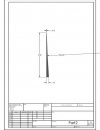
kitchen cross section

timos-

Knifemaker / Craftsman / Service Provider
Joined
Oct 22, 2012
Messages
2,213
cross section.jpg

I am thinking about using this type of grind in a couple chef blades. Here is a picture of the cross section. I was looking at Nakiri bōchō style knives and kataba grinds.

I would like to use my 36" radius platen and leave a flat of .015 on the cutting edge before heat treating. I send my stuff to Peter's by the way. Using 154-CM for these. Do you think this is asking for trouble in terms of blade warp? Should I leave this thicker pre-heat treat?

As far as function I think this cross section would be pretty awesome to use. Thoughts?
 
I've had a bunch of single-grind knives HT'd by Peter's, and I haven't had much of a problem. A couple of them had a little bit of warp in them, but I was able to straighten them out without much trouble (minus the one that I broke). They were all 1084, so I can't comment on how it will be with 154cm. If it was me, I'd leave some more thickness on the edge just to be sure.

- Chris
 
It is going to warp when they quench it, but that is what happens. That is also why Peter's is used so they can deal with the straightening. There are different amounts of stress on either side of the blade and that is the main cause of the warp. Like Chris said above, leave a little extra thickness to finish grind and that should minimize your problems. Brad will send it back as straight as possible, I never got a blade back that was not near perfect.
 
I find the Peter's is able to do a rather fine edge on a thin blade in stainless very well. I use a lot of 1/16" CPM-S35VN and some are ground to an edge that is almost sharp with no issues.
If you like the CPM-154, you should try some S35VN. For thin slicers I find it well worth the slight extra cost over CPM-154. I have Peter's do it at Rc61.

You may need to go with a 60" radius arc grind. I plugged in 2" chord and 36" radius, and got a segment height of .01389". That would grind right through a .110" blade. 60" gives a height of .00833". That would be really thin, but would fit.

I would grind the hollow back first, then grind a 1" bevel from the edge to the arc center on the front side. Leave a small edge flat. After HT, re-grind the back and then re-grind the bevel to a zero edge. Add a micro-bevel and it should slice things really well.
 
Last edited:
Shigefusa grinds its knives like that but I am not sure what size big wheel they use. From what I have been told, their knives are also a bit thicker at the spine than some made by other traditional Japanese makers.
 
Thanks for the feedback all,

reason I am going with that radius is I have a 36" radius platen from that Dastardly Machinist :)

bladsmth, I think I got what you are saying...I will make a new drawing tomorrow showing a cross section along with pre heat-treating material. I will look at other traditional grinds too, I am fast becoming addicted to this type of info.
 
You can do the back-yard engineers method of drawing this.
Put a loop on a piece of string, and tie the string to a nail with the string being 36" long.
Place a drawing pad down and swing the string across it with a pencil in the loop. You now have a 36" radius arc.
Draw a 2" chord. That is one side of the steel bar.
Draw a tangent parallel to the chord. That is the bar of steel's other side.
Connect the tangent to the chord. That is your theoretical 2" bar of steel.

If you measure the distance from the chord to the tangent, that is the minimum thickness possible. Since you can't have a blade that is 0.0" thick at the center of the hollow grind, you will have to add at least .02" to the thickness. I would add a bit more, to allow for the steel removed after HT. This final number is the minimum bar thickness possible to maker that grind from.

I haven't done the math exactly, but in my head, it seems like a 2"X5/32" bar would work for a 36" radius full hollow grind. My head math says that is about .02" thicker than the web. 3/16" would be safer, but with careful grinding, 5/32" should just do it.

Options:
If you want to stay with the .125" steel, just do a partial hollow grind from the edge area to about 1/2 or 3/4 the way up the back.
Or you could do the more traditional method of doing the hollow grind down the middle of the back, and leaving 1/4 of the back unground on each side of the hollow down the center.

 
Back
Top