Kitchen knife damascus question.

jdm61

itinerant metal pounder
Joined
Aug 12, 2005
Messages
47,357
I wanted to throw this one out to the group. i have made almost all of my damascus from 1084 and 15N20. I made one billet from 115W8 and 15N20 but that is unicorn steel. i was thinking about what steels you might use for kitchen knives if fine edge stability a la 52100/W2/AEB-L was you primary goal and you weren't worried so much about contrast/darkness when etched. What steels would you guys look at?
 
In kitchen knives the best choice is to make suminagashi - A core of high carbon steel and sides of damascus. The sides can be A36 and 201E if you want ( very low carbon damascus with high contrast), because they won't cut anything. A core of 1.1%C with Cr,N, and Mn will be very tough and sharp - Takefu, Hitachi, W-2, 52100, etc.
 
I would think the W2/15n20, 52100/15n20, or even O1/L6 combos to work very well. Those are on my list for kitchen knives once I get me press running. I would think cruforge v and L6 would work well, but be more difficult to sell.
 
I wanted to throw this one out to the group. i have made almost all of my damascus from 1084 and 15N20. I made one billet from 115W8 and 15N20 but that is unicorn steel. i was thinking about what steels you might use for kitchen knives if fine edge stability a la 52100/W2/AEB-L was you primary goal and you weren't worried so much about contrast/darkness when etched. What steels would you guys look at?

I always use Damasteel damascus...holds an edge like nothing I've ever seen.
 
In kitchen knives the best choice is to make suminagashi - A core of high carbon steel and sides of damascus. The sides can be A36 and 201E if you want ( very low carbon damascus with high contrast), because they won't cut anything. A core of 1.1%C with Cr,N, and Mn will be very tough and sharp - Takefu, Hitachi, W-2, 52100, etc.

This is what I want to do, and I don't understand why more people don't. I'd really like to try forge welding low carbon high contrast damascus and then forge welding it to CPM or other cores, and doing very little additional forging after the jacket weld. Something like a Z-wear core with high contrast damascus jacket would be the best of both worlds in my opinion, aesthetics and performance. But, maybe that's not a good idea for some reason I'm not aware of. Unless there's a concern about the welds coming apart at the high temperature heat austenitizing temps of those steels?
 
I think it's a cost/experience thing. Most people don't even make stainless Damascus, and forge welding the higher alloy steels would be equally as difficult. I remember Nick Wheeler posting on forging 3v, and he couldn't draw it out on his press, as the 3v just deformed his dies. It would take a bit of experimenting to get this right, and the steel would be bloody expensive, with a limited market. That's assuming the steel stays together in the first place. It's on my list of things to do, since I don't have to make money doing this.

Devin Thomas can chime in, as he's the only person I know who's actually done this.
 
Sure that makes sense. That's also why I want to do very little forging after the jacket weld. I'm thinking similar to how I made stainless/carbon san mai. Forge out your jacket, so you have 1/8" or whatever finish ground, stack around your .060 super steel core, weld up the entire billet, heat, press with flat dies to set the weld, or better yet, roll it out, and then make a stock removal knife from the billet you made.

That way you don't have to worry about red hardness or whatever other forging challenges, just isolate the forging down to making a successful weld.
 
Sure that makes sense. That's also why I want to do very little forging after the jacket weld. I'm thinking similar to how I made stainless/carbon san mai. Forge out your jacket, so you have 1/8" or whatever finish ground, stack around your .060 super steel core, weld up the entire billet, heat, press with flat dies to set the weld, or better yet, roll it out, and then make a stock removal knife from the billet you made.

That way you don't have to worry about red hardness or whatever other forging challenges, just isolate the forging down to making a successful weld.

I think we're on the same page here. :thumbsup:
 
In kitchen knives the best choice is to make suminagashi - A core of high carbon steel and sides of damascus. The sides can be A36 and 201E if you want ( very low carbon damascus with high contrast), because they won't cut anything. A core of 1.1%C with Cr,N, and Mn will be very tough and sharp - Takefu, Hitachi, W-2, 52100, etc.
Stacy my problem is that I do Damascus for appearance and that typical Japanese cladding Damascus is as ugly as a Walmart prom dress . My otherproblem with mono steel core blades of that type is the limitations on what type of pattern manipulation you can do
 
The bad news is that if you want to have any kind of pattern other than a random you have to compensate for drawing your billet out to at least 2 1/2 times its original length
Sure that makes sense. That's also why I want to do very little forging after the jacket weld. I'm thinking similar to how I made stainless/carbon san mai. Forge out your jacket, so you have 1/8" or whatever finish ground, stack around your .060 super steel core, weld up the entire billet, heat, press with flat dies to set the weld, or better yet, roll it out, and then make a stock removal knife from the billet you made.

That way you don't have to worry about red hardness or whatever other forging challenges, just isolate the forging down to making a successful weld.
 
Ok, that I understand. I already think patterns are challenging to wrap my head around. I was mostly planning random, or coarse twists when thinking about it.
 
Ladder pattern might be quite doable with a high alloy core with cladding.
 
Ladder pattern might be quite doable with a high alloy core with cladding.
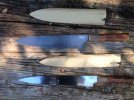
Warren, i see that "double ladder donjon thicker blades, but I would be concerned with a kitchen blade that is like .100 thick. That says that if you are lucky, the core you have to work with is like .033 and probably closer to .025. With the one ladder pattern gyuto that I did in 1084 and 15N20, I forged to general shape, but a bit shorter to account for "stretching" when I pressed and took it down to around .25. thick I then pressed shallow with Uncle Al 3/16 ladder dies and ground the ridges down and I was fairly close to final thickness. I was able to stock remove. Sorry for the bad pic. IMG_0028.jpg
 
Back
Top