Kitchen Knife Question

DanF

Moderator
Knifemaker / Craftsman / Service Provider
Joined
Apr 17, 2017
Messages
1,673
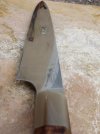
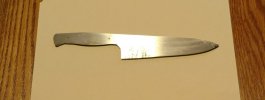
Never messed with kitchen knives but wife wants a set so I need to start practicing. This will be a 6" blade, 9-7/8" OAL.
I'm planning a full flat bevel but don't know where the plunge line should go. Should the bevel go back to the start of the scales, or just ahead of the scales? I'm using .120 thick steel. Or, should I fade the plunge line out gently?
Any good books on kitchen knife design and making available?
Thanks,
IMG_20170902_131047.jpg
 
IMG_0367_zps8164674d.jpg IMG_0446.jpg
Fading looks best on a kitchen knife IMO, if you can do it clean. But I don't like hard plunge cuts on big kitchen knives. You can do it with both types of tang. For full tang, I would recommend grinding the bevels first and blending from that side leaving the tang full thickness. They you can go back and "flatten" the tang a bit and blend from that side. The best way to describe that may be to say that you essentially do a very tall "saber grind" where the flat by the spine is very short in length and then you just sand away the "shinogi line" That way you extend that "flat" forward of where the front end of your scales will be and then make it disappear. Some Japanese knife makers bevel the tang too like a sword. That makes getting everything flat easy, but you have to compensate when you drill your scales, You would drill your pin holes before you bevel do you don't have to compensate twice.
 
Last edited:
Ekim knives on YouTube has a great tutorial on plungeless chef knives.
It's worth a look.
There are lots of great looking chef knives with plunges too, they usually take them back to just above the scales.
 
don't worry about a plunge line. if you are doing a full flat, you probably won't notice it up by scales. have not found any books on kitchen blades. go here and look, http://www.zknives.com/knives/kitchen/ktknv/indexall.shtml. he has reviews and pictures of most Japanese style knives. I have cheated and downloaded some of the pictures then printed them actual size on graph paper to get an idea of dimensions. try to be as thin as possible near the edge for best performance, 0.03" at 1/2" above the edge is a good target. you didn't mention what kind of steel. if possible, harden to Rc62-64. IMHO, .120 is thick for this size blade, try 0.065 on the next one. with 1/16" steel and light weight wood, you should be 3oz. or lighter, my wife loves that feature. this is one I made a year ago http://www.bladeforums.com/threads/basic-lightweight-chefs-knife.1511853/
 
Thanks folks, much appreciated.
@josh, lot of good stuff on Ekim's site!

I'm using 15n20, it was the thinnest thing I had at hand. Figured the extra thickness would leave me some room for error until I got the hang of kitchen knives. And, the 15n20 wasn't so pricey should I really mess up a piece.
 
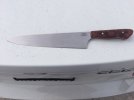
15n20 is an AMAZING steel for kitchen knives. Imade this one for the wife last year.
Photo%20Oct%2013%2C%204%2021%2047%20PM.jpg


Photo%20Oct%2013%2C%204%2022%2039%20PM.jpg


Photo%20Oct%2013%2C%204%2020%2044%20PM.jpg
 
Thanks folks, much appreciated.
@josh, lot of good stuff on Ekim's site!

I'm using 15n20, it was the thinnest thing I had at hand. Figured the extra thickness would leave me some room for error until I got the hang of kitchen knives. And, the 15n20 wasn't so pricey should I really mess up a piece.

0.120" 15n20 will make great larger chef's knives. It's also good for offset grinds and d-grinds. With over .100" steel, do a distal taper and keep the heel height around 2". You can always thin the steel a bit too.

Butch has a great tutorial on plungeless kitchen grinds. Once you do a few, they're not hard at all. Basically it's a ffg, and as you get to the ricasso, you blend it like a convex grind.

15n20 is great at Rc62/63 for kitchen use, and will hold a stable edge at less than 0.005" before sharpening.
 
Ekim knives on YouTube has a great tutorial on plungeless chef knives.
It's worth a look.
There are lots of great looking chef knives with plunges too, they usually take them back to just above the scales.


Thank you for the recommendation. I watched both of the videos on that and although I was blending my tapers I like his style of doing it by leaving the grind the way he does before blending. I was doing a regular plunge and blending in that tiny little area.

I tried the blending just now on my flat disk and it worked great. I think it'll even be easier once I put a little 3/16 inch neoprene on the face to give it some give..

Death to hand sanding!

My goal is to get to the point where I can do everything on the belt grinder and vfd disc and just the straight sandpaper pulls by hand.
 
Back
Top