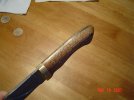
I've been working on another knife and have it to the point of staining the handle. It's #2 and this one's been an interesting build as well.
I used another knife "kit" blade and bolster. The handle material is mahogany, which is softer than I thought. The color of the unstained scales is different too, which surprised me as they were cut from the same board and side-to-side.
Anyway ... lessons learned so far?
1. You can't drill through a bolster and through a hardened blade without breaking the drill bit. You break the drill bit and create a learning opportunity for breaking out steel drillbit parts and soldering a brass rod piece into the remaining hole.
2. Heating the knife in the oven on "warm" does help set up the epoxy when you're setting scales and pins.
3. A buffing wheel will remove wood faster than metal.
The next step is final finishing of the handle and polishing the brass and steel. I've thought of using superglue as a handle finish, but I'm not sure about it's durability. If I chicken out, I'll likely stick with polyurethane or tru-oil ...
I used another knife "kit" blade and bolster. The handle material is mahogany, which is softer than I thought. The color of the unstained scales is different too, which surprised me as they were cut from the same board and side-to-side.
Anyway ... lessons learned so far?
1. You can't drill through a bolster and through a hardened blade without breaking the drill bit. You break the drill bit and create a learning opportunity for breaking out steel drillbit parts and soldering a brass rod piece into the remaining hole.
2. Heating the knife in the oven on "warm" does help set up the epoxy when you're setting scales and pins.
3. A buffing wheel will remove wood faster than metal.
The next step is final finishing of the handle and polishing the brass and steel. I've thought of using superglue as a handle finish, but I'm not sure about it's durability. If I chicken out, I'll likely stick with polyurethane or tru-oil ...