Knife blanks or steel sheets?

Joined
Dec 21, 2017
Messages
183
hi im not a knife maker. I dont even know the process of knife making, so please know that my questions are purely out of curiosity, so I may sound very silly...

When people make a custom knife, do they start from a flat sheet of steel and cut them to knife shapes or are they like strips of steel that people cut to a knife shape before grinding?

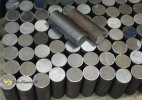
Where do people get the steel? Could anyone show me what the steel looks like when they first get it before the cutting happens?

Thanks.. apology in advance, i wasnt sure where I could ask.
 
Ok, I'll bite. I buy six foot lengths of steel from steel suppliers on the internet like Admiral steel or Pops' knife supply. I buy the strips of steel in usually about 5/32 inch thick or 3/16 inch thick pieces that are about 1 1/2 inches wide. I then design my knives on paper and cut out the patterns to trace onto the steel bars and begin cutting. You should look at some knife making videos or DVDs an get some idea of what it takes to make a custom knife. Some makers heat pieces of steel in a forge and hammer it into shape and other makers use a " stock reduction" technique and begin with processed steel bars. Do some more investigating on the net. Larry
 
Steel can come from a variety of sources in a variety of shapes. The choices and reasons for those choices are different from knifemaker to knifemaker. Someone with limited experience and/or budget may use found/repurposed items like old files and rasps, lawnmower blades, leaf springs, railroad spikes, saw blades, etc. Pieces that are shaped like flat bars like leaf springs can be cut and ground to shape or they can be forged to shape. Thicker or irregularly shaped items like railroad spikes are usually forged to shape (followed by grinding).

In most cases the maker will buy steel of a known composition as bar stock, sometimes as round or square bar stock from various steel suppliers. The steel variety is chosen by the properties a particular steel has and in a set of dimensions that works for the maker. The steel looks like the steel you might find in the big hardware stores. But hardware store steel is not suitable for making knives. Most information about making knives is readily available. As Larry said, do a little looking around. Search YouTube for "how to make a knife". There is also a "sticky" section at the top of this subforum with all the information you could want.
 
Thank you both. The answers are what I was looking for. No plans on making knives, maybe in the future. But i was genuinely curious. Thank you again for the answers!
 
Steel can come from a variety of sources in a variety of shapes. The choices and reasons for those choices are different from knifemaker to knifemaker. Someone with limited experience and/or budget may use found/repurposed items like old files and rasps, lawnmower blades, leaf springs, railroad spikes, saw blades, etc. Pieces that are shaped like flat bars like leaf springs can be cut and ground to shape or they can be forged to shape. Thicker or irregularly shaped items like railroad spikes are usually forged to shape (followed by grinding).

In most cases the maker will buy steel of a known composition as bar stock, sometimes as round or square bar stock from various steel suppliers. The steel variety is chosen by the properties a particular steel has and in a set of dimensions that works for the maker. The steel looks like the steel you might find in the big hardware stores. But hardware store steel is not suitable for making knives. Most information about making knives is readily available. As Larry said, do a little looking around. Search YouTube for "how to make a knife". There is also a "sticky" section at the top of this subforum with all the information you could want.
Thank you for jumping in with a more detailed answer to the young man's inquiry. I just didn't have the energy today to explain knife making...as if I could. It is much more complex than most of us will admit. Good job! Larry
 
Been there Larry. It's a wonder I have the energy to brush my teeth before crawling into bed.
 
Everything from this

To hammering these
DNGnLBP.jpg


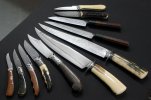
Into these
VLCME4G.jpg


and then into this
Mlu9zJw.jpg


And everything in between :D
 
I prefer to use 6 inch wide stock if I can find what I want. I can nest more blades side to side. If I have an inch and a half wide piece, I feel like I am throwing half an inch piece away. Even if I have to drill in places I feel the savings are justified.
 
Don, Your knives are truly beautiful. I like that you do not make them all the same as some makers today do to make money. You are an artist worthy of praise in my estimation. Thank you for sharing some photos of your work. Larry
Larry, you are much too kind! Thank you!
 
Back
Top