
-
The BladeForums.com 2024 Traditional Knife is available! Price is $250 ea (shipped within CONUS).
Order here: https://www.bladeforums.com/help/2024-traditional/
You are using an out of date browser. It may not display this or other websites correctly.
You should upgrade or use an alternative browser.
You should upgrade or use an alternative browser.
Knife Designs (seeking advice and feedback)
- Thread starter mocaba
- Start date

- Joined
- May 12, 2012
- Messages
- 846
Go to imgur.com and upload your photos. After they are uploaded on the right you will see several different links. Copy the one that says BB code for forums and paste it into your post.
Cheers
Cheers

- Joined
- Apr 5, 2012
- Messages
- 238
Look at some experienced maker's knives before you even begin to try to design you own...
I'm not saying that you should copy them--far from it.
What you need to do is look at the melding of form and function, the flowing lines of the work, the elegance, the symmetry...
I'm sorry to say this, but in my opinion, your designs are not anywhere close to where they need to be. You need to think about the function and aesthetics of the piece before you even begin sketching.
I know that experienced makers will be able to give you more practical advice, but here is what I have to say about each one.
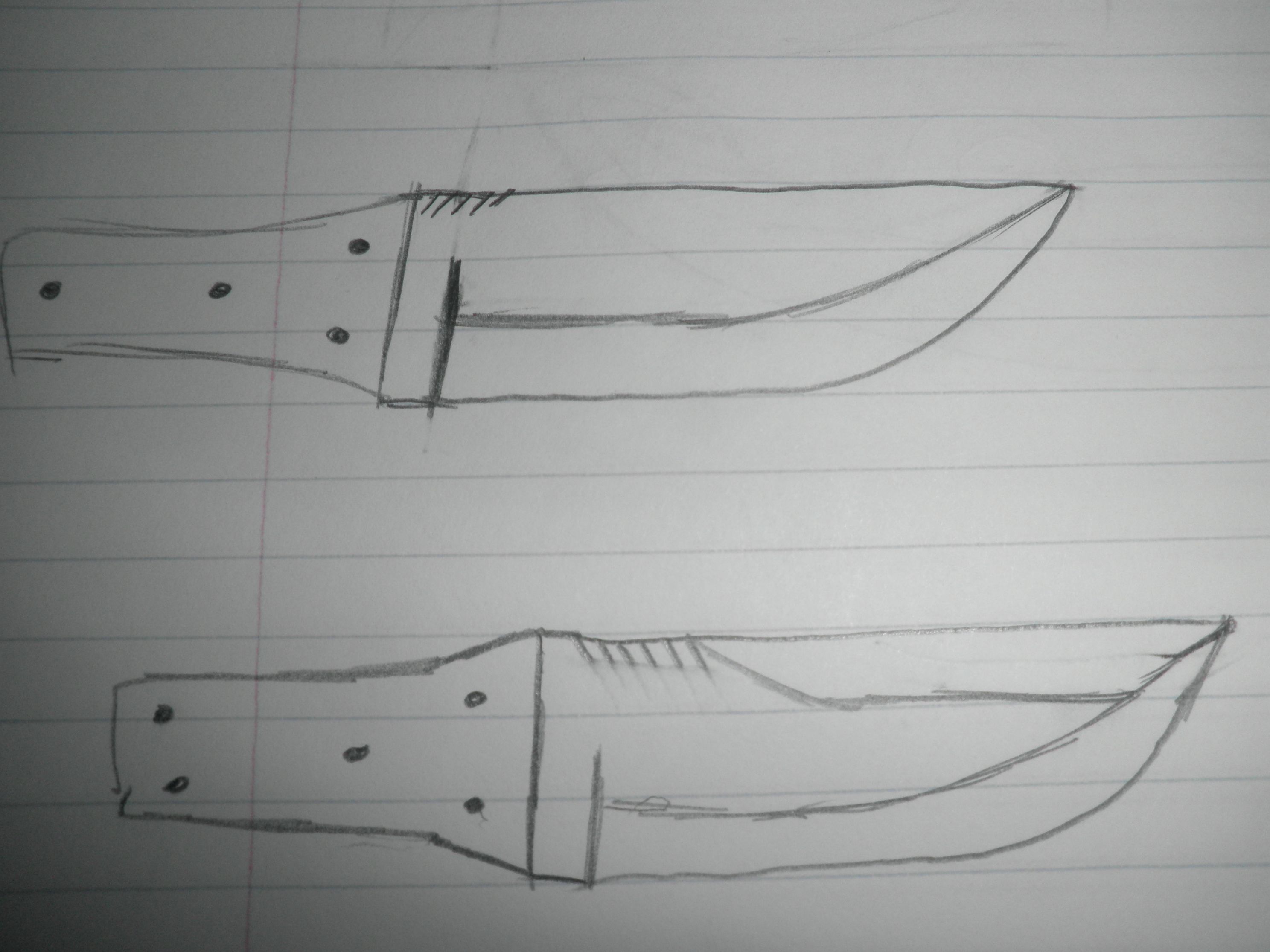
Design number 1--no curvature to speak of, no flow
Design number 2--you've got this weird sort of bowie tip with this false edge, and the grindlines are going everywhere. A well designed knife is "clean"
Design number 3--Most makers see no need for a guthook integrated into a knife, but you have this huge and extremely impractical one combined with false edge. In my opinion, knives need points.
Design number 4 --big blocky blade, again no curvature or flow, also a pretty weird grindline...and the handle is totally impractical--your hand will slide right off
Design number 5--same problems as Design number 4, worsened by that false edge.
I'm sorry this is so critical, but the truth (as I see it) is what you need with this advice.
Ironwood666
I'm not saying that you should copy them--far from it.
What you need to do is look at the melding of form and function, the flowing lines of the work, the elegance, the symmetry...
I'm sorry to say this, but in my opinion, your designs are not anywhere close to where they need to be. You need to think about the function and aesthetics of the piece before you even begin sketching.
I know that experienced makers will be able to give you more practical advice, but here is what I have to say about each one.
Design number 1--no curvature to speak of, no flow
Design number 2--you've got this weird sort of bowie tip with this false edge, and the grindlines are going everywhere. A well designed knife is "clean"
Design number 3--Most makers see no need for a guthook integrated into a knife, but you have this huge and extremely impractical one combined with false edge. In my opinion, knives need points.
Design number 4 --big blocky blade, again no curvature or flow, also a pretty weird grindline...and the handle is totally impractical--your hand will slide right off
Design number 5--same problems as Design number 4, worsened by that false edge.
I'm sorry this is so critical, but the truth (as I see it) is what you need with this advice.
Ironwood666
Man, slow down. Read more of the stickies, post less, when in question do again. You need to slow down and read a bit. For all that is holy, how old are you? My nine year old doesn't go on like you.
Wow your response is pretty unprofessional and insulting,maybe you need to do a little reading yourself.

- Joined
- Nov 29, 2011
- Messages
- 1,396
He has a point to a degree. Most of his questions are in the stickies and he has a ton of research left to do as do most of us. Still asking for assistance is a good way to get others opinions on where your going wrong and what you should probably do to change a few things to get on track.
IMHO 1 and 2 are pretty cool designs, 3 well slightly impossible. 4 and 5 have some work but are solid ideas that need refining. Now the one biggest thing I see from a beginners stand point are that those grinds are monsters to take on when your starting out. I have made just a few knives and know I wouldnt take that on yet. Maybe for practice but not as first projects. Find a tried and true simple design to start out with and try it out. I ground several knives before I finished my first one. Every single one was a learning experience but they all had huge mistakes and what not. I am still making alot of grinding mistakes but can actually complete one once in a while.
IMHO 1 and 2 are pretty cool designs, 3 well slightly impossible. 4 and 5 have some work but are solid ideas that need refining. Now the one biggest thing I see from a beginners stand point are that those grinds are monsters to take on when your starting out. I have made just a few knives and know I wouldnt take that on yet. Maybe for practice but not as first projects. Find a tried and true simple design to start out with and try it out. I ground several knives before I finished my first one. Every single one was a learning experience but they all had huge mistakes and what not. I am still making alot of grinding mistakes but can actually complete one once in a while.

- Joined
- Dec 27, 2010
- Messages
- 6,852
In DanCo's defense, the flood of questions that could, by and large be answered by doing some reading, all in separate threads, can be a little overwhelming. Many new makers will at least just ask their new question in the same thread, rather than starting a new thread every time. The enthusiasm is great, but I can't fault anyone for getting a little overwhelmed.
Mr. Apelt had a pretty good post earlier (although I cannot, for the life of me, remember where) talking about what makes a good knife design (IIRC, it boiled down to curves, lots of curves, and they need to flow together organically, etc).
Mr. Apelt had a pretty good post earlier (although I cannot, for the life of me, remember where) talking about what makes a good knife design (IIRC, it boiled down to curves, lots of curves, and they need to flow together organically, etc).

- Joined
- Oct 27, 2010
- Messages
- 8,721
Yeah, slow down a bit and read. There are hundreds, if not thousands of threads on here that start with "design critique, making my first knife."
The thing I find strange is that you say you are going to school to be a chef. My wife is a chef, one of the very first classes she took went over knives, why they are designed the way they are and how they relate to their intended purpose. I don't see much thought of intended use in some of your designs.
You say your a fan of Bowies in your profile, I say go for a small bowie style knife, maybe only a 3-4" blade. Look at the intended purpose first, then design to that.
-Xander
The thing I find strange is that you say you are going to school to be a chef. My wife is a chef, one of the very first classes she took went over knives, why they are designed the way they are and how they relate to their intended purpose. I don't see much thought of intended use in some of your designs.
You say your a fan of Bowies in your profile, I say go for a small bowie style knife, maybe only a 3-4" blade. Look at the intended purpose first, then design to that.
-Xander
- Joined
- Jul 13, 2009
- Messages
- 21,855
Look at some experienced maker's knives before you even begin to try to design you own...
I'm not saying that you should copy them--far from it.
What you need to do is look at the melding of form and function, the flowing lines of the work, the elegance, the symmetry...
I'm sorry to say this, but in my opinion, your designs are not anywhere close to where they need to be. You need to think about the function and aesthetics of the piece before you even begin sketching.
I agree with that for the most part
Download this link and have a look at these
Bob Engnath Patterns compiled into a PDF http://www.mediafire.com/?qgx7yebn77n77qx
Mocaba, I am also just starting out making knives and have run into difficulties in finding functional, but beautiful, designs. We have to remember that we are not going to be able to sell our knives at Gerber price points unless I change the name to JAG Knives Charity. The time and quality materials that will be invested into each blade make it imperative that you don't take short cuts at this point.
My first step was defining exactly who I was making knives for. I am more interested in the tactical to survival type of blades. This makes the grip designs very important, as someone can not afford to lose the knife while engaged in combat or allow their hand to slip up the grip onto the blade while in a survival situation. Either of these scenarios could be disastrous in a hunting blade, but will become deadly in a combat or suvival situation. Next came the blade design. I would highly recommend that you find a set of french curves, which should be available at most art type stores and woodworking stores. It is much easier to find a line that flows using these than trying to freehand a design based on your eyes and fine motor skills working together. The blade design once again boils down to intended use. A useful blade that is ugly will not usually sell well, despite the success of the Spyderco Schempp Rock ( http://www.spyderco.com/catalog/details.php?product=664 ). Also, a blade that is beautiful but will not excel at it's intended purpose will only sell to people who are not sure how to use it and will be disappointed and smear your name when they determine the design does not work properly.
I would recommend that you first decide who your intended customer base will be. From there, find knife makers that target this same group of customers and look at their designs. Identify some of your favorite knives from those makers and determine why you like the design so much. Focus as much on functionality as beauty. Then go back to the drawing board. Look at the stickies and also search through the knives for sale for ideas. When it comes time to make a knife though, either start from scratch or use a design that someone has pointed out is available for any to use.
Good luck and remember to pace yourself. I started this journey close to a year ago and have just now completed a few knives for testing. It is my hope that I will be able to sell a knife by the end of the year, if things continue to go well.
My first step was defining exactly who I was making knives for. I am more interested in the tactical to survival type of blades. This makes the grip designs very important, as someone can not afford to lose the knife while engaged in combat or allow their hand to slip up the grip onto the blade while in a survival situation. Either of these scenarios could be disastrous in a hunting blade, but will become deadly in a combat or suvival situation. Next came the blade design. I would highly recommend that you find a set of french curves, which should be available at most art type stores and woodworking stores. It is much easier to find a line that flows using these than trying to freehand a design based on your eyes and fine motor skills working together. The blade design once again boils down to intended use. A useful blade that is ugly will not usually sell well, despite the success of the Spyderco Schempp Rock ( http://www.spyderco.com/catalog/details.php?product=664 ). Also, a blade that is beautiful but will not excel at it's intended purpose will only sell to people who are not sure how to use it and will be disappointed and smear your name when they determine the design does not work properly.
I would recommend that you first decide who your intended customer base will be. From there, find knife makers that target this same group of customers and look at their designs. Identify some of your favorite knives from those makers and determine why you like the design so much. Focus as much on functionality as beauty. Then go back to the drawing board. Look at the stickies and also search through the knives for sale for ideas. When it comes time to make a knife though, either start from scratch or use a design that someone has pointed out is available for any to use.
Good luck and remember to pace yourself. I started this journey close to a year ago and have just now completed a few knives for testing. It is my hope that I will be able to sell a knife by the end of the year, if things continue to go well.

- Joined
- Feb 5, 2010
- Messages
- 3,911
I'll just make one comment. You seem to be focusing all your attention on the blade, and saving little or nothing for the handle. While the blade shape is undeniably important, the handle is (hopefully) the part of the knife most often in contact with the user. As such, it deserves more attention (at least more than you seem to be giving to it).
Don't let the handle become an afterthought, or you won't have the material left to do it right.
However, if you find yourself in the position of having to work out a handle solution after the blade is already done, you really should consider a hidden tang handle, as this minimizes the tang material needed and maximizes your after-the-fact options.
Even so, a handle should be more than a rectangle with slightly rounded edges. Hold your fingers in a gripping stance, as if holding an invisible knife. Look at the curves your fingers make and design a handle to correctly fill those curves. Consider adding a swell at either the front or the back (or both) to keep the handle from slipping while being gripped.
And, as was mentioned before, the best designs flow from tip to butt. Moreover, I think the best designs have a smooth curve or two defining that flow. Straight lines are okay, but curves are sexier (if a bit harder to implement).
Don't let the handle become an afterthought, or you won't have the material left to do it right.
However, if you find yourself in the position of having to work out a handle solution after the blade is already done, you really should consider a hidden tang handle, as this minimizes the tang material needed and maximizes your after-the-fact options.
Even so, a handle should be more than a rectangle with slightly rounded edges. Hold your fingers in a gripping stance, as if holding an invisible knife. Look at the curves your fingers make and design a handle to correctly fill those curves. Consider adding a swell at either the front or the back (or both) to keep the handle from slipping while being gripped.
And, as was mentioned before, the best designs flow from tip to butt. Moreover, I think the best designs have a smooth curve or two defining that flow. Straight lines are okay, but curves are sexier (if a bit harder to implement).