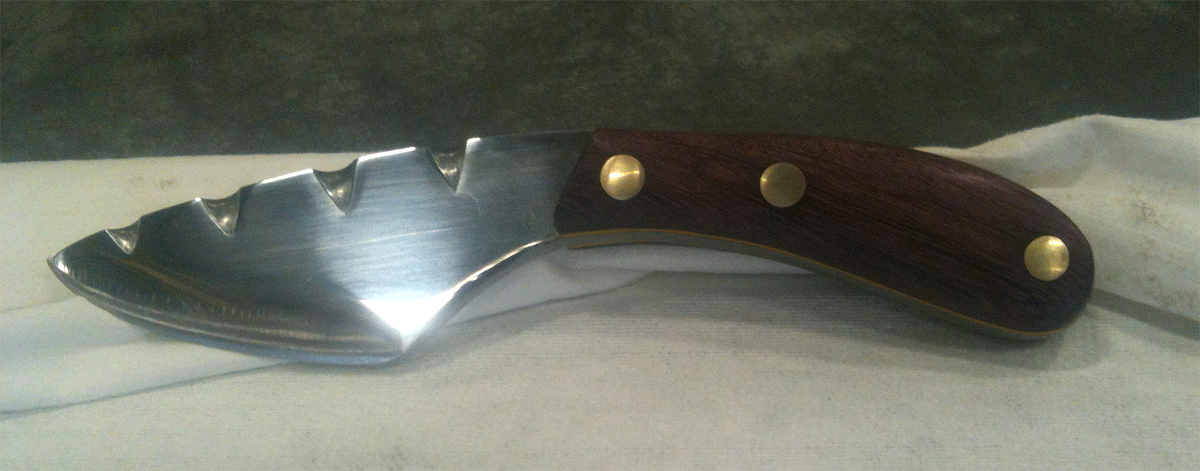
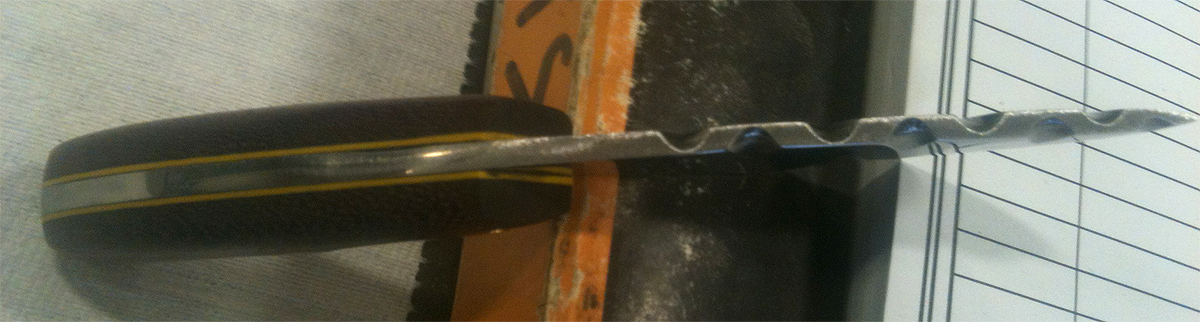
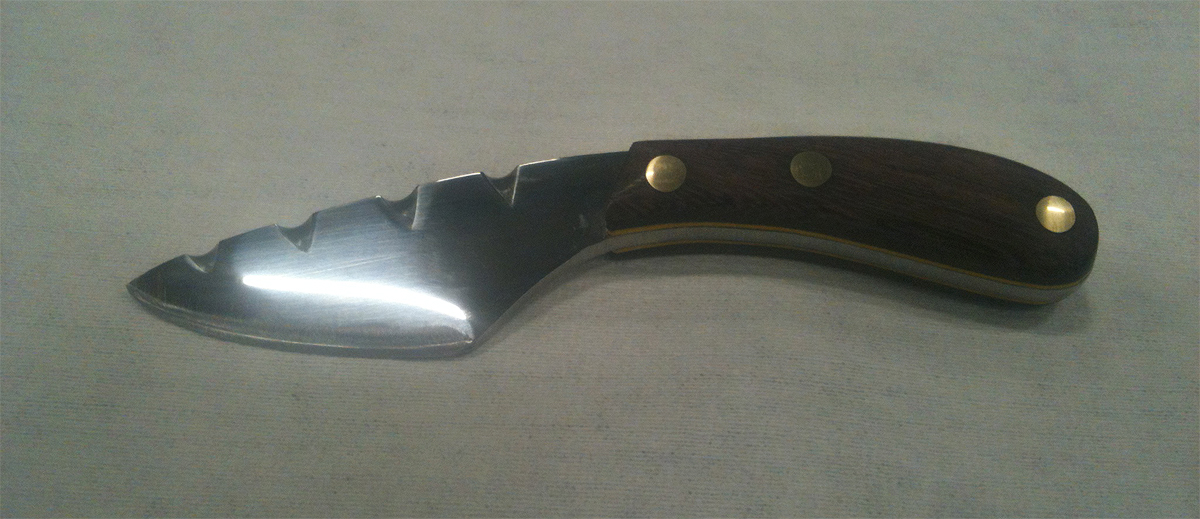
Knife for a friends birthday. Second try at "filework".

Joined
Jul 19, 2014
Messages
92
It's 1084 steel, with Purple Heart wood for the handle, brass pins, and yellow G10 liner. Honestly this was just a small scrap chunk of steel I didn't want to waste, so I kind of just designed it as I went, working with that small piece however I could.

I was always intimidated by that nice look you get from file work, but I tried it once, and it turned out ok. So I tried it again here, and while it isn't perfect, it looks pretty decent IMO, gives the knife some extra style. (Though perhaps compromises it's integrity?)

I still have some trouble getting that "shaving sharp edge". This will slice paper nicely, but it won't push cut, nor will it properly shave your arm hair. I know the bevel is shallow on this one, but it's a problem I have with most of my knives. I don't know if my geometry is way off, or if I simply don't know how to use a whetstone or what, but my knives aren't as sharp as I'd like.

I have a feeling somebody will say that first pin is too close to the edge, because I thought so myself. I just removed too much material on the handle though and it couldn't be helped unless I wanted to totally redo it.

Anyways, I am fairly proud of this, I am making good progress finally but I have a long way to go.

(Taking proper pictures of knives is hard... I know this isn't a great knife, but the pictures really don't do it justice...)
PE5DzWH.jpg

C9O7pH7.jpg

Do1G6bS.jpg
 
I'm pretty green, but here are aome things that stick out to me. My first tries at file work were really basic, like yours, but I wouldn't bring it so far down the blade. Look up how to do the "climbing vine" it's relatively simple and looks very neat. Also pins aren't spaced symmetrically. Is your handle material flush with the tang? It looks like the metal dips below your wood. If you don't already, shape the handle on the knife, once I learned that the hard way, it really helped. What are you grinding your bevels with?
 
Overall, it is a good early knife.


Nic pointed out the major things:

The file work is far too large and comes down the blade side too far. This makes it a detraction, not an embellishment.
The handle needs some rounding. It should be an oval or egg shape cross section. Pins should be smaller and evenly spaced.
The blade bevel got "washed out" in sanding and buffing. It should be crisp and flat, not rounded. The reason it won't cut right is it is too fat behind the edge.

You didn't mention HT. What was the steel type and the HT?
 
Overall, it is a good early knife.


Nic pointed out the major things:

The file work is far too large and comes down the blade side too far. This makes it a detraction, not an embellishment.
The handle needs some rounding. It should be an oval or egg shape cross section. Pins should be smaller and evenly spaced.
The blade bevel got "washed out" in sanding and buffing. It should be crisp and flat, not rounded. The reason it won't cut right is it is too fat behind the edge.

You didn't mention HT. What was the steel type and the HT?

Well it is 1084. I heated it up in my forge and regularly checked it with a magnet, once it stopped sticking I gave it a few more seconds pulling it back and forth through the coals. I then took about a second and a half to plunge it into a 6 inch round can of canola oil, which I had pre heated by dropping a small hot piece of steel in earlier.
I tempered it immediately, in a toaster oven. I let it preheat to 500 while I was at the forge, with 2 1/8th inch pieces of steel inside. Came back from the quench after letting it cool in the wind for a few minutes, scrubbed the scale off with a rough pad and sandwiched it between those 2 pieces of preheated metal in the oven.
I let it sit for about an hour and ten minutes, then checked, and it was a crisp, dark golden color. So that was it. I normally hear it should get two cycles like that, but I also hear that is the exact color you want for a temper. When I give it an extra hour cycle it comes out a blue color..
As for hardness, I don't have a tester, but I have scratched some hard steel with the tip.
 
That HT will work for 1084.


Some tips:

The time from forge to quench tank should be as short as possible. Don't delay any amount of time. The "one second" thing you read about has to do with the rate of cooling for steels in the 1080-1095 range. Once the steel is in the oil, it has less than one second to drop from 1450F to below 1000F. If the cooling rate is slower, it will not harden properly.

The color on the blade after the temper indicates almost nothing. It is often a blue or even a rainbow. The temper color charts seen on the internet are for quickly drawing an edge temper on tools with a flame, not for oven tempering a knife blade.

Placing a second thermometer in the oven to check the oven temperature is a good idea. The one that controls the heating coils on a toaster oven is notoriously inaccurate. The kitchen oven is far better to do tempering in, BTW.

Check the oil temp with a thermometer. 120F is just about perfect for most quench oils ( Parks #50 is used at 70-90F).

Two temper cycles are needed for proper tempering. There are changes that are made in the steel during the first that are finished in the second. A quick cooling by dunking in water between the tempers is all that is needed before the blade gets the second temper.

500F is a bit high, 400F to 450F is a far better range for a 1084 knife.

.
 
That HT will work for 1084.


Some tips:

The time from forge to quench tank should be as short as possible. Don't delay any amount of time. The "one second" thing you read about has to do with the rate of cooling for steels in the 1080-1095 range. Once the steel is in the oil, it has less than one second to drop from 1450F to below 1000F. If the cooling rate is slower, it will not harden properly.

The color on the blade after the temper indicates almost nothing. It is often a blue or even a rainbow. The temper color charts seen on the internet are for quickly drawing an edge temper on tools with a flame, not for oven tempering a knife blade.

Placing a second thermometer in the oven to check the oven temperature is a good idea. The one that controls the heating coils on a toaster oven is notoriously inaccurate. The kitchen oven is far better to do tempering in, BTW.

Check the oil temp with a thermometer. 120F is just about perfect for most quench oils ( Parks #50 is used at 70-90F).

Two temper cycles are needed for proper tempering. There are changes that are made in the steel during the first that are finished in the second. A quick cooling by dunking in water between the tempers is all that is needed before the blade gets the second temper.

500F is a bit high, 400F to 450F is a far better range for a 1084 knife.

.
Ah yes, poor wording on my part. I didn't mean I purposely took that time to get it into the quench, it was just my work area is cluttered and the can isn't as close as it should be, it took me a moment to get from forge to quench. I will definitely try to find a better place for the can.

I'll definitely start giving my blades a second cycle in that case, I was pretty much under the wrong impression that it was the color you had to be sure of more then anything. Thanks.

Here's a slightly unrelated question for you Stacy, I have a bar of 1095/15n20 Damascus. I have in fact searched the forum but come up with little luck, and I didn't want to make a redundant heat treat thread, so perhaps you can help me here a bit.
From what I understand I should pretty much just treat it as 1095 and heat treat it that way, no?
As far as that goes, it's more or less the same as the 1084 HT, except you want cold oil because it needs to cool even faster then the 1084, is that correct?
 
The old rule was to HT it for the "hard edge steel". It was easier to just say that because it got good results. I have regularly used the same phrase.

This has been modified due to more people understanding metallurgy. The carbon diffuses through the billet in manufacture so it comes out as pretty even. If you have even amounts of 1095 and 15N20, the final billet will have about .85 carbon content thorough the blade. The alloying materials will stay in place, so the pattern of light and dark will remain.

For 1095/15N20, the HT would be about the same for either steel - 1475-1500F, ten minute soak, quench in fast oil or canola, temper twice at 400-425F.
 
Back
Top