Knife Geography

Billhooks themselves are typically of the single-handed variety, though some versions of the Yorkshire pattern are found with a double-handed shaft halfway between the length of a standard billhook and a slasher. Billhooks are sometimes also known as a fascine knife.

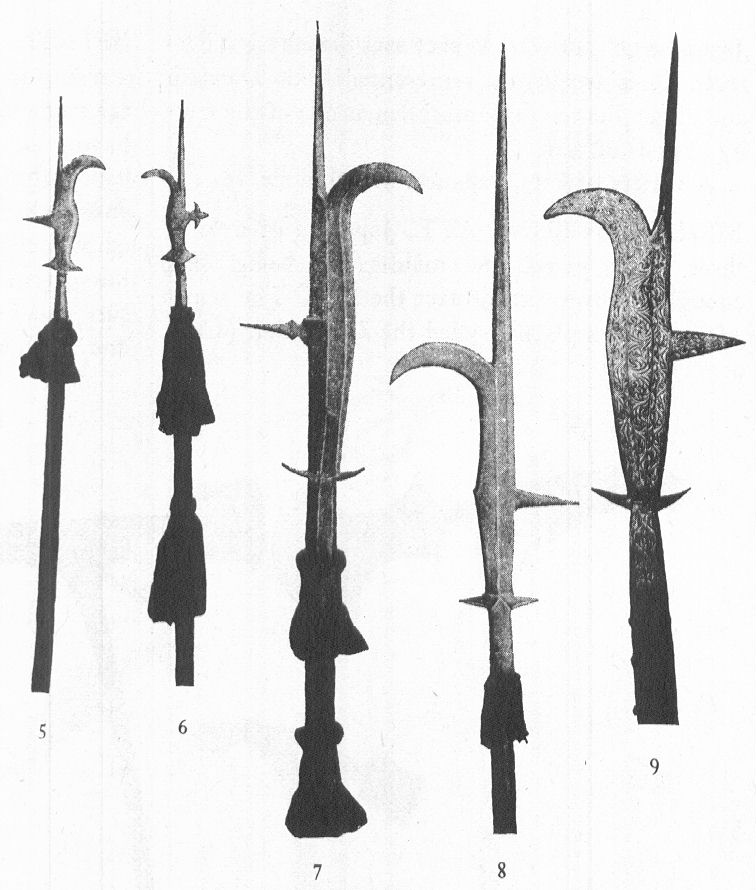
During the early medieval period, billhooks were re-hafted as pole-arms for battlefield usage and evolved into both the halberd (mostly hacking, but can thrust) and glaive (mostly thrusting, but can hack).

Actually billhooks didn't evolve into anything else and remained a separate military weapon until polearms stopped being carried in the battlefield. Halberds and Glaives originated separately as polearms. Kinda goes with the "flow" of this topic.

polearm2.jpg


Thanks for the link though, I've always wanted one of my own!
 
Is prison considered a geographical location?

Spoon knife:
idiotworld3.jpg


Toothbrush knife:
WC_910649_39_image.jpg

Well yes ...yes it is.
The knives are made from the material available, based on a traditional knowledge of what locales knows works for the region.
Could they use a Green River or Sheffield, maybe a Mora instead ?
I think so. :)

A good alternative viewpoint on the tread I think.
 
Hi

Have a search for other billhook entries on the site for more info, but just to extend the geographical aspect...

In the UK there are several hundred regional billhook patterns - even in some counties there are local variations... in Wiltshire, where I live there used to be Warminster, Imber, Salisbury and Downton patterns, as well as the more common Chippenham pattern. The Buckland family from Netheravon made their own pattern, as did Down of Mere... we also 'poached' tools from the neighbouring counties, so it was common to find Berkshire, Hampshire, Dorset, Somerset and Gloucestershire patterns near the county borders...

Makers would also make any pattern to order, so if a local farmer or landowner wanted something different, he would send a paper pattern and a minimum order (usually a dozen) and yet another pattern entered the catalogues - ditto some local iron-mongers (hardware stores), who often also had their name and location stamped on the blade...

Standard blade shapes were also made in differeny sizes, some makers offering from 7" to 12" in 1/2" increments.... Apart from the 100 or so large industrial makers, many more hundreds of regional makers were still in existence until WWll....

In France the situation was similar - Talabot, a large manufacturer boasted over 200 patterns in their 1935 catalogue, but held templates for over 3000. Most European countries had a wide regional variation in blade shape, handle style, thickness, dish, single or double edged, concave, straight or convex etc...

I have collected over 4000 names of French Edge Tool makers from about 1870 to 1930, most of whom made billhooks - and over half of my french billhooks have a maker's stamp not in my list - so it is likely there were as many regional styles as there were villages...

 
I've never been to South America, where the parang was designed (not for certain), so I can't speak of the vegetation in that region. I can say though that the parang design works great here in the hills of TN.

Parangs are widely used here from trail-whacking to wood gathering. South America are located within the same belt line of Equator, making machete their trademarks as efficient knife there.

The evolution of Khukuri went back all the way to Alexander the Great's era or probably before. As we speak today the design stood for 1500 years.
You could see shadow of it through the Spanish Falcata and Greek Khopesh model and the shape slowly morph into Indo-Aryans' need for local vegetation.

And we are yet to pry open another majestic knife of its own.....the Nihonto.
The exhaustive 411 about katana are just one hecka knowledge to acquire through the years.
 
Most populations that developed ironworking also independently developed similar tools. You find knives, axes, hoes and spades etc in all societies before the intervention of the European colonial settlers. The brush clearing knife, be it billhook, machete, parang or khukuri also developed in many areas. The Chinese billhooks from the 13th century, the nata from Japan or the curved knives from Java would all be recognisable to a European explorer...

Post colonialism most local iron making gave way to imports of tools from Europe - mainly France, Spain, England and Germany - cheap factory mass produced tools supplied by the settlers provided the tools required for the exploitation of the land and the peoples. With slavery came a fresh need for tools to exploit virgin territories such as the West Indies and South America, where there had been no previous history of iron working or tool making (other than use of wood and stone)...

To aid the development of new lands tools were required, and so as different terrains and vegatation required different tactics, new tools would have been developed from those already known... Tools used in sugar plantations with English masters were different from those in regions run by Spanish or Dutch colonialists - so a whole range of different types of slashing and cutting knives, previously unknown in the home country, were made for export.

As with the humble European billhook, different designs of the same tool were developed or requested by the local landowner - as with styles of machete, hundreds of different types of axes, sickles and hoes can also be found in the 19th century export catalogues of all the major European manufactures...

Some tools and weapons did undoubtably move across the world with early civilisations - the Assyrian pruning hook from Mesopotamia travelled into Egypt and the Eastern Mediterannean - with the later Greek civilisation it extended into Italy, Spain and southern France. With the Romans it extended into northern Europe... later it became more widely used for agriculture and the billhook was born... It probably also moved eastwards through Persia into India - and maybe further east into Indonesia... It is likely the Chinese and Japanes tools developed independently, and maybe moved westwards - also towards Indonesia, where a fusion of the two cultures took place (at least until the Europeans arrived)....
 
Back
Top