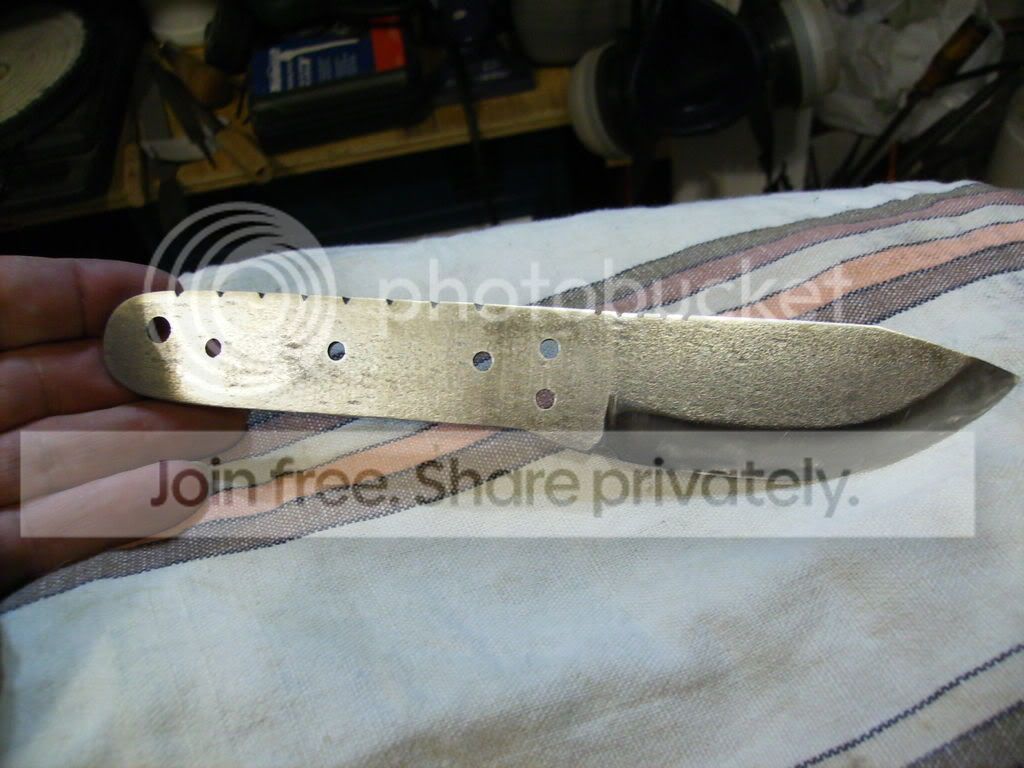
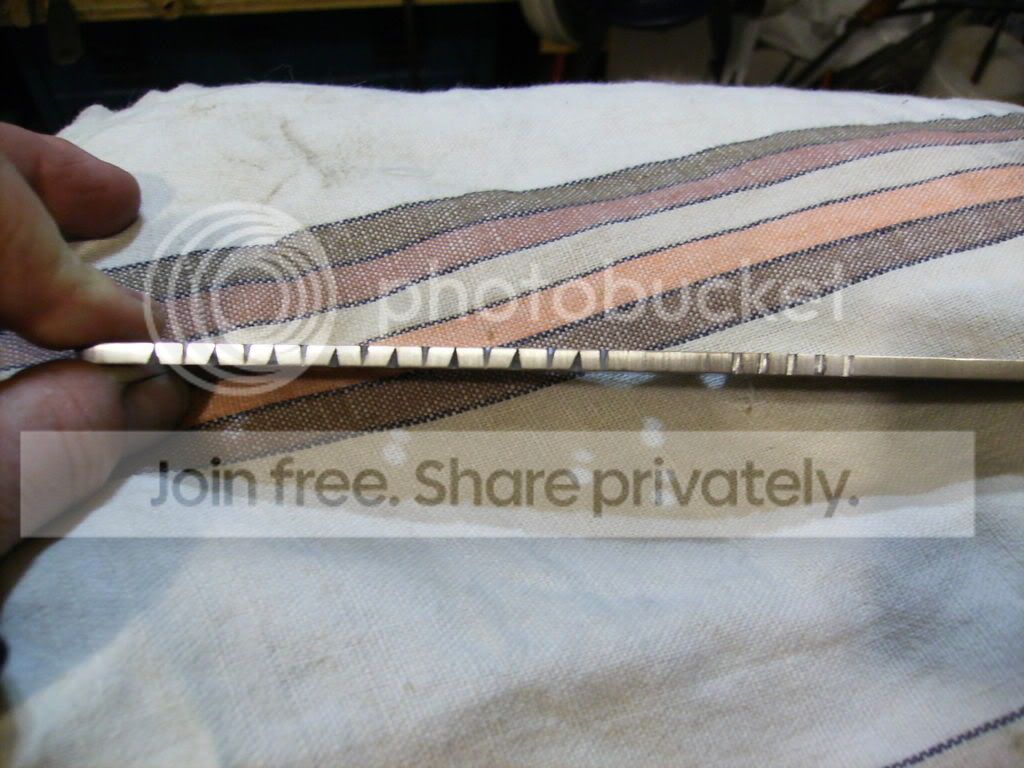
I believe the knife is ready but i have a couple questions prior to heat treat. Should the knife be sanded down to 400 and then buffed shinny . ????? I did a rough sharpen on the edge and sanded out any deep scratches its slightly sharp but i can feel a small burr that developed but i could buff that up in a heart beat or does that wait til im in the step just before i glue on the handle /fingergaurd . I did sand a little at 240 and then took a scotch brite belt and buffed it up with that . I am just a little confused as to the steps with out alot more reading. thanks kellyw

-
The BladeForums.com 2024 Traditional Knife is available! Price is $250 ea (shipped within CONUS).
Order here: https://www.bladeforums.com/help/2024-traditional/
You are using an out of date browser. It may not display this or other websites correctly.
You should upgrade or use an alternative browser.
You should upgrade or use an alternative browser.
Knife prep prior to het treat
- Thread starter hellgap
- Start date

- Joined
- Aug 19, 2005
- Messages
- 220
I usually do mine to 220 grit, I sand them on the 6"x48" sander, making sure to get them flat, both sides. But I have sen guys do 120, 80, and on up to 400. I have one friend who gets the knife ready to ship, and then heat treats it. Then after HT, he cleans it up and sends it out.
A few ideas....hope they help.
A few ideas....hope they help.

Stacy E. Apelt - Bladesmith
ilmarinen - MODERATOR
Moderator
Knifemaker / Craftsman / Service Provider
- Joined
- Aug 20, 2004
- Messages
- 38,698
Well, everyone has their own level of finished ,but I would not consider that knife ready for HT.
1) The grind could be moved farther up the flats.
2) There doesn't appear to be any distal taper on the blade.
3) The flats are still very rough. They should be as smooth as the bevels.
4) You never want the edge sharpened (even a little bit) before HT. The edge should be about .040" thick pre-HT. The blade may well crack or warp with a fully sharpened edge (as well as have too much de-carb in the edge).
5) Plunge line needs to be cleaned up.
6) Do not polish a blade before HT. Just sand to 220-400. The blade should look about the way you want the finished knife to look, just not polished or sharpened. Removing any deep scratches or defects after HT will be much harder.
The overall look of the blade is nice. Just sand a little more and tidy it up before HT. Dull the edge back to at least .020.
Stacy
1) The grind could be moved farther up the flats.
2) There doesn't appear to be any distal taper on the blade.
3) The flats are still very rough. They should be as smooth as the bevels.
4) You never want the edge sharpened (even a little bit) before HT. The edge should be about .040" thick pre-HT. The blade may well crack or warp with a fully sharpened edge (as well as have too much de-carb in the edge).
5) Plunge line needs to be cleaned up.
6) Do not polish a blade before HT. Just sand to 220-400. The blade should look about the way you want the finished knife to look, just not polished or sharpened. Removing any deep scratches or defects after HT will be much harder.
The overall look of the blade is nice. Just sand a little more and tidy it up before HT. Dull the edge back to at least .020.
Stacy
- Joined
- Jul 28, 2006
- Messages
- 3,953
What Stacy said.

- Joined
- Oct 6, 2008
- Messages
- 4,076
I'm about to start profiling some small hunters in 1/8" 440C. I'll be sending them out for HT. They will end up with either a full-flat or mild convex bevel (couple of each for testing and fun).
My question is, with stock this thin, should I grind the bevels almost done (except for the .040" of edge Stacy mentioned, I understand that), or leave extra "meat" on the blade? Especially with having to send them out, I don't want to risk warping. On the other hand, I don't want to have to shape any more hardened steel than necessary, had enough fun with that making blades from old, re-tempered files.
My question is, with stock this thin, should I grind the bevels almost done (except for the .040" of edge Stacy mentioned, I understand that), or leave extra "meat" on the blade? Especially with having to send them out, I don't want to risk warping. On the other hand, I don't want to have to shape any more hardened steel than necessary, had enough fun with that making blades from old, re-tempered files.
Last edited:

- Joined
- Jun 2, 2007
- Messages
- 1,354
A question is, how are you going to heat treat it? A forge? A kiln? What kind of steel is it? Using a forge, or propane torch even you're gonna end up with decarb/scale that you need to grind off or sand off, with a kiln with air hardening type steels, (if done right) won't have any scale to grind/sand off.
You don't want to sharpen it as like stacy said kinda, the edge could curl up on you ! the more beef you can leave, the better !
A thick blade (1/4") is alot less likely to warp in a kiln than a 1/16" or an 1/8" blade. however if the thick blade does warp, it's much more a pain to straighten it out.
Personally I don't care what my plunge lines look like before heat treat as they always get taken back a little on the grinder after heat treat.
Do you plan on regrinding on it?
Is there a prior thread i didn't read on how you did this? probably !
If you did this all with files and sand paper, then yeah you want to do what Stacy said ! Otherwise you can pretty much reshape any knife even in the hardened state so long as you don't heat it and have the steel change colors on you !
You don't want to sharpen it as like stacy said kinda, the edge could curl up on you ! the more beef you can leave, the better !
A thick blade (1/4") is alot less likely to warp in a kiln than a 1/16" or an 1/8" blade. however if the thick blade does warp, it's much more a pain to straighten it out.
Personally I don't care what my plunge lines look like before heat treat as they always get taken back a little on the grinder after heat treat.
Do you plan on regrinding on it?
Is there a prior thread i didn't read on how you did this?
probably ! If you did this all with files and sand paper, then yeah you want to do what Stacy said ! Otherwise you can pretty much reshape any knife even in the hardened state so long as you don't heat it and have the steel change colors on you !
- Joined
- Jun 2, 2007
- Messages
- 1,354
I'm about to start profiling some small hunters in 1/8" 440C. I'll be sending them out for HT. They will end up with either a full-flat or mild convex bevel (couple of each for testing and fun).
My question is, with stock this thin, should I grind the bevels almost done (except for the .040" of edge Stacy mentioned, I understand that), or leave extra "meat" on the blade? Especially with having to send them out, I don't want to risk warping. On the other hand, I don't want to have to shape any more hardened steel than necessary, had enough fun with that making blades from old, re-tempered files.
I would say leave enough "meat" on the blade so you don't have to be there for days sharpening it but thick enough so it doesn't warp..
i'm sure the place heat treating (if they know what they are doing) will be able to fix any warp in the blade.
- Joined
- Oct 6, 2008
- Messages
- 4,076
hellgap, sorry for butting in but I was going to ask these questions anyway, so why start another thread? 
Thanks Leu, that's about what I thought. I also know it's important to have the grinds even on both sides of the blades, and to round out any tight inside curves to reduce stress risers. Anything else I should watch out for?
I know steel's not that expensive (at least, the grades I'm using) but I still hate to waste it, not to mention time, belts etc.
Mind you, I fully intend to break at least one of these on purpose but that's not waste, it's R&D
Thanks Leu, that's about what I thought. I also know it's important to have the grinds even on both sides of the blades, and to round out any tight inside curves to reduce stress risers. Anything else I should watch out for?
I know steel's not that expensive (at least, the grades I'm using) but I still hate to waste it, not to mention time, belts etc.
Mind you, I fully intend to break at least one of these on purpose
but that's not waste, it's R&D