Knife Project Advice

Joined
Aug 3, 2012
Messages
12
Hi all, I have been a serial lurker in these forum for quite awhile now, reading up the posts here and else where on knife making. I think I have the basics down and figured it is time for more detailed questions. For now I am going to keep out of the design questions, as I am more interested in finding out about the manufacturing process for now.
First off some background information, I plan to make this a one off/extremely limited project to make a knife or two for my needs more then anything else.I do not really want to spend on equipment like grinders and ovens as I have problem sourcing them. So I would like your opinion on working out a supply chain process to get my knife made and shipped to me (I am not living in the US), and if it is feasible.

Method 1) Cut out knife blanks by US suppliers (such as greatlakeswaterjet or alphaknifesupply.com including bolt and lanyard holes as required/designed. These should be precision cut to the final shape as close as possible. Have them sent to a heat treater if the supplier does not offer it. Have heat treater send the blanks to me for completion.

Method 2) Cut out knife blanks by US suppliers and sent to me. Drill out bold holds and rough grind blade profile. Source local heat treatment. Final completion work

I know method 2 is the preferred way of doing things. But I am pretty sure the heat treatment would not be as good as if it was done in the US (lack of experience). So I would really like if all the major works can be done and only left for me to grind the blade to completion.

Any comments is much welcomed! :)
 
You will have to do the shaping before the heat treatment. There should be many people in Malaysia that can do it for you. There are a lot of knife makers over there.

Unless you want to spend a lot on shipping, your best choice is to get some steel in Malaysia and make the knife with a file and sandpaper. This tutorial has all the information needed.
http://www.bladeforums.com/forums/showthread.php/694673-How-to-instructions-for-making-a-knife

Here is a thread with some info on finding a Malaysian knifemaker:
http://www.bladeforums.com/forums/s...amp-wilderness-people?p=10891248#post10891248
http://www.bladeforums.com/forums/search.php?searchid=3061624

Steel like 1080, 5160, O-1, A-2, and 1095 should be pretty easy to find. Check with a spring shop or machine shop. They might also be willing to cut out the profile of your drawing for you and drill the holes.
 
Riiiight... you'll just make one or two.... and I'll just eat one or two chips!

I wish you all the best in containing your involvement in knifemaking. Very few are successful at stopping after two knives.
 
You will have to do the shaping before the heat treatment. There should be many people in Malaysia that can do it for you. There are a lot of knife makers over there.

Unless you want to spend a lot on shipping, your best choice is to get some steel in Malaysia and make the knife with a file and sandpaper. This tutorial has all the information needed.
http://www.bladeforums.com/forums/showthread.php/694673-How-to-instructions-for-making-a-knife

Here is a thread with some info on finding a Malaysian knifemaker:
http://www.bladeforums.com/forums/s...amp-wilderness-people?p=10891248#post10891248
http://www.bladeforums.com/forums/search.php?searchid=3061624

Steel like 1080, 5160, O-1, A-2, and 1095 should be pretty easy to find. Check with a spring shop or machine shop. They might also be willing to cut out the profile of your drawing for you and drill the holes.

I am actually quite familiar with the two sites for Malaysian knife forums. However saved for large choppers such as parangs where there are more local makers, there really is a lack of smaller knife makers. Also the humidity here is rather high at 80-100 year round so a stainless steel blade is definitely my preferred choice,something the makers here do not use and have no knowledge in HT in. They are always CS blades (1095 or 5160), not really a choice as they tend to rust pretty fast.
From what I search on Google there seems to be a few steel suppliers who can cut the steel as required. Other then the two I ID'ed are there any others that can be recommended? I think I should start looking for local HT sources too.
 
Riiiight... you'll just make one or two.... and I'll just eat one or two chips!

I wish you all the best in containing your involvement in knifemaking. Very few are successful at stopping after two knives.

Because I dont have the equipment I am pretty sure I can stop at two .... I hope! :)
 
OK I have tried sourcing for cut materials from Leading Edge Fab, but it is a no go. So to simplify my supply chain, I have found a Assab Steels locally who can supply Elmax sheets and also do the HT. I have seen the chemical composition, and it is a powdered steel metal just like S30V key take away is that it is higher chromium and lower vanadium. A quick search here and subsequent link to Alpha Knife Supply summarises Elmax as "The performance of Elmax is far superior to S30V. Elmax is much tougher and has far better edge holding. It is also easier to finish." From what I can tell corrosion and strength will be better. But what about edge retention? Any comments or experiences with this steel agaisnt 154CM or S30V? Its really the first time I am hearing of it.
 
Because I dont have the equipment I am pretty sure I can stop at two .... I hope! :)

Not meaning to distract you, but lack of equipment doesn't stop too many folks... certainly didn't stop me.

I'd answer your questions... if I knew the answers. I don't. Never worked with stainless yet. I have some bars, just haven't used them.

- Greg
 
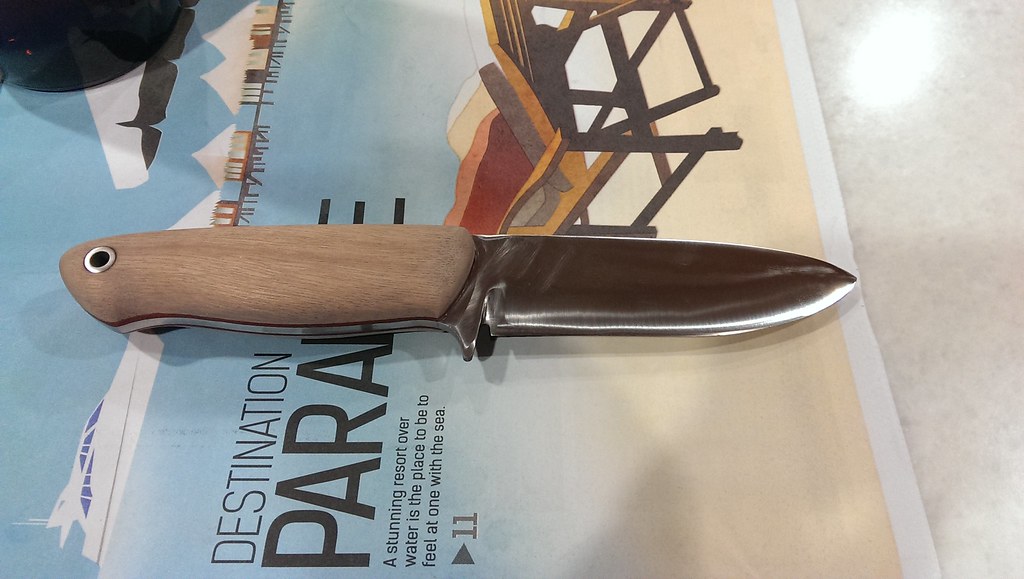
Ok so after nearly a year since I started on my journey to make my own knife I am now happy to report that I am in the final stages of finishing the knife! whoopie! I spent a lot of time refining the design through multiple prototyping just to get the "right" handle. I went through 20 odd versions before I settled on this one that feels right to me. This has been a really really slow project for me since I only have a couple of days a month on weekends to actually work on the knife due to my job schedule and other weekend activities.

The knife is fully functional but is really just a proof of concept for me before I start using Elmax steel. Currently I am still in the process of treating the handle with tung oil so it will be a good 2 more weeks before I finish with it's 3rd full strength coat and fully cures. Some stats to the knife:

Overall length: 233mm
Blade length: 111mm
Blade thickness: 4mm
Handle length: 92mm (at the belly)
Grind: Drop point half height convex at an estimated 18 deg.
Blade Material: D2 at 60.5 HRC with cyro. Low temperature temper
Handle: Meranti (a local light hardwood) finished with pure tung oil, red vulcanised fiber as liner
Notes: The blade is finished to 600 grit - I just didnt like mirror finish. There is one 8mm OD tube as lanyard hole plus another 2 hidden pins.

I have learned a lot from making this knife, and obviously this knife itself is not perfect and has quite a lot of flaw. Two of the most obvious now is 1. I screwed up when trying to refine the plunge line by over grinding the area. 2. I should have properly tape up the blade before sanding the handle to prevent scratches to the nicely polished body.

My photography skills lies somewhere else but I promise more pictures once the knife is fully oiled.

10800818534_539b4e4803_b.jpg
 
Last edited:
Elmax and S30V are complex stainless steels which require very careful control of temperature and time to heat treat.These are not steels for beginers !!!
 
I think the gentleman said he was having the blade professionally heat treated - not attempting that himself.

Ken
 
Good first knife.


....with one big thing to never do again.....It needs rivets in the handle. The epoxy WILL fail in time and the handle WILL lift up at the front.
 
Bladsmth,
Do you think hidden pins could work if they're deep and press-fit? Granted this probably wouldn't hold up in natural wood that can swell and shrink, but stabalized woods and synthetics (G10, micarta) should be stable enough to hold tension. I would think that a set-up like that combined with a high quality epoxy would be at least as strong as full non-peened pins with epoxy.
 
Hidden pins will work if properly made , but my take on them is ....Why hide the pins?

If I made a hidden pin, I would not make it a press fit. I would make the pin have grooves or threads, undercut the hole with some room, and use structural grade epoxy.
 
Elmax and S30V are complex stainless steels which require very careful control of temperature and time to heat treat.These are not steels for beginers !!!


Thanks for the head up mete, but as Ken mentioned I am not doing my own HT... would love to but I am doing to small a quantity to justify an oven right now if ever :(


I like your knife. Now make more :D


Thanks! I have a few designs already converted from sketches to DWG drawing and just waiting to be cut out.


Good first knife.


....with one big thing to never do again.....It needs rivets in the handle. The epoxy WILL fail in time and the handle WILL lift up at the front.

Thanks for the note Stacy, I will see how the pins hold up against testing later. I based my design on the a couple of kitchen knives I have that uses wooden handles, no epoxy and only two pins... probably peened. It sees daily use in wet and dry conditions including light bone chopping (cheap knife so we dont really care) and still sturdy as ever.
Do you think if I used highly oily wood like cocobolo will prevent the wood from shrinking/expanding as much?
 
Wood expands and shrinks. Oily woods - rosewood, cocobolo, African blackwood, desert ironwood,etc. - expand and contract less. Stabilized wood also has much less movement. Oily woods need strong fasteners, like Corby bolts, as they don't bond to the glue as well as other woods.

I know I seem like a salesman for Corby bolts, but there is no stronger method of attaching the handles on kitchen knives. Once you understand the installation, and learn the basic tricks, installation is nearly as easy as pins. I have had scales pop up off peened rivets on chef's knives, warp and lift up on fillet handles with seven 1/8" pins, and found gaps where the scales have pulled away from the blade at the ricasso on kitchen knives....but I never had a handle failure with a handle installed with Corby bolts.
 
Thanks for the info Stacy. I try bolted on my next blade with cocobolo... now if only usaknifemaker.com would hurry and restock on their steel so that I can make a purchase!
 
Back
Top