knife scales

Joined
Jan 2, 2009
Messages
309
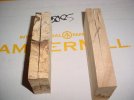
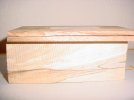
so, you get a set of wood scales and what is the case for all the scales I have bought, the scales are from a single piece of wood that was cut down the middle and you end up with a really nice wavy cut with the wood being thinner in some spots than other spots. But, you need the wood to be the same thickness throughout and you don't have any sophisticated tools like planers and such.

How do ya'll remedy this?
 

Attachments

  • DSC00370.jpg
    DSC00370.jpg
    42.2 KB · Views: 82
What I have done in that situation is laid a piece of medium grit sandpaper down and rubbed the side that you need to be completely flat on it.
 
Flatten the tang side of the scales on the platen and finish flattening them by hand of a hard, flat surface as Mike suggested. The exposed side of the scales will be shaped during the handle shaping process and can be evened up during that time.

--nathan
 
so, you get a set of wood scales and what is the case for all the scales I have bought, the scales are from a single piece of wood that was cut down the middle and you end up with a really nice wavy cut with the wood being thinner in some spots than other spots. But, you need the wood to be the same thickness throughout and you don't have any sophisticated tools like planers and such.

How do ya'll remedy this?

The best way I have found is a disc grinder, it will get the tang side nice and flat.

BTW I love the quote. AuH2O
 
Disk grinder here also. I just have the craftsman 2x42, but it's got a 6" disk on the other side. Truing up scales is about the only time I ever use the disk.
 
Dave,
I get your point here and indeed you want to take the excess wood from the back side not the book matched side. However if you wanna take scales from 3/8 to 1/4 you've really got your work cut out for ya doing it by hand. Bandsaw or grinder would help. Hacksaw might help if your good with it. You could try clamping the scale between 2 2x4's and using a jigsaw. These are some options other than a planer that are not ideal but will work in a pinch. What other tools do you have at your desposal ?

-Josh
 
Dave,
I get your point here and indeed you want to take the excess wood from the back side not the book matched side. However if you wanna take scales from 3/8 to 1/4 you've really got your work cut out for ya doing it by hand. Bandsaw or grinder would help. Hacksaw might help if your good with it. You could try clamping the scale between 2 2x4's and using a jigsaw. These are some options other than a planer that are not ideal but will work in a pinch. What other tools do you have at your disposal ?

-Josh

I started using my belt sander. It is time consuming and I don't always get the same thickness the full length of the scales and and not always the same thickness from scale to scale.

Hand sanding is also time consuming.

I have a band saw, router, belt sanders, drill press, orbital sander.
 
Get a cheap plastic miter box and handsaw. You'd be surprised how quick and easy it is.
 
Someone gave me some wood that he cut in half with a hack saw. The thickness is not even. I have been trying to figure out how I can fix this without spending too much time.

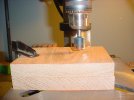
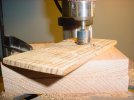
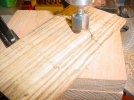
Here's what I came up with today.

I placed a router bit in my drill press; ran the table and the piece of wood up to router bit and "planed" the wood to obtain a consistent thickness.

Depending on the wood I found that I get the best results removing .05" at a time. Try to remove too much material at a time and the bit will chatter or pull the piece from my hand. I have to use a fair bit of downward pressure and I rotate the piece against a clamp (see photos).

What do ya'll think of my solution?
 

Attachments

  • DSC00373.jpg
    DSC00373.jpg
    42.8 KB · Views: 26
  • DSC00375.jpg
    DSC00375.jpg
    60.5 KB · Views: 35
  • DSC00376.jpg
    DSC00376.jpg
    68.4 KB · Views: 36
  • DSC00377.jpg
    DSC00377.jpg
    72.8 KB · Views: 35
Sorry, i misunderstood. I thought you were having trouble cutting it strait....
Novel idea if it works.
 
Have you tried clamping a piece of angle iron or, something with a tall straight edge, to the table of your band saw as a guide? Go slow and be sure to clamp it parallel to your blade. Work out your placement with some test pieces. You should be able to get it pretty close.
 
The only problem is that my drill press is in the second bedroom and I have a lot of shavings to clean up. :)
 
Have you tried clamping a piece of angle iron or, something with a straight edge, to the table of your band saw as a guide? Go slow and be sure to clamp it parallel to your blade. Work out your placement with some test pieces. You should be able to get it pretty close.

Yes, I do something like that when I want to cut the wood in half but when it's already been cut crooked I need to smooth it out some.
 
Disc sander... you know where one is right ?

hint: you saw it when you were over ;)

Not sure how coarse of 9" discs I have though.... probably nothing coarser than 120 grit.
 
What I have done in that situation is laid a piece of medium grit sandpaper down and rubbed the side that you need to be completely flat on it.
I agree with Mike. Sand paper on surface plate works for me as well. Most of the time you do not need the scales to be the same even thickness, you just need them to be thick enough for your needs and the bolster side of them to be flat. So far I found that I needed the scales flat and even only when I was fitting them to dovetailed bolster.
 
That router bit in the drill press idea can work, but please watch your fingers. I always cringe when using small pieces of wood with sharp spinning things.

That said, I almost always screw up when I try the sandpaper on a flat surface technique. I usually end up rocking the piece slightly as I sand and make a mess out of it.:grumpy:
 
If your tablesaw blade leaves a nice finish you could use that. Set up the fence, run them through with push sticks and viola! flat pieces of uniform thickness. Watch out for kickback though.
 
I take the slabs and run them through the table saw,too. Set the fence for just a tad below the thinner one ( or just above the desired thickness) and run them both through. USE A PUSH STICK. Lay then flat on a 100 grit sheet of sandpaper to smooth the saw lines if needed.

TIP:
When cutting a block in half, or mounting scales, take the center cut surfaces and flip them so they become the outside. This makes the scales bookmatched and the sides will be a closer match. If you just cut down the middle and mount the scales the way they were cut, the sides may be very different. On some woods the grain or burl requires the scales to be mounted non-bookmatched, and on others it looks better bookmatched. Flip them both ways and see which looks better. If you have a block of wood that has the grain lines running at an angle to the block edge ( often created by angle sawing a 4" board to get 5-6" blocks), flip one scale end for end and you will create a herringbone pattern with the grain at the spine. This looks very nice. Works well with many bold grained or striped woods. Herringboned tiger maple is stunning.

Stacy
 
I purchased the thinnest table saw blade I could find, the kerf is .059. I got a 7 1/4 blade with 40 teeth. The more teeth the cleaner the cut should be supposedly. I also made a zero clearance worktable insert so the scales do not get sucked down into the saw.

Here is the one I got. It is super sharp and the cuts are super smooth.
http://www.freud-tools.com/freuddiabfin.html
 
Back
Top