Knife selection: Is its ability to skin important to you?

Joined
Jul 31, 2007
Messages
1,421
In reading through the WSS neck knife thread, Koster says that part of the design of the knife is to allow it to skin better. This made me wonder how many people look for this in a knife that they choose to use and carry?

For me, it's probably the last thing on my mind. I've never skinned anything other than my hands with a fresh blade. So, in a survival situation, skinning wouldn't be important to me at all. I also don't hunt (because animals were not meant for food... JOKE! I've just never had the chance to get into it), so most of my knives of bushcraft oriented, rather than hunting.

Seems just about any knife would get the job done, and several of my knives have a good belly to them, but I've never once said yes or no to a knife because of the desire to skin and animal.

What about you? Is it important for your knives to perform well when skinning?

L!
 
It's somewhat important for me, but I find that if the knife is comfortable for doing other things, then it will work fine for skinning. The only real requirements I have for a skinning knife is that it have a comfortable handle and not be any longer than 4 or 5 inches. I have no qualms skinning an animal with a wharncliffe, even.

I really don't use a knife that much when skinning most game. Only to cut skin in places that need it and sometimes if the hide sticks in a spot.
 
I thinky in most survival situations you'll be processing small game if any at all...skinning small game for the most part only requires a few cuts and a bit or pulling so the shape of the blade is not as important... for larger game you'll need to seperate the hide from the connective tissue underneath.. that will require a bit more "belly" but I would consider something like that more of a dedicated "hunting knife"
 
In a word, "no."

Shape is more important in separating meat from bone/tissue in difficult to reach places.

Warm game hides mostly pull off, even at that...rabbits, pheasants...hardly need a blade at all. Squirrels are a little more difficult. Deer? If you can get to them warm...I've seen videos of guys pulling the skin off with a rope and a car...need selective cutting, of course. If the torso is cold, the equation changes and separating the membraneous attachment from the hide is more difficult. Mostly involves just slitting the membrane and tugging on the hide.

But really...it is nice to talk of harvesting game for survival...but dunno just how practical it is on a day-to-day basis. Snares work when you aren't there, as do fish traps, trot lines....

justsayin'

But these days...I skin every thing. Plucking is for the birds. (small joke. I'm sorry.)
 
Remember, skinning isn't always the sole purpose of a blade design. How many folks here choke up on their knives or grasp their blades forward of the guard. Sometimes, you take a skinning grip when you aren't skinning.
 
Skinning in itself is not as important to me as it was when I was hunting a lot,

…but I still like a skinning style of blade with a high point and a lot of belly for many cutting chores.


"If you're not living on the edge, …you're taking up too much space."

Big Mike
 
No, I do not particularly need them to perform well when skinning. I have knives that I have just for skinning the game I shoot. Of course, if I were to get lost or something whilst on a short hike, or a short trip into the woods, than I may be in a little trouble if I happen to catch something. However, any knife can get the job done, if you know how to do it properly.
 
No, I do not particularly need them to perform well when skinning. I have knives that I have just for skinning the game I shoot. Of course, if I were to get lost or something whilst on a short hike, or a short trip into the woods, than I may be in a little trouble if I happen to catch something. However, any knife can get the job done, if you know how to do it properly.

Exactly my sentiments. A skinning blade makes it easier, and if I know I might be skinning out a deer, I'll throw my skinning blade in my bag and leave it at camp. However for skinning out small game in a survival type situation, I'm sure that I could do it with any of my blades.
 
I have to agree with Kevin on this one. I often find myself holding the knife in front of the guard for fine detail work.

I also know that you can skin game with a Stanley utility knife blade if you have to.
 
A primary bush craft knife does not need skinning ability purpose built into the geometry of the blade, IMO.

On 11/30 my party was hunting for bull elk when my friend Tim brought down a large bull. After gathering the hunt party and about 10 gallons of water (20 minutes) we began processing the carcass. Tim was the cutter, while the rest of us were the pullers and limb holders. Tim had the bull fully (and cautiously) field dressed in 40 minutes.

In his pack my friend Tim had the Outdoor Edge skinning set; a paring knife, a broad bellied knife with a gut-hook, and an 8" bone saw. Each production knife was purpose built for its roll in the field dressing process. Truly, a well laid out set.

This allegory goes right to one extreme end of the argument; large hoofed animals. I describe this episode to corroborate my point that specialized tasks need special tools. The bush craft knife should cover a wide range of common tasks; essentially enough capability to return the knife user to civilization.
 
I "skin" cardboard, plastic, tape, cloth, etc. all the time. ;)

In other words, anytime I turn the knife upside down and run the blade upwards...I'm technically using the same motion as skinning.


But, that said, it's normally not on the top of my "must-have" features...but is sure nice to have!

Dan

p.s. and I give all the credit to Brian/Kevin for the skinning feature. :D :p
 
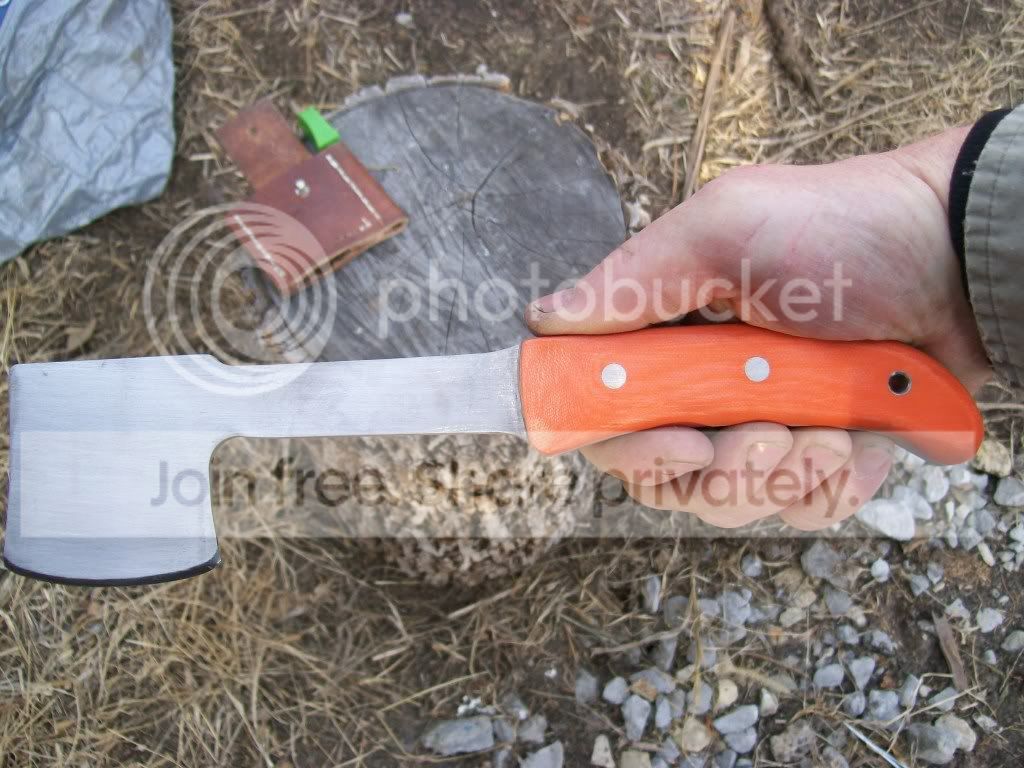
I think it depends on the person. You can use a sharp rock to get it done or a peace of broken glass. My two nephews just a few days back processed a young steer that we had saved for our selves. This one did not go to market like the rest. My older nephew used my little hatchet that I made a few days before the meet processing started with the steer we were saving for us. My younger nephew used the Nessmuk style of knife I made a few months back. The little axe did really good. Les (older nephew )said that he liked it better than using the nessmuk knife. Also when it came time to cut through the pelvis the little hatchet just flew through the bone.
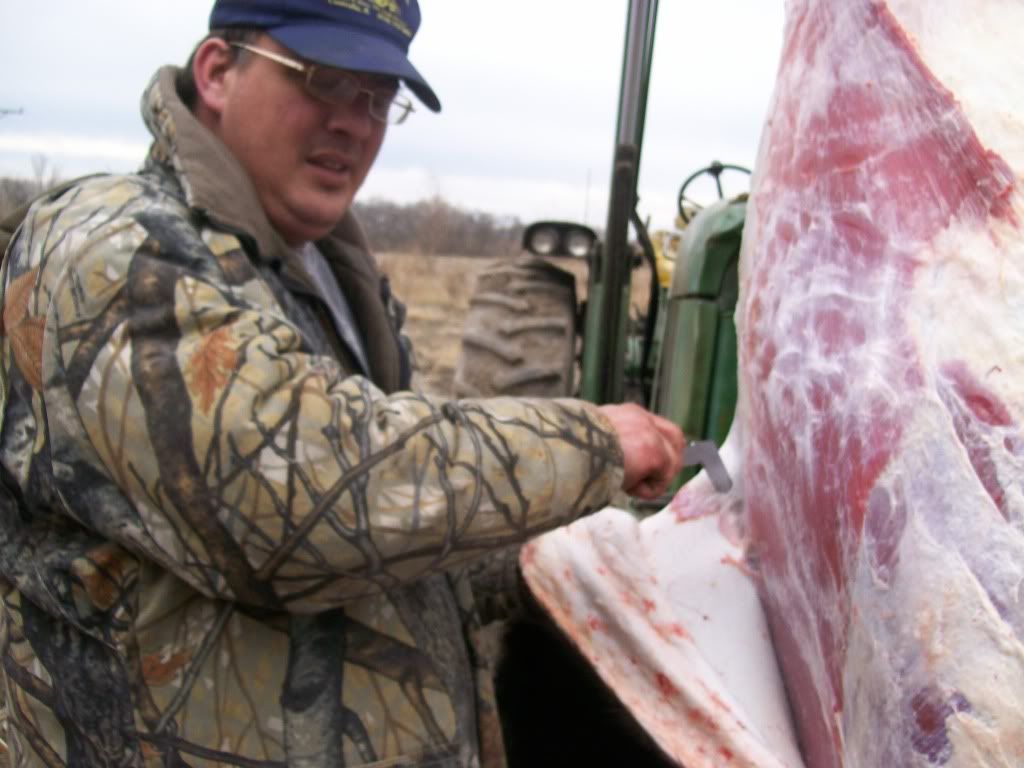
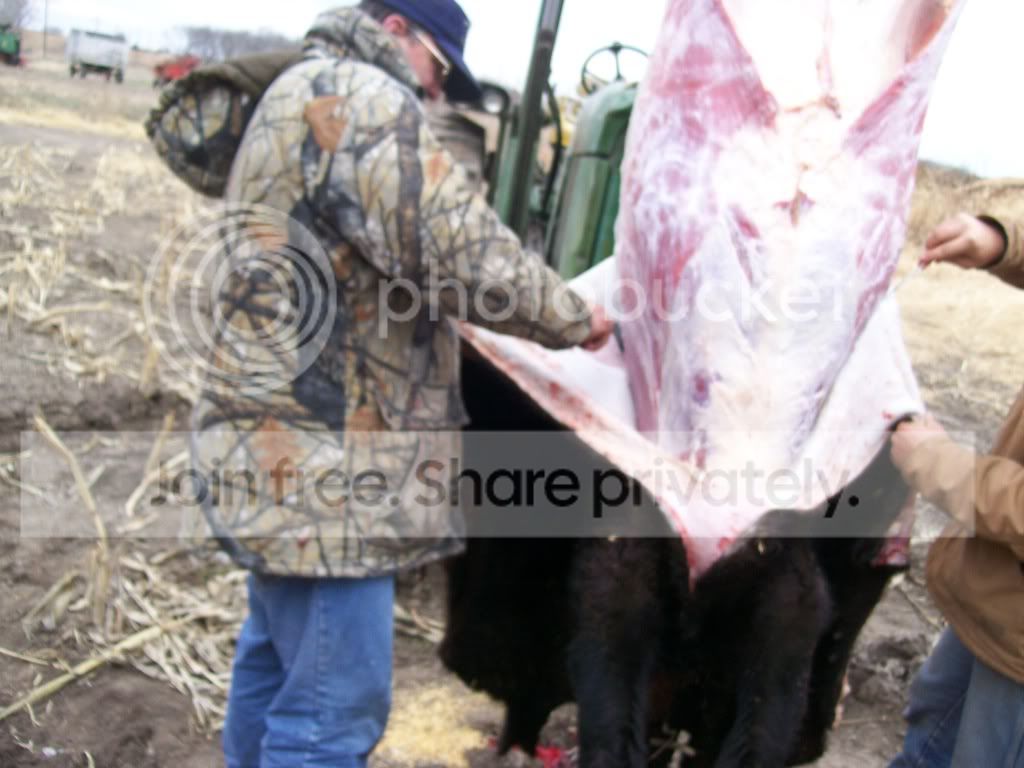
My younger nephew said he liked the knife better but Les who has skinned way more animals than Kory said he liked the little hatchet better so eveyone is different on that. Well here are the pics of the knife and hatchet skinning the steer.
The hatchet

101_0948.jpg


Then the skinning with both nephews
101_0955.jpg


101_0956.jpg


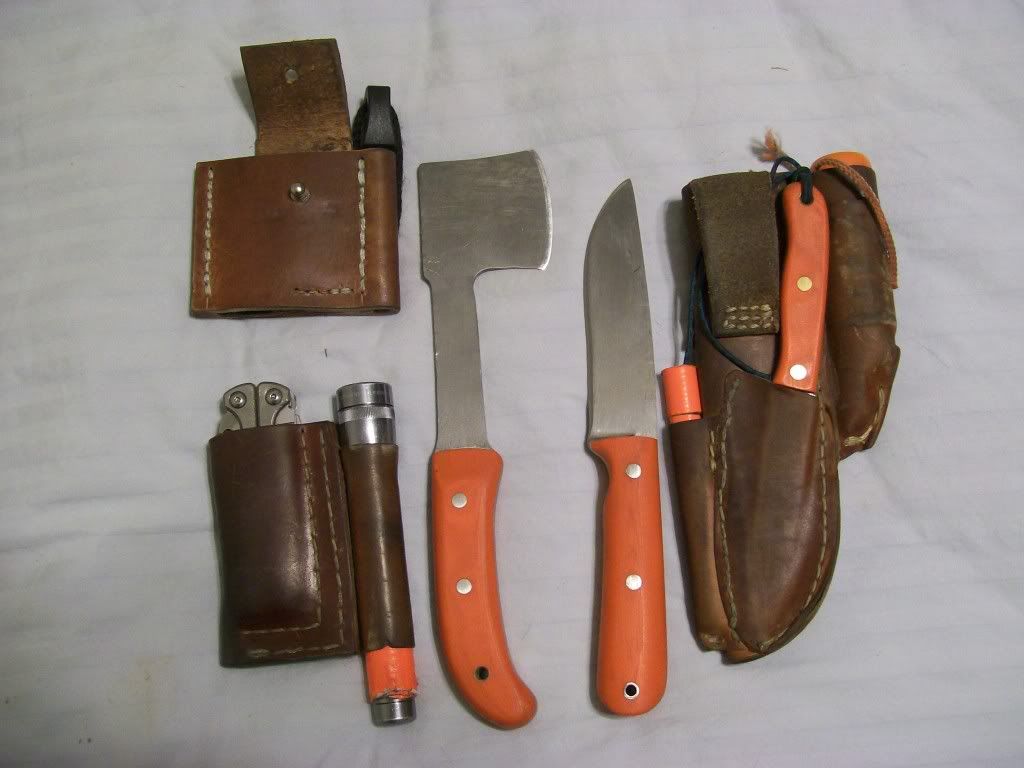
Personaly I like to use both knife and hatchet.

101_0963.jpg


I have used other hatchets, but when I made this one up I had other thoughs on it use than just chopping wood. So far so good.
I have since made another hatchet with a little longer head and have a third cut out and shaped with a head like the second hatchet but with a curved handle. I think I got the perfect hatchet design for me anyways. I will post a pic when it is done.

Well that is my thoughts anyways.
Good thread Luke,

Bryan
 
just about any knife will do for skinning, i like some curve to the blade, but a sak is sharp enough to skin even a large animal, the brown bear from knives of alaska is i think the best skinner i have seen, like an ulu shape to it, but i have seen white tail skinned by hooking on with a garden tractor or atv and just pulling slowly, after splitting the hide up the limbs and the belly while adding a few swipes here and there. this is the most efficient method i have seen to process them, a butcher friend of mine does this with a whole cow, using an electric 3 ton hoist and attaching the skin to a bolt in the floor of his shop.


alex
 
I think that if skinning was not a consideration there would be more wharncliffe bushcraft knives. Personally, I do not rank it high as a feature.
 
I want my blades to be suitable for skinning, but I think many may see a good skinner as needing WAY more belly than is required. Every animal killed past few years has been skinned and quartered via Mora Clippers and/or Byrd Cara Cara. I see it more from a "are my skinning blades capable wood cutters?" point of view, and yes most definitely, they are.
Also, IMO, excessive specialization is against the grain of a good survival mindset. My blades need not be SUPER at any one thing, but good at many.

Beckerhead
 
all my hunting friends use construction razor blades to skin. Not one uses a knife. As for me, no its not important.

a SHARP knife is important to me, i can adapt it to any situation.
 
To me a skinner type knife is a good knife. I think in the states we care a great deal about knife designs and type of steel. You be amazed if you travel to other countries they use really simple knives for everything. If you go to the U.K. the knife styles are limited and the steel type basically boils down to like two types or something like that. The most important thing to me in knife design is well balance where the knife becomes and extension of my finger or hand, and finger guard. I can skin with any sort of knife that is sharp. It may take me longer thats the only difference between good skinner guthook and non skinner.
 
Actually naked, I said that, and it is minor part of the design, designed to get a little more purchase with your thumb while skinning, or even doing any task that could be slippery. It just fit with the way i have skinned deer before. The idea also spawned from the possibility of having cold conditions and cramped hands in a survival situation, where you don't have the grip control you normally would for ANY task, and further helps to keep the hand off the sharp part of the blade.

Just clarification...it suits several purposes, any of which require a grip that keeps the thumb in place and the forefinger in place...and it is designed to be reversed, with the forefinger on top of the spine and the thumb on the lower plane of the handle.

I don't think I described it in enough depth as a multi-purpose feature. The travails of having a stomach flu and fever i suppose.

But, the primary idea came about for... if I needed it for skinning, without being to hang the animal to do so, and if my hands might be cramped and/or cold and losing feeling and ability to grip as well.

Does this help make a little more sense? It's really a minor feature that is useful for many purposes.
 
Last edited:
Back
Top