Knife set for my mother-in-law

Joined
Apr 19, 2012
Messages
212
My father-in-law has asked me to make a set of kitchen knives for my mother-in-law for her birthday. He wants a paring knife, a boning knife and a chef's knife. His only stipulation was a "non-slip" handle. I'm not sure how to go about that. I think Micarta is a better material for durability but I don't think it would be as attractive if I leave it textured--I usually sand to 600 or 800 grit then polish. I kind of wonder if the handle design could aid in the non-slip function more than a coarser textured handle material.

Also, while I'm at it...
I've used 154CM in previous kitchen knives, usually .103-.110" thickness. I've been happy with the result, but honestly I don't have much diversity in my background. 1095 and 154CM is pretty much it for me so far. I'm considering trying AEB-L this time which I can acquire at a lower price for a higher quantity, although this will come in .070" thickness. This would be the thinning starting stock I've worked with. Any opinions on this change over? Should I stick with 154CM or give the AEB-L a try?
 
Last edited:
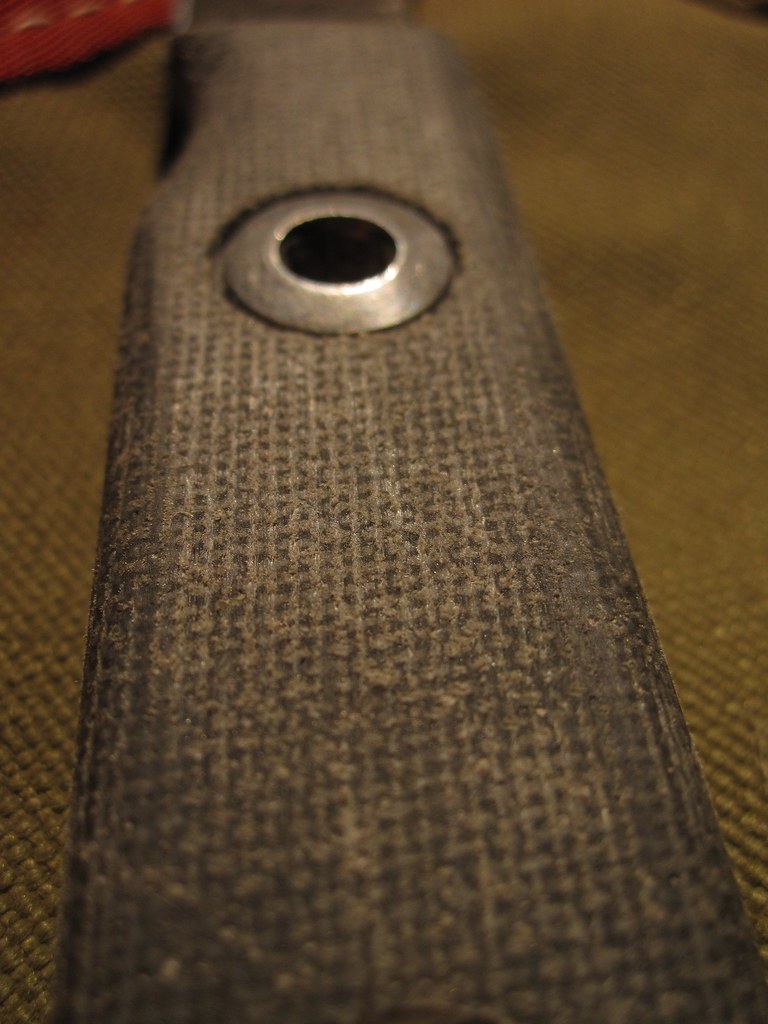
Give TeroTuff handle material a look. It is kind of like Micarta but with a very slight rubbery feel to it. I have used it on a few knives and I liked the way it worked ( worked as in the way it shaped and sanded) . Here is a pic of one of the handles that I used the grey TeroTuff on.
EDIT to add Yes handle shape has a huge amount to do with grip. Even more than material IMO. Using the two together is the key to achieving an outstanding and comfortable grip.
12709102825_60abc76e15_b.jpg
 
Canvas Micarta or any of the "xxxx-Tuff" materials work well. Just sand to 400 grit and rub hard with a cotton cloth. I use a lot of black canvas Micarta on kitchen knives.


A few suggestions:
1) Most people make kitchen knives wrong two ways - Too long and too thick.

2) Make the paring knife 3" long, the boner 4-5", and the chef's blade 7". Use .060-.090" thick steel for the chef's blade ( I use .060"), and .060" for the smaller blades.

3) Sharp points are nice on darts and arrows, but of little use on a kitchen knife. Make the tips a bit thicker than most knives and fairly blunt shaped. they will last longer and do less damage that way.

4) handles should be simple and fairly thin. Big "ergonomic" shaped handles might go well in a camp knife, but will end up stuck in a drawer never used on a kitchen knife.

5) Corby bolts excel in a kitchen knife.

6) Take out your three favorite kitchen knives - the ones you grab when you want to fix dinner. Look at them and measure the blade and handle. Take a lot of inspiration from what works! The kitchen isn't where re-inventing the wheel will happen.
 
Thanks for the ideas guys. I think I will give tero tuff a try, although I have grown rather fond of Micarta. Thanks for the suggestions bladsmth, I was actually wondering about the physical dimensions of the three blade types. I'm leaking toward the AEB-L, although it will be a new steel for me
 
AEB-L makes great kitchen blades. Get enough to make about ten blades and sent the whole batch to Brad at Peter's. Aldo carries it in thin sizes that are perfect for slicers.
 
That's actually where I'm ordering from. The thinnest they have is .070, but I think that's gonna work out just right.
 
I was just curious... most of the knives in Santoku and Chef's style for sale in the kitchen knife sale forum seem to be around .090 - .110" thickness. I'm not scared to use thinner stock, just curious why it doesn't seem to be very common. Is it due to the degree of difficulty?
 
I also like Corian for non slip handle material. It polishes great, is tacky when wet, dish washer safe, comes in 8000 colors and you can get it dirt cheep if you buy it as scap pieces from a corian counter top installer. Its not everybodys taste but I like it.
 
Back
Top