knife snapped while straightening, explanation needed

Joined
Jul 13, 2011
Messages
2,090
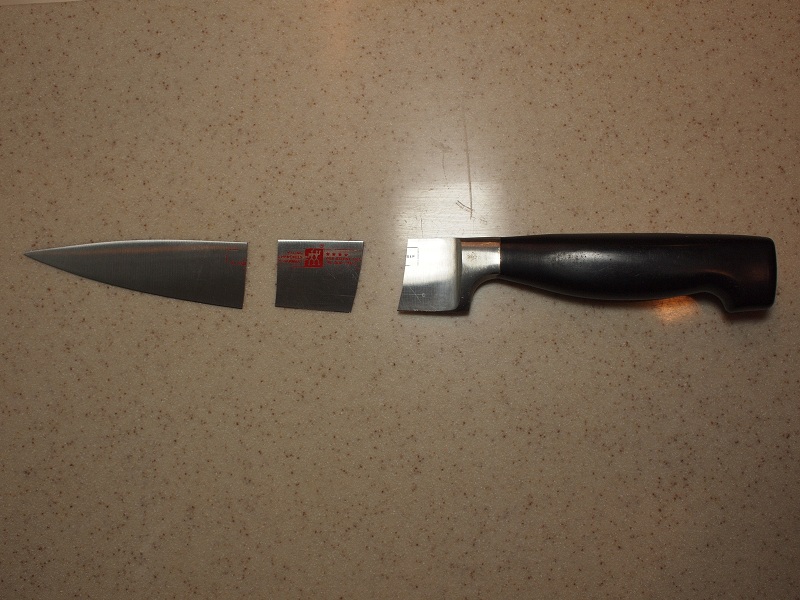
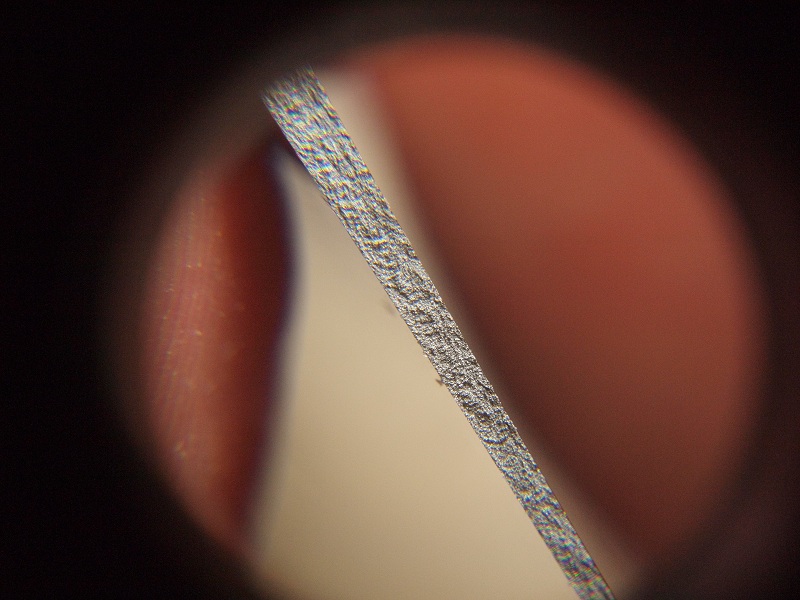
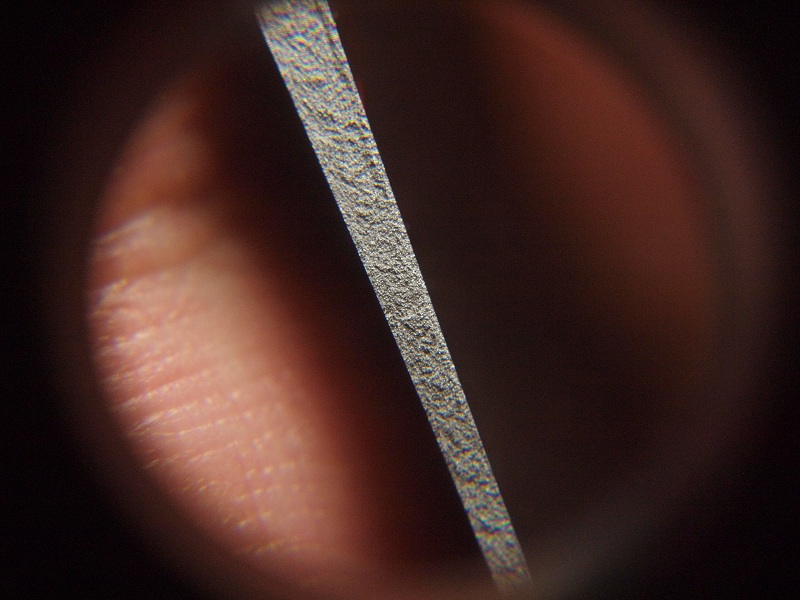
I very rarely post in this sub-forum, but I was wondering if anyone here might be willing to offer some expert opinion on this. I sharpen knives for people, and sometimes they are bent when I receive them. I straighten on the edge of a table (always with goggles and using a towel over the blade). Today, this happened. Keep in mind, I've straightened lots of J.A. Henckels before without incident. I had just begun the straightening on this knife and didn't even put a lot of weight into it when *SNAP* this happened. Do these pictures give any indication as to why this knife broke like that?


QbU5o6S.jpg


N3vzu37.jpg


NOduFQC.jpg
 
Grain is too coarse. Poor HT. Not really your fault, and very likely there are more like it out there that were in that same batch. I would say that something went wrong in the oven and it got over heated, and either the situation was not noticed, or was ignored by the operator.
 
I will assume you told your customers that the knife was bent, and you would attempt to straighten it at customer's risk. There is always a chance that a knife will break if you try and straighten it. Professional craftsmen always advise their customers that any risk on a damaged item is the customer's. You are a craftsman, not a psychic, and don't know what may or may not happen during a repair. In my jewelry trade, I have repaired well over 100,000 items. Every repair ticket has printed on it, "Delicate repairs done at customer risk". Of that 100,000 ,a dozen of so times something happened I had no way to prevent...or even expect. That is where the risk lies.


Any hardened steel will break if bent beyond the elastic limit. That limit is a factor of lots of things - steel type, HT specs, condition, previous damage......but mostly it is a factor of the thickness and geometry.

Lets assume the steel type is OK for the knife type.

Commercial knives are done in huge batches. A few from each batch are checked to make sure the HT is OK, but some may slip through with problems. AFIK, no commercial manufacturer has a 100% record on avoiding problems. Even the space program has failures, and they have the highest QC in the world.

Things that may have affected the knife after HT are chips in the edge, and other damage. Even minute scratches across the blade can make a place where a crack can start ( ever cut a piece of glass?). Previous bends can leave behind internal damage that will break if bent again. This knife was bent, and when trying to bend it back, the elastic limit was passed.

It is hard to look at a photo and say for sure, but the grain looks OK on that knife. There is no variation in consistency, stair-stepping, or staining indicating a flaw or large grain line.

Lets talk about why the knife broke:
Because it snapped in two places, I would assume you really bent it hard. We all have snapped a knife trying to remove a warp or bend....it happens.
When doing something you have done many times, you probably apply the force estimated to be needed all at once as determined by experience. This is what a professional does. However, sometimes you estimate wrong. In the case of a thinner section of a blade the force can be much greater, and the amount of flex higher without damage. In a thicker section, like near the handle, it resists flex more, and will snap with much less flex. Now, if we add the bevel of the blade - from thick spine to thin edge - we have a problem. The edge will flex far more than the spine. The knife may start to flex easily, but the spine will quickly reach the limit and break. Once the rupture of the grain boundaries starts, it shoots across the line of flex at the speed of sound - that sound is SNAP !

Ways to avoid this are to use gentle pressure and avoid 90° edges to bend across, as they will concentrate all the force in one spot.

All in all, you may never have been able to know it would break, or prevented it.
 
Okay, before this explodes into something way off base, I need to clarify a few things...

1. Let me be clear: I already ordered the replacement knife. I am not trying to absolve myself of responsibility. I’m posting here because I want to understand better why the knife broke. I’m not looking for “excuses,” just information.

2. I sharpen a lot of knives (3 – 5 per week), but always free of charge for friends, acquaintances, coworkers, and people who’ve heard of me by word-of-mouth, only when I have time. This knife was no exception. Several of you have brought this up, and it’s strange to me because it never even entered my head. I wasn’t going to try to dispute anything with the “customer” or try to avoid responsibility or anything like that…

3. I did not bend the knife very hard. To the contrary. That’s why I’m posting here. I’ve sharpened Henckels for the same “customer” (if we’re going to call him that) with much more severe bends that I really bore down on in sessions over a whole day to straighten out with no incident. I use a towel over the already-rounded corner of the table. It’s not a hard 90 degree edge. But before I do that, I always go very light and bend at different places, straightening little by little until it’s straight. I don’t just grab the blade, stick it on a straight edged table and push down with all my strength, guys. I had just begun straightening this one, very lightly testing and then adding a bit more pressure when it snapped unexpectedly. It was not a hard bend.

4. I have never heard that it’s a mistake to straighten knives at room temperature. That’s the way I was taught, and that’s the way I’ve always done it. How else should it be done?

 
Last edited:
It may be worth asking the "customer" if the knife has taken a few trips thru the dishwashing machine. That will also accelerate a knifes demise IMO...
 
The knife was in bad shape. The tip was bent, the edge was badly damaged with a carbide V sharpener. Yes, it was washed regularly in the dishwasher, but would that really affect the blade that much? Again, I don't know why it happened, but dishwasher temperatures? How hot does it get inside a dishwasher?
 
I have seen more than one person use a mallet to baton kitchen knives through frozen food. I am not advocating that practice, just saying that I have witnessed it. It would not surprise me a bit to learn that someone, at one time, did something similar with this knife. The fact that it was bent and otherwise not well cared for tells a story in itself.

If it broke under the conditions you describe, I would consider it due to damage or defect. Where the damage or defect originated is probably beside the point. Sharpening is routine maintenece for a knife, straightening is damage control. I would not perform them as services to a customer under the same terms. In the case of a knife with a factory warranty that is bent, I would not touch it-the factory warranty should be the owner's first recourse and you will void it by trying to fix it yourself.
 
Last edited:
That's a good idea. By the way, the "customer" is a friend who will probably just laugh when I tell him what happened. When I inspected the knife before beginning the sharpening, I showed him the bend and told him that I would like to try to straighten it. He said that was okay. I didn't think to tell him, "By the way, I might break your knife in the process." I didn't even think about that, but I will definitely add a disclaimer in the future, even though I'm doing it for free. I cancelled the order for the replacement knife (for the moment), and I will ask the "customer" to let me submit the knife for warrant replacement. If that doesn't work, I'll replace it.

Does that sound reasonable?
 
IMO, it is not even worth straightening a production knife unless you are going to scrap it anyway. You have little to no idea of the internal structure or hardness. The grain you showed seemed fairly coarse to me... even if you could remove the scales and bring it up to 400F, coarse grain would be prone to breaking.
 
IMO, it is not even worth straightening a production knife unless you are going to scrap it anyway. You have little to no idea of the internal structure or hardness. The grain you showed seemed fairly coarse to me... even if you could remove the scales and bring it up to 400F, coarse grain would be prone to breaking.

I'd send him to you for a proper knife, Rick, but first he needs a lesson in knife care (which I will teach him). Besides, you don't make kitchen knives... or do you? :D :D :D
 
I don't know about Rick but Stacey and Butch do, at a minimum. Course with one of Stacey's your friend might come up missing fingers!
 
My best guess would be less than ideal HT. You could see a lot more with proper metallographic analysis.

Normally I would never recommend straightening a hardened blade at less tha 400 F !
 
Okay, before this explodes into something way off base, I need to clarify a few things...

1. Let me be clear: I already ordered the replacement knife. I am not trying to absolve myself of responsibility. I’m posting here because I want to understand better why the knife broke. I’m not looking for “excuses,” just information.

2. I sharpen a lot of knives (3 – 5 per week), but always free of charge for friends, acquaintances, coworkers, and people who’ve heard of me by word-of-mouth, only when I have time. This knife was no exception. Several of you have brought this up, and it’s strange to me because it never even entered my head. I wasn’t going to try to dispute anything with the “customer” or try to avoid responsibility or anything like that…

3. I did not bend the knife very hard. To the contrary. That’s why I’m posting here. I’ve sharpened Henckels for the same “customer” (if we’re going to call him that) with much more severe bends that I really bore down on in sessions over a whole day to straighten out with no incident. I use a towel over the already-rounded corner of the table. It’s not a hard 90 degree edge. But before I do that, I always go very light and bend at different places, straightening little by little until it’s straight. I don’t just grab the blade, stick it on a straight edged table and push down with all my strength, guys. I had just begun straightening this one, very lightly testing and then adding a bit more pressure when it snapped unexpectedly. It was not a hard bend.

4. I have never heard that it’s a mistake to straighten knives at room temperature. That’s the way I was taught, and that’s the way I’ve always done it. How else should it be done?

Hey no offense, but 3-5 knives a week is not a lot of sharpening in my book, and I hope that whomever taught you to straighten hardened steel in this manner was not also the person who taught you to sharpen knives.

While you may get away with this method on some (or even many) knives, it is folly to presume that all knives will behave the same way. There are a lot of variables out there and few decent kitchen knives were designed for lateral stresses large enough to result in bending...let alone MULTIPLE bends (i.e. at least once to bend it, the more to attempt to straighten it).
 
Hey no offense, but 3-5 knives a week is not a lot of sharpening in my book, and I hope that whomever taught you to straighten hardened steel in this manner was not also the person who taught you to sharpen knives.

While you may get away with this method on some (or even many) knives, it is folly to presume that all knives will behave the same way. There are a lot of variables out there and few decent kitchen knives were designed for lateral stresses large enough to result in bending...let alone MULTIPLE bends (i.e. at least once to bend it, the more to attempt to straighten it).

3-5 knives per week is a lot for the average person who is not a professional and only does it in his free time. And I don't use any power equipment. It's all free-hand, from bevel correction, to reprofiling, to finishing. I do about that many knives every week. I'm not sure what standard you are using or how you sharpen knives, but most people would consider that a lot of sharpening, especially if it's full-on reprofiling and correction, as is often the case for me.

As for who taught me, I learned quite a bit from Murray Carter for both. Also Mark Richmond at chefknivestogo. Professional knife sharpeners like Jason (knifenut1013) and others have helped me out tremendously.

Since my teachers are clearly not up to snuff, maybe the "unit" could share his techniques?
 
Last edited:
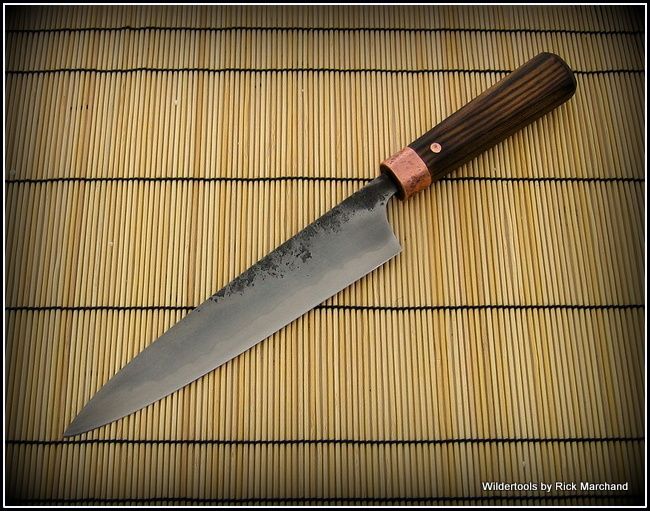
Lets try to avoid a stand-off fellas. The interwebz is an easy place to misread intentions. It is not worth a lockdown on an otherwise informative thread with a rather beautiful picture of one of my knives.:p
 
Back
Top