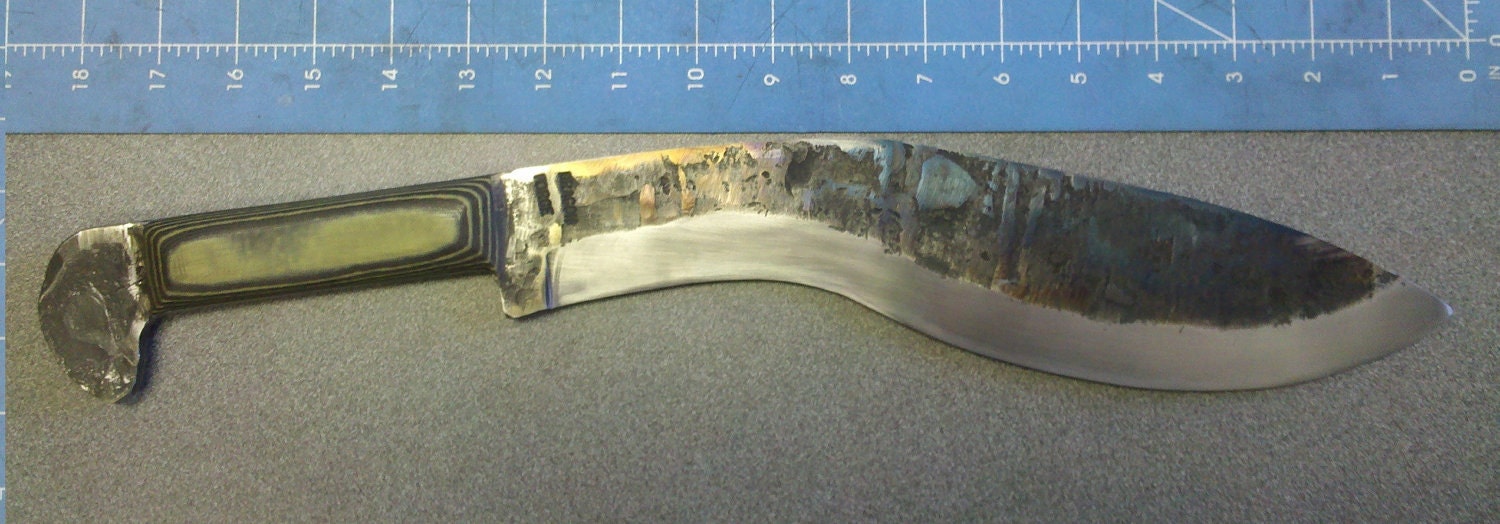
Honestly, if you want an apples to apples comparison, the knifetests guy needs to try out a chiruwa (full tang) version. For his kind of abuse, doesn't it make sense to buy the strongest knife? Besides, HI's have a limited lifetime warranty, which covers anything that a knife could properly be expected to do. Personally, I think that destruction testing knives should only extend as far as something that you could reasonably actually do in a situation where you'd be using your knife. Most of the stuff that guy does, you'd never actually do.
Well....
1) The difficulty involved in destroying a (presumed) stronger knife lends no information regarding what to expect from a (presumed) weaker knife, so
no it does not make sense to buy the strongest unless that is the most common/popular version, which it isn't. But as a side note, that guy in the mask went on to buy himself an HI CAK with pride because, heck, look what its little brother could handle!

2) Which part of the term "destruction testing" is confusing? To test a tool to the limits of
its durability,
you do not stop until
the tool experiences catastrophic failure, i.e. by definition it should extend as far as something that the tool canNOT withstand, otherwise you have entirely failed to discover that objective limit and have not performed a "destruction test" at all.

Most users will likely never find themselves in a situation coming anywhere close to pushing such a tool to the limits of its durability
(unless you're a BRKT fan, in which case you should use caution when whittling). So what? Ignorance is bliss? What if you're a user who wants to know just how much his tool can endure? Maybe you're looking for a "hard use" knife - well, "hard use" apparently varies quite a bit from user to user
(again, the whittlers), so it makes sense for ALL manufacturers marketing a tool as "hard use" to support that assertion
themselves via limit/destruction testing... how many do?
3) "
Most of the stuff that guy does" - slicing an apple, slicing webbing, carving wood, chopping wood, batonning wood, applying stress to the tip, laterally stressing the choil area (pry), impacting hard materials (rock, metal) along the tip & edge & spine ... *shrug* Those sound like pretty common occurrences for these types of knives to me ... but I'm just one guy.
So what is "reasonable" use? The manufacturer has the right to establish whatever warranty policy they like on their product, but if the product performs admirably under "unreasonable" (ab)use, word-of-mouth promotion
explodes and Himalayan Imports takes a seat of honor among those who appreciate a quality tool able to withstand the rigors of life's many unreasonable circumstances
But if he got one of the full-tang ones he probably couldn't have broken it, and what fun would that be?

You mean he couldn't have broken the tang? Well, maybe not, but the handle scales might still have fractured. Eitherway, the blade remained intact and I think the knife was deemed a "survivor"... so I guess this wasn't really a true "destruction test"

But personally, I think the fun part is the abuse itself and am always sad when the knife breaks
It's like sports or a good action movie, sad when the presented 'hero' is defeated ... unless he goes out in a blaze of glory!
Alright too much rambling. did the OP go with a khukuri or a machete?