Laddered san mai question.

jdm61

itinerant metal pounder
Joined
Aug 12, 2005
Messages
47,357
I have seen some folks like Russ Andrews do "double ladder" steel where they have ladder pattern cladding and monosteel core with eh wavy ladder transition line. How do you do that without the core being out of whack? Do you grind the edge down to say a 45 degree short bevel and then just ladder the flat parts? My concerns trying to do it on thin stocker kitchen knives where you idon'thave much to play with.
 
I haven't forged any knives in this style yet so take this for what it's worth, but I always thought that after the san mai billiet was forged welded and only had the tip forged in, that grooves were then ground into the edge area (or half way up the blade, but becoming shallower in depth) of the outer patterned 'jacket' steel to expose the core steel at the lower portion of the blade bevels. Then the grooves were forged to the surface during the drawing out of the blade. So I'm guessing you need to start out with a 'meaty' san mai billet to cut the grooves into before fully forging the blade to shape so you have enough thickness at the end

This makes makes sense in my mind, at least lol.


~Paul
My YT Channel Lsubslimed
... (It's been a few years since my last upload)
 
Last edited:
If you've ever seen how Claudio Sobral patterns the transition area of his stainless san mai blades before forging the the blade bevels, this will make sense. I'm pretty sure what you are describing is done in pretty much the same manner, but in a ladder pattern as opposed to the random cuts to create the crazy transition 'lines' that Claudio does.


~Paul
My YT Channel Lsubslimed
... (It's been a few years since my last upload)
 
When I do regular ladder, I forge to a slightly foreshortened profile, but do not forge the bevels. I "stock remove" the bevels on all damascus blades. This is particularly effective with random as you expose more layers. The first guy that I saw doing that was Bailey Bradshaw and I was a bit surprised, but it works. I press, but either way , you have to account for the blade blank "stretching" in length. I would think that you probably get a bit more stretch if you cut grooves.
 
^^ There you have ýour answer.
Etch every now and then while grinding to see where the center is going.
 
Here is what I was referring to regarding the way Claudio patterns his san mai: http://www.bladeforums.com/threads/cas-ryanw-collaboration-knife-wip.1015849/page-2#post-11599433

It's the twelfth picture down in the post that the link takes you to.

I do understand that damascus with non end-grained patterns look better when the bevels are ground in as opposed to forged, which is why I think in the pattern you are seeking you would simply forge the general profile and then draw it out to its final length/thickness after the grooves have been cut in, with possibly some light bevel forging at the bottom of the bevel.

I'm just posting to make myself more clear but I'm sure you have already figured it out. :)


~Paul
My YT Channel Lsubslimed
... (It's been a few years since my last upload)
 
Last edited:
This is the pattern that I was referring to. I am wondering how you could do it on blade that .100 thick at the ricasso and tiers to almost nothing without stretching out the pattern to where it no longer looks good?
russandrewssanmai.gif
 
I'm no expert, but the few I've done, I hammered the pattern in, then ground it down, rather than grinding grooves, and forging flat.
 
Tom Lewis explained to me once how he does it, I haven't tried yet, but he would hit the pattern with round dies in his press, then flatten it again in his press, rather than how you would typically do a ladder by grinding grooves or grinding flat.
 
3iVmUgv.jpg
[/IMG] The knives I have made are thicker than what you plan to do so I don't know if this would work for you or not. When the billet is 1/4" to 3/8" thick I use round dies to press in a pattern. I don't grind anything off, I just use my 100lb power hammer to flatten the billet to the thickness I desire. Then I pretty much do stock removal. I will try to post some pictures.
7uInkZS.jpg
[/IMG]
vrmwCPo.jpg
[/IMG]
MkCUCMz.jpg
[/IMG]
 
Well, that didn't seem to work very well. Since Blade forums made a lot of changes I don't seem to know how to post pictures anymore. If you do a search for things I have posted you can find where I explained how I did what I did along with pictures.
 
Tom, you can post pics directly from your desktop with this new system.
 
Here is one Tom sent me last year when describing his process.
 

Attachments

  • IMG_20170716_51690.jpg
    IMG_20170716_51690.jpg
    67 KB · Views: 22
When I'm going to ladder a san-mai blade, I set the billet up in thirds (aprox) and draw the blade out a bit short of the length I want to finish with.
The ladder is always filed in with round files...i'll wear out 2-3 on a full size bowie. Prior to filing the ladder in, the edge of the blade is ground clean
and etched to expose the thicknesses and centering of the core. If the core is a little off center, some stock can be removed to re-center. Since the thickness
will vary, the file cuts will vary in depth so that the pattern height will be better centered vertically, and near the same on both sides of the blade. Once the
cuts are done, the blade is drawn out to full length, and since the cuts vary in depth, i'll finish the forging near the edge with a hand held hammer.
on a blade with a mono-steel core, the ladder actually is forged in along with the rest of the blade, it just isn't visible. Also, it's best to do a stress relief cycle,
or spherodize, to reduce warp/twist.
I've not done this on a blade thinner than 3/16 or so, but suspect that the same process would work....drawing the blade out to near full length, slightly over thick,
then filing a shallow ladder, and reforging.

 
Last edited:
IMG_0052.jpg Thanks, Russ.
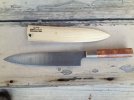
Karl, that is my concern with kitchen knives. I have the finer 3/16 inch Uncle Al dies in both straight ladder and chevron and the thinnest that I have ever pressed was a fairly stout 1/4 inch thick pre-form for this 240mm gyuto. I did a fair bit of "stock removal" to get the whole mess "de-ridged" and down to .100 after pressing as you might imagine.
 
Last edited:
Back
Top