Laminated woods

Joined
Jan 20, 2013
Messages
783
First off, this is one of my first times posting. My name is Joe. I've searched for answers but to no avail.
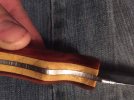
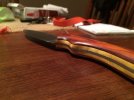
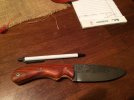
I laminated too woods, cocobolo and osage orange. I roughed them up and made them flat on a tile with 60 grit. Cleaned it with alcohol. I epoxied them together and let it cure for 24 hours. Epoxied them to my knife and shaped them sanded them yada yada. Well it's been 2 days and I'm noticing there is a slight gap between my laminated woods. I mean it's just enough that I can feel a bur.

My first question is what did I do wrong?

And second, what can I do to fix this? The headaches make it fun but dang...
 
Last edited:
Two things I can think of... one, you are seeing the glue line, the small admit of glue left over from joining the two. Or they could be separating. You did pick two particularly oily woods to try to join... I'm not sure that you can fix it. You might try hating them up with a steam bath, then popping them with a soft faced hammer. Then sand the epoxy off and try again. Maybe use a harsher degreaser, like acetone or something, then use alcohol to clean up the residue left by the acetone. Re glue and see what happens...
Somebody with more experience might come along with better advice though...
 
Two things I can think of... one, you are seeing the glue line, the small admit of glue left over from joining the two. Or they could be separating. You did pick two particularly oily woods to try to join... I'm not sure that you can fix it. You might try hating them up with a steam bath, then popping them with a soft faced hammer. Then sand the epoxy off and try again. Maybe use a harsher degreaser, like acetone or something, then use alcohol to clean up the residue left by the acetone. Re glue and see what happens...
Somebody with more experience might come along with better advice though...

I think they are pulling apart, could I super glue them. Just fill the gap then resand?
 
I like two wood handles:


I also think it sounds like a glue line. I don't use your method but would like to hear more about it. I cut pieces to fit, kind of like jigsaw pieces, then ad a layer of epoxy both between the join and on the inside of the scale as I attach it to the knife blank.


It figures, I've decided, that anything used to join them together needs it's own space and show, same reason it's important not to over clamp. Sometimes this is noticeable sometimes not as much.


No matter how fine or slowly I make two pieces to fit each other, this has happened.


If the woods are actually coming apart, I'd speculate the the moisture level in one the other or both is beginning to effect it. The woods may not have been dry, or one has started to swell with moisture. Is it getting worse with time?

Any chance of some pictures, it'
 
I think they are pulling apart, could I super glue them. Just fill the gap then resand?

Sorry, must have posted at the same time, if there is a definite gap I have filled it with epoxy and re-sanded before (I have also tried mixing wood dust in the gap with it band while it works it's never "hidden" the gap, just made a non clear patch)
 
I had some old wood I've had for 2 years in the shop, that's the cocobolo and osage. I ripped the osage to 1/8 sanded it down. Alcohol and then epoxied. It was flush snd pretty. I soaked it for 5 minutes in a thin poly then wiped it off, let it dry then buffed it by hand. Let that dry for a good while and repeated then waxed it twice.

Also. I know you can see my marks on my tang. I only have a shotty 1x30 that I only use for handle finishing and it scratches the tang. I try like heck to sand those marks out but I can't without making a ridge because the wood is softer. Any methods? Just order some high grit 1x30 belts for hitting my tang???
 
You need to wrap fine paper around a bar/dowel and sand to marks out.

Richard

Oh I like that. Oh that would work beautifully. Thank you so much. I've been fighting that for a while. That's the first knife I've posted and the third I've made.
 
I really like what you've come up with there, BTW, very nice! I just do the handles FYI, the blanks are by JK knives, kind of in awe of the skills aorudn these parts.

The gaps: It may be some shrinkage, although you've put a lot of effort into the preparation, or maybe exposed a looser clamp at the edges of the scales.

Tang marks: I've never tried the bar/dowel but I did use a pencil the same way once :) I like attaching a piece of fine paper on a piece of leather against a firm level table and running it the tang along that. Those tang marks kill me, longest single action of the process. I've had good luck getting them out with the 1 by 30 since though.
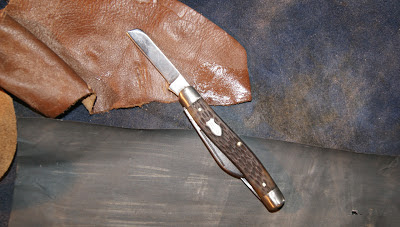
Don't have a picture of that but it's something like this:

DSC06589.JPG


sorry, I'm addicted to pictures.

Again, really nice knife you're making there, fella.
 
You didn't say much about your process for the glueup. I would use a hand plane to flatten wood before glueup unless it's really small. Sanding will work (planing is so much faster/cleaner) but I think 60 grit is pretty rough for a visible glue line. And then clamp the crap out of it. Even poorly flattened wood will glue tight if clamped properly.
 
You didn't say much about your process for the glueup. I would use a hand plane to flatten wood before glueup unless it's really small. Sanding will work (planing is so much faster/cleaner) but I think 60 grit is pretty rough for a visible glue line. And then clamp the crap out of it. Even poorly flattened wood will glue tight if clamped properly.

In the glue up, I made sure the pieces were flush and there was no visible light. A planer would be faster. I clamped it pretty well on a 1.5 inch thick table as my base so it was good and straight.

Why I still don't think it's a glue line problem is because it was smooth as a babies bottom last night and when I got off work today it has a slight little gap. Which was probably 18 hours? So I'm assuming it's moisture? But why? The environment hasn't changed or anything. Im concerned I'm doing something wrong. I want to know why so I can prevent it. Ya know?
 
My next thing is getting different hard woods and trying that. My pa and I are going to an exotic lumber shop tomorrow. So. Wish my luck! I guess I really need to figure out how to prevent the shrinkage expansion
 
Cocobolo takes a long time to season. I have read, and my own experience has agreed, that scales cut from typical turning timber squares will have significantly different moisture contents between the outside and inside of the square. Scales from the inside may shrink compared to those from the outside, if not given time to dry as scales. Drying time may be l...o...n...g, like cut to scales and leave indoors for a year or so.

Also, even in cocobolo, more shrinkage occurs with the rings than across them. Cutting so all shrinkage is perpendicular to the tang' flats will minimise the chance of feeling those gaps. Unfortunately having the rings parallel to the tangs face often shows off the grain best. :rolleyes:

It's no consolation, but I have had stuff like this happen when laminating Micarta handles!
 
Hi Viral. I'd love to see pics of your knife making in my forum if you're game. As to bonding wood to wood, expect movement. BUT, more than likely, you didn't achieve flatness. When you are flatening on your tile, blow off the scales and hold them together with light finger pressure. Hold them up to a light and try to see if you see any light getting through between the pieces. If you do, even just a bit at the corners, then you aren't flat. If you have to squeeze hard to get rid of the light, you aren't flat. Squeezing with clamps and glueing to remove gaps doesn't work.

Hint on flattening. FLATTEN THE CORRECT SIDE! One side of each piece will be cupped and the other bowed. You want to flatten the cupped side. (this might appear to be minor, but in reality it is big) Determine the correct side with this quick test. Do a couple of quick circular passes on each side of the piece. Look at the scratch pattern. If the scratches are concentrated in the center, then that side is the bowed side. If the scratches are around the perimeter, thats the cupped side. Always flatten the cupped side. It is much faster.
 
Don't use a power planer to prepare wood for gluing. They do not leave good surfaces, even when the blades are sharp. Ideally, saw straight and sand. I use 120g to finish, 60 to start. Paper must be glued down flat all over, not just laid on a flat surface unless you are happy cutting 1/2 inch off the edges of the scales. I only use a hand plane when my saw has wandered and I want to get it back to where it is easy to sand flat. The problem is that scale length wood is a bit small to sit a bench plane on and get an even cut end to end. Also, the plane you use for carpentry probably won't be set up to take fine shavings from hard, splintery, difficult grained knife handle wood (sharpness, angle, mouth size, flatness, lack of chatter).

If you want to be even more sure of flatness, sighting for light with a narrow straight edge which you move around over the surface will show up lack of flatness more readily than holding scale to scale. I usually use scale to scale, but the narrow edge will find imperfections better.

Definitely agree with flattening the cupped side being faster. Not always a situation I can achieve and maintain matched scales though.
 
Hi Viral. I'd love to see pics of your knife making in my forum if you're game. As to bonding wood to wood, expect movement. BUT, more than likely, you didn't achieve flatness. When you are flatening on your tile, blow off the scales and hold them together with light finger pressure. Hold them up to a light and try to see if you see any light getting through between the pieces. If you do, even just a bit at the corners, then you aren't flat. If you have to squeeze hard to get rid of the light, you aren't flat. Squeezing with clamps and glueing to remove gaps doesn't work.

Hint on flattening. FLATTEN THE CORRECT SIDE! One side of each piece will be cupped and the other bowed. You want to flatten the cupped side. (this might appear to be minor, but in reality it is big) Determine the correct side with this quick test. Do a couple of quick circular passes on each side of the piece. Look at the scratch pattern. If the scratches are concentrated in the center, then that side is the bowed side. If the scratches are around the perimeter, thats the cupped side. Always flatten the cupped side. It is much faster.

I will work on making an album and upload to your forum, i think the guys might enjoy it. I always make them flat and put them together and show no light. But, I'm a rookie so it may not have been. When your using matchbook sets, you can't really choose the cupped side can you? Or do you guys not really care if your matchbook set comes out perfect?

I got some mystery hardwoods from a place for $10 this weekend I'm really excited about. I believe one was is bocote and the other is mystery. I also got some quarter sawn oak which I think will be pretty cool.

Oak has kind of big pores I've noticed, is there a trick to finishing it?
 
Oh I like that. Oh that would work beautifully. Thank you so much. I've been fighting that for a while. That's the first knife I've posted and the third I've made.

You're right about bookmatched scaes. That would dictate the side you have to flatten. Mr. Claycomb is correct about keeping the saw cuts straight in the first place. Its much easier if you get the cuts right. We use a sled we made for the tablesaw, rather than the bandsaw, to do the cuts so this usually isn't an issue for us. I wouldn't risk this type of cut on a tablesaw without a lot of serious consideration though, its a very dangerous cut. Ken is a table saw guru and spent a lot of time coming up with a safer system for these cuts.

Now as to your wood score, be sure the wood is dry before using it. Most times when I get wood from odd sources, it is wet. For Oak, and other heavily poored woods sand to 220, then coat it with thick ca glue (it cures slower) and sand again with 220. The dust and the slurry of superglue will fill the poores. I don't leave any on the surface to 'finish' the piece. I don't like super glossy looking handles. When I'm done, I wax the handle with a good furniture wax.
 
You're right about bookmatched scaes. That would dictate the side you have to flatten. Mr. Claycomb is correct about keeping the saw cuts straight in the first place. Its much easier if you get the cuts right. We use a sled we made for the tablesaw, rather than the bandsaw, to do the cuts so this usually isn't an issue for us. I wouldn't risk this type of cut on a tablesaw without a lot of serious consideration though, its a very dangerous cut. Ken is a table saw guru and spent a lot of time coming up with a safer system for these cuts.

Now as to your wood score, be sure the wood is dry before using it. Most times when I get wood from odd sources, it is wet. For Oak, and other heavily poored woods sand to 220, then coat it with thick ca glue (it cures slower) and sand again with 220. The dust and the slurry of superglue will fill the poores. I don't leave any on the surface to 'finish' the piece. I don't like super glossy looking handles. When I'm done, I wax the handle with a good furniture wax.

Thank you for taking your time to reply. I really appreciate it. My neighbor does a lot of wood working and has helped me with cuts on his table saw. I recently got some Purple Heart 1/8. Most of the board is mostly straight but some of it is warped from how they stored it. Is there any way to fix this? Or am I pretty much screwed? It's flat, just has a Warp to it.

I'm still having trouble flattening my steel. I draw file and there's still some unevenness to it. When I notice it pre heat treat I'll heat it up and beat on it on a 1 inch thick piece of steel. That gets it mostly straight but I can't seem to get it perfect. It's starting to bug me, I spend most of my time screwing around with silly little things like that which I know should be an easy fix.
 
Back
Top