WI_Hedgehog
Basic Member
- Joined
- Apr 20, 2026
- Messages
- 19
I haven't seen a Lansky thread go active in a while, and Lansky stones are an affordable way to get a great edge compared to most home methods--at least for people not sharpening as a hobby. They're fast and affordable, not "$20 affordable," but "reasonably affordable." Well, "fast" is relative, if you want "sharp" they're "fast," if you want "WHOA! That's sharp!!" it takes longer.
I started with Lansky over 20 years ago when a friend introduced me to them--what an eye opener! He had the type of knife sharpness that was better than the factory put on the knife new. That's what I was looking for so I bought a 5-hone system and got great results for about the cost of what I considered a "really good" knife. A year later I wanted better results so added 1000 and 2000 grit polishing hones, but man it took a long time to get a "darn sharp" knife.
I learned about getting a burr though didn't fully understand it, at least not until somewhere around four years ago when I was sharpening other people's knives and it was taking for-ev-er. Figuring there had to be better methods than what I was using I learned what getting a burr really was, plus started stroking both directions instead of following the instructions and stroking only away from the blade edge (which is likely a safety thing, Lansky probably doesn't want fumble-fingers like myself getting hurt).
I bought a quality 10x jeweler's loupe and found I was having trouble getting the hone scratches out of the metal with the next progressively smaller grit, so focused on "using force" when starting the sharpening process until a burr was starting, then stroking (still both directions) progressively lighter until I was holding the knife vertically and barely touching it with the stone. Then I'd make 20 extremely light passes front-to-back of the knife instead of up-and-down and that really helped (Lansky doesn't exactly hold a tight angle and the rods bend slightly when putting pressure on them, so using a stone to get it's own scratches out is far easier than doing so with a less course stone).
Since it was taking several hours to sharpen one small "reasonably priced" knife I expanded the set to include Arkansas stones and figured out where to add them into the existing set by looking at the scratch pattern, and doing so shortened my time somewhat, but it still took two hours or more to get a mirror finish--but, it is a mirror finish where you can see features in the room clearly, just like looking in a mirror. For a while I used diamond stones, but the scratch pattern didn't work well with the other stones so they got sidelined. And...under a loupe you can see it's not really a "mirror finish," but to the naked eye it's amazing!!!
Granted, I think much of the excessive sharpening time comes from people using glass cutting boards instead of wood--doing so can fold a knife edge over in a hurry and require a fair amount of rework when they then keep using the knife and forcing it to cut (generally, back into the glass cutting board). And, sooner or later the same people will cut themselves with a knife I sharpened to "really, really sharp," no matter how much I warned them it is "really, really sharp."
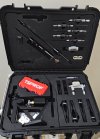
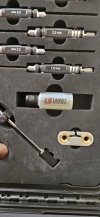
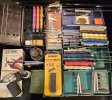
Here's the setup I've built up over the years, the diamond stones didn't get much use like I said but the others have and because I use oil to float away the filings when honing and the same oil to clean the stones after, they look and perform like new (mostly).
So if you're getting started and have a limited budget, Lansky might be a great way to get really, really good results. I'd suggest getting a $10 Chinese loupe also (they work "pretty well").
---
Note: I don't have any relationship with Lansky and the links are not affiliate links, nor do I sell anything knife-related, I just like "really, really sharp" knives and find sharpening relaxing. Are they "really, really sharp" compared to guys with far more expensive setups? Uh, no, Lansky won't hold super-tight angles and the knife edges--while sharp--won't whittle hair or do the other fancy stuff the "far more smarter" people do, and that's okay; and for about $80 you can impress others with your own self-smarts.

I started with Lansky over 20 years ago when a friend introduced me to them--what an eye opener! He had the type of knife sharpness that was better than the factory put on the knife new. That's what I was looking for so I bought a 5-hone system and got great results for about the cost of what I considered a "really good" knife. A year later I wanted better results so added 1000 and 2000 grit polishing hones, but man it took a long time to get a "darn sharp" knife.
I learned about getting a burr though didn't fully understand it, at least not until somewhere around four years ago when I was sharpening other people's knives and it was taking for-ev-er. Figuring there had to be better methods than what I was using I learned what getting a burr really was, plus started stroking both directions instead of following the instructions and stroking only away from the blade edge (which is likely a safety thing, Lansky probably doesn't want fumble-fingers like myself getting hurt).
I bought a quality 10x jeweler's loupe and found I was having trouble getting the hone scratches out of the metal with the next progressively smaller grit, so focused on "using force" when starting the sharpening process until a burr was starting, then stroking (still both directions) progressively lighter until I was holding the knife vertically and barely touching it with the stone. Then I'd make 20 extremely light passes front-to-back of the knife instead of up-and-down and that really helped (Lansky doesn't exactly hold a tight angle and the rods bend slightly when putting pressure on them, so using a stone to get it's own scratches out is far easier than doing so with a less course stone).
Since it was taking several hours to sharpen one small "reasonably priced" knife I expanded the set to include Arkansas stones and figured out where to add them into the existing set by looking at the scratch pattern, and doing so shortened my time somewhat, but it still took two hours or more to get a mirror finish--but, it is a mirror finish where you can see features in the room clearly, just like looking in a mirror. For a while I used diamond stones, but the scratch pattern didn't work well with the other stones so they got sidelined. And...under a loupe you can see it's not really a "mirror finish," but to the naked eye it's amazing!!!
Granted, I think much of the excessive sharpening time comes from people using glass cutting boards instead of wood--doing so can fold a knife edge over in a hurry and require a fair amount of rework when they then keep using the knife and forcing it to cut (generally, back into the glass cutting board). And, sooner or later the same people will cut themselves with a knife I sharpened to "really, really sharp," no matter how much I warned them it is "really, really sharp."
Here's the setup I've built up over the years, the diamond stones didn't get much use like I said but the others have and because I use oil to float away the filings when honing and the same oil to clean the stones after, they look and perform like new (mostly).
So if you're getting started and have a limited budget, Lansky might be a great way to get really, really good results. I'd suggest getting a $10 Chinese loupe also (they work "pretty well").
---
Note: I don't have any relationship with Lansky and the links are not affiliate links, nor do I sell anything knife-related, I just like "really, really sharp" knives and find sharpening relaxing. Are they "really, really sharp" compared to guys with far more expensive setups? Uh, no, Lansky won't hold super-tight angles and the knife edges--while sharp--won't whittle hair or do the other fancy stuff the "far more smarter" people do, and that's okay; and for about $80 you can impress others with your own self-smarts.
Last edited: