Lanyard tubes,,,flare or no,,,,

Joined
Apr 17, 2018
Messages
319
Just wondering how you guys like to install in your tubes. Are they put in straight, or do you flare the ends and countersink the holes? Thank you

 
I've only done it once on a knife but I prefer the looks of a flared tube.
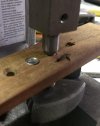
I cut the heads of two large screws and use them in a vice to flare
 
On the rare occasion I make a slab handle, I done both. But would not exactly call what I do a flared tube into a countersink, its slight taper thru the handle material and tube is drifted open accordingly. Results a slight hourglass profile.
Either way, end of the tube gets a radiused inside edge.
 
Last edited:
I prefer the flared tube ends, they just look better - to me anyway. Most of my lanyard tubes have been straight because I didn't have flaring ability. I just got the stuff together for flaring the tube ends. In fact, been working on that today with practice tubes. By annealing the brass tube before flaring I have less problem with cracks in flared cone.
 
My problem with flared tubes is that they either have to be recessed or you have to have a flat spot on your handle scale at that point. I don't like either option.
 
You're right, a heavy curve in the handle does prevent the use of a flare, but a slight curve with a flare still works. If the curve gets too much even a straight tube doesn't look right to me. With a heavy curve perhaps the best bet is the hidden lanyard from butt in tang?
 
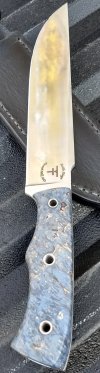
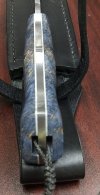
Or make it an extra feature

IMG-20180913-111042.jpg
 
I have done it both ways and prefer the ease of flush finish but flared makes a better mechanical attachment and smoother concave hole for lanyard.
 
You don't need dies and presses to flare tubing. It can be done with sharply tapered punches or rounded dapping punches.
cut tubing 1/8" longer than necessary. Place in handle hole with reverse side on anvil. Shape first side. Turn the knife over and do the same thing. It may take a couple of turns for it to tighten up. Then grind/file flush.
 
Can anyone provide a WIP of this procedure? I’m wanting to do the same thing…I know this is an old thread but I’m reviving it.
I found my old youtube video but it's not great, do this.


-Get scales ready for glueup, do 82 degree countersink on each hole to roughly 1/8" depth. (hole should look right, not massive) 1/4" thin wall seamless tube pin

-Glue up as normal paying extra attention to pin area so no glue squirts out in countersink (clean up with razor or dental pick if some does set up there)

- sand tubes flush with scales at roughly final; thickness to at least 220-400 so the pin looks nice, you can very lightly chamfer the pin now but just touch it

- use flaring jig to flare pins maybe 1/3 way, flip, 1/3 more, flip and finish

- finish scale very carefully


The other option is to superglue the tube in at a near finished stage, make sure it is well centered then flare. This is tricky to get right but how most of them are done in a factory... with or without the superglue.

Things I have tried - wooden pins, drill out and chamfer a bit more, this will bypass any glueup issues with glue in the countersink

Deeper holes so I have more room for finishing - works OKish but hard to get right

No superglue/pin glue up - hard to center pin but doable with practice, good for a large group
 
Last edited:
You don't need dies and presses to flare tubing. It can be done with sharply tapered punches or rounded dapping punches.
cut tubing 1/8" longer than necessary. Place in handle hole with reverse side on anvil. Shape first side. Turn the knife over and do the same thing. It may take a couple of turns for it to tighten up. Then grind/file flush.
This is basically what I did the last time I flared a tube and it worked great. I mounted one large center punch in my vise and set one side of the tube in it and used an equal sized center punch to drive into the other side. I flipped back and forth every couple of hammer strikes then tore some thin strips of emery cloth to polish out the tube using a shoe shine motion after I had filed it flush. I did that on a handle that was about 90% complete and had no issues.
 
Back
Top