Latest Bowie

I think you are right about the colors on the handle wrap being better than all black.

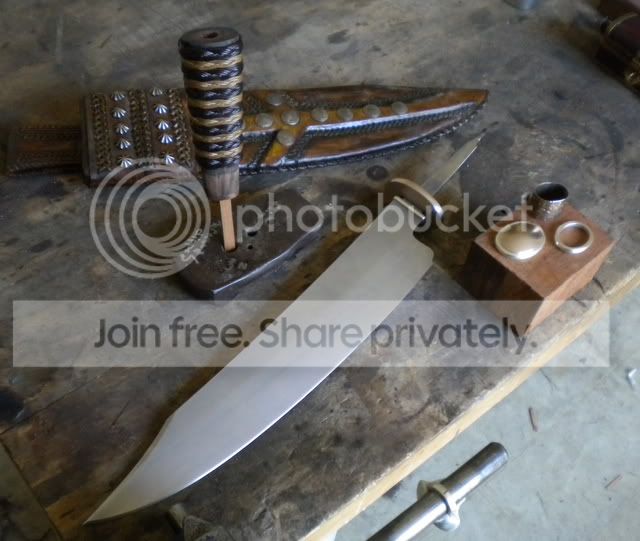
Funny how that worked out, but it kind of goes along with a new approach I’ve been experimenting with… working the knife (and looking at it) more as a whole. I almost always used to start with the blade, and work towards the back,... guard, handle, end piece,… and sheath last, if any. Lately, on some I start with the handle, hold off on heat treating the blade until after all the parts are made etc., and try to work it more as a whole than parts put together. It allows me to make minor changes to the overall composition which can really add up.

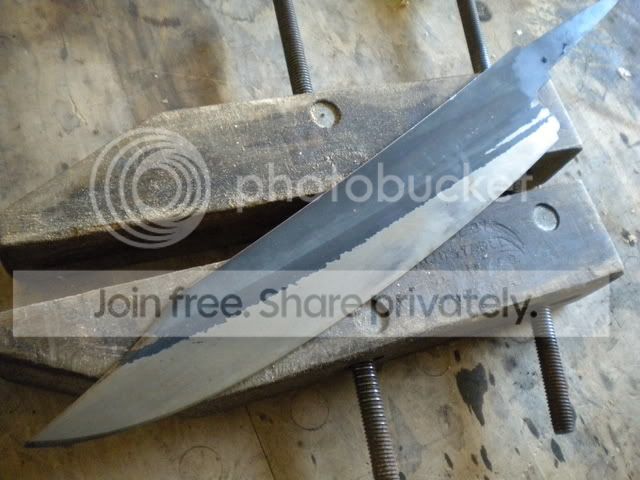
Another example with the wrappings on this one ( beside the colors of the sheath) is, once I saw the “rhythm” in the quench line (perpendicular to the main quench lines, or length of the knife), I decided to go with a smaller diameter cord for the wrapping, and use a higher contrast in color/hue than originally planned,... to carry the rhythm and “music“ through to the end. That all just came together for me.

… very mathematical and geometric, cold and calculated in composition, but still retaining a warm “human” quality. Obliviously a lot of thought and labor went into it,… but it still looks natural and effortless, which is what I wanted.

Much like composing a song,... with division of time, accents, breaks and melodies etc.
 
Last edited:
Thanks Pat. :)

The really big question is,… how much of the aesthetics of it came about through intention, and how much of it was just a natural inherent expression of beauty found everywhere in nature?
 
The really big question is,… how much of the aesthetics of it came about through intention, and how much of it was just a natural inherent expression of beauty found everywhere in nature?

Depends on your inherent talent I think. For example, in your case, I think intention is a big part of it. On the other hand, for the less artistically talented folks like me, it surely must comes from somewhere else. ;)
 
Patrice Lemée;10600473 said:
Depends on your inherent talent I think. For example, in your case, I think intention is a big part of it. On the other hand, for the less artistically talented folks like me, it surely must comes from somewhere else. ;)

This might sound weird but,... maybe it's more like "channeling the beauty" that is already there... just need to see it, be aware of it and appreciate it. :)

It has more to do with the inside part which is out of view,… not like the surface of an object.. don't put too much emphasis on the surface… make it “pretty on the inside“. :)
 
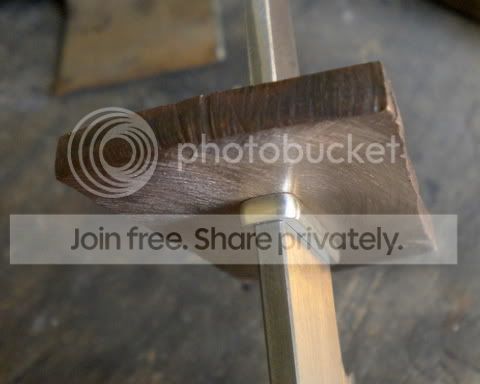
A few more WIP pix.

DSCN2660.jpg


DSCN2670.jpg


DSCN2721.jpg


DSCN3315.jpg
 
Wow Tai. Great as usual.

For those who have not seen one of his Rainbow Bowies in person, no picture can even come close to capturing all the subtleties on the blade. Tai brings out all the refractions and colors with his polishing process. Exquisite is an understatement.
 
Thanks.

Chuck, I didn't actually "sand" any of it past 150 grit paper, but used etching, subtle patina, powder abrasives and soft backed abrasives, like abrasive pads, steel wood etc., to bring up the luster and finish. It goes along with what I was saying a while back about leaving "process markings". You can see all the "scratches" in the finished piece. It also gets away from the old standard that all the scratches should run in the same direction and be of the same grit. On this piece scratches intersect in different grits and run across each other in numerous directions and angles. It does something to the way it catches and reflects light from different angles etc. Working the surface this way is really more of a psychological challenge than a physical one.

... I actually used some orbital hand sanding on the top and bottom of the guard where straight lines just didn't look natural.
 
Last edited:
Back
Top