latest sharp implement

Joined
Feb 13, 2005
Messages
295
500453416_870888b8a2.jpg


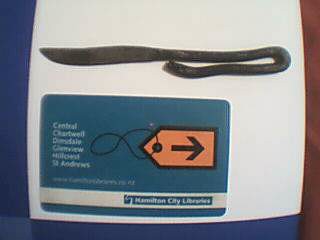
Wasn't sure if this can even be called a knife, so stuck with the term Sharp implement. :rolleyes:

This is made for one purpose only, to sit in the rear storage compartment of the 4wd farm bike so theres always a sharp object handy when out the back of the farm and need something to cut with, but Murphy intervened and ensured the EDC pocketknife or the genera purpose farm knife has been left in the shed or on the table several Km away up and down hills and through muddy bogholes. :jerkit: Murphy can be a real asshole sometimes.

made from a length of chainsaw sharpening file (mystery metal) which had the handle spike snap off, heated in the wood fire, normalised once then brought back up to temp till the shadows in the steel settled down and dissapeared, then water quenched in 30 gallons of cold chilly rainwater. tempered by sticking it in the oven at 350*F as dinner and some bread cooked. It's probable that it's almost untempered, being low temper temps for less than an hour and a half.
 
Some more info now it's been cleaned up and sharpened.

Blade 2" long, overall length 4.5" Blade thickness 1/16" blade depth 5/16"

Made from Sthil 3/16" round file, the library card size reference in the above picture is the same size as a standard credit card.


I'm thinking of using a 5/16" Sachs/Dolmar round file from the previous chainsaw to make a filleting knife now, another mystery metal but still good fun hammering on hot metal. :D
 
You know you could make yourself a one brick forge to give that thing a proper heat treat, or at least attempt one.

When I started and wanted to do my own HT I got 2 mapp gas torches and figured out that I could ht a 3.5-4 inch long blade depending on the design.

Now I send things off to Paul Bos.;)
 
As far as one brick forges go, I'd need to source the bricks, and I haven't managed to find any even from farrier supplies. No idea where the farriers manage to source their horseshoe forge supplies from but it's not from any of the farrier supply places I've found, and importing stuff from the US to NZ is not really worth it when a properly drawing wood fire produces enough hot coals and charcoal to manage the job.
The wood burner can get the steel up to whiteish orange-yellow, just not quite able to weld, i've tried welding some cable, some strands managed to fuse, most didn't. But it's more than enough to shape metal. More of a pain is the lack of a grinder so theres a lot of work involved with files.

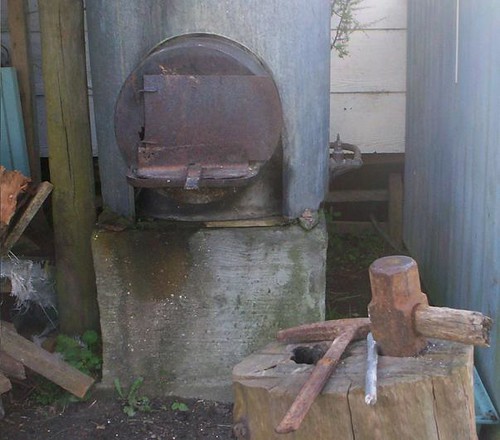
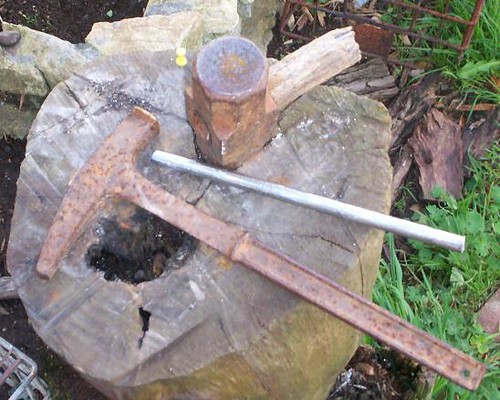
Heres a couple of pictures of my "forge" and "anvil" setup.

501665652_a09ca30d6f.jpg


The fire is a wood burning Marshall heater with a 1" hollow water skin around the firebox, and the fire cavity extending into the water storage cylinder, the chimney runs up the middle of the water cylinder and exits up the top. We can heat the water enough that it boils out the relief valve. More than hot enough to run straight out a tap and through a hose in the window to scald and scrape a pig hung outside. :D

501665654_163a759f4b.jpg


The Anvil is an old hammer head slotted home in a socket carved and drilled in the end of a log of kanuka firewood, the hammer is an old geologists spike hammer with the spike ground and rounded to a peen, and the other end refaced to a even slightly convex face.

the bar between the hammer and the anvil is a length of 12" x 1/2" high tensile carbon steel bolt I ground the galvanising, thread and head off to form a 9.5" x 1/2". formerly a high-stress house piling structural bolt that was part of the foundations of this house when it was 70 miles away :D this farm was bare land, so we shifted the house here to have somewhere to live in :P
 
Man, I heard you Kiwi guys were tough, but I had no idea!

Nice job and an inspiration to us with not many tools:p

Actually, you can do quite nicely with a charcoal forge. You probably already know how to make it, right? A little blower and a top, and it will weld.

Mike
 
made a charcoal forge, Used a cheap vacuum cleaner with a hose exhaust port, just remove hose from front end, slot in back end and duct tape to steel pipe with a tap in it :D then rig that into a clay lined steel wheel rim.

But when it comes to making charcoal, why not just use the fire you're buring the wood to make the charcoal in? :D the only difference here with burnign wood to form charcoal and burning wood to form high temp hot coals is how fast the draught is, eith locked down tight for next to no air, or the damper off and a fast hard draught with plenty of air producing hot coals.

Besides, it provides lots of hot water to go have a bath and get rid of the sweat and grime afterwards with no hot water electric bill.

Our electricity bill is less than a third of our neighbours due to having hot water radiators hooked up to the marshall heater instead of expensive to run oil fin radiators. Just a small pump and fan instead of big heating elements. add to that cuttign wood warms you up as well :D then theres no hot water electric cylinder costs :p
 
As far as one brick forges go, I'd need to source the bricks, and I haven't managed to find any even from farrier supplies. No idea where the farriers manage to source their horseshoe forge supplies from but it's not from any of the farrier supply places I've found,

Link for Online NZ yellow pages listings of Pottery Supplies in Waikato & King Country

http://yellowpages.co.nz/Pages/Sear...Pottery+&+Supplies&keyword=&pageNum=1&street=

Knife making supplies can be either available from specialized dealers or from other industries.
I have posted a link for the type of suppliers in your end of the world that may help you.
Jump on the telephone and see what you find


There are both hard and soft firebricks
Hard firebrick is for applications from 1000F (fireplaces and woodstoves) to 3000 F (foundry applications), Lightweight, insulating firebrick rated to 2800F.

Even if you don’t build a separate forge, you can stack the bricks on the top of your charcoal fire to create a little oven to hold in the heat. You may be able to reach welding temperature then

The bricks used in the one brick forge are – Soft firebricks or insulating firebricks IFB
They are very lightweight

The name brand I have found here in Canada is
Thermal Ceramics' K23 brick is the standard used by most kiln manufacturers.
It can be found in pottery-Ceramic supply stores to replace broken bricks in a kiln.
R23IT K23 4.5" x 9" x 2.5". $3.52/ea

R23IX K23 4.5" x 9" x 3" $5.26/ea


Others are

Manufacturers & Brand Names:
Clayburn Refractories; Flame & Skagit-X
Chicago-Wellsville Co.; Mo-Flint & Duralite
Thermal Ceramics; K-23 & K-28


Steve
 
Cheers steve, rung around those places, but no luck, they're all either potters or ceramic art galleries who use either a backyard kiln, or a co-op society kiln, both of which are huntly firebrick structures. Big hefty heavy solid bricks made with clay from the coal mine surrounds.


Anyhow, i managed to get my latest plaything up to the point at which it just needs drilling for pins, HT'ing, finishing work and a handle installed. But before oing the HT i decided to flatten out and quench a scrap bit of the bolt shaft to see how well it responds to HT. Using an angle grinder supplies sparks nice and fat like 5160 does, but the water quenched scrap acted like tempered spring steel rather than brittle untempered high carbon steel.

I'd suspect from the reading that the steel is between 20 and 40 points carbon, too low to harden sufficiently for making a blade... so now I have a nice bit of mild steel. Good practice hammering it out of 1/2" round bar, and theres another unfiled blade blank from the same bolt shaft...
All that work and fun and no knife to show for it. I'll just have to scrounge a JD control shaft and start flattening that :D
 
Back
Top