Leather sheaths

JGguns

Hobbyist here to learn
Joined
Nov 15, 2009
Messages
407
Well I am ordering the sheath making DVD from the wild rose. I have bought some of the basic hand tools as well. Im wondering what weight you guys recommend? Also is there certain brand dyes that are better than others? I know I am jumping the gun alittle by asking this before the DVDs get here. But I really want to have all my materials ready so I can give it a shit right away. I'm really excited to try my hand at this. I think it's something I will enjoy very much.

And lastly would anyone be will to sell me a few sq ft of lether to have some to try out. I really don't want to go out an buy a shoulder right away without at least trying it out. If someone can spare a few ft to sell please email or pm. Thanks for the help fellas.

Post some pics of your sheaths for inspiration!
 
Last edited:
You can get some leather from Tandy or USA Knifemakers. Think it's around 8oz. You can get it in 12x12 or 12x24 sheets. Fiebing's dyes are very good and available from Tandy and many other places. That DVD is a very good dvd.
 
I like 7-8 oz. leather the best. The thicker stuff works but is hard to work with. If you only want a small piece find a local Tandy Leather and stop by. They usually have some smaller pieces and even remnants for cheap.

For dye I prefer Fieblings oil on my sheaths and I also use Fieblings alcohol based dye. I also will use an antiquing gel for details. I started with eco-flo and I couldn't get consistent results so I don't use it any more.

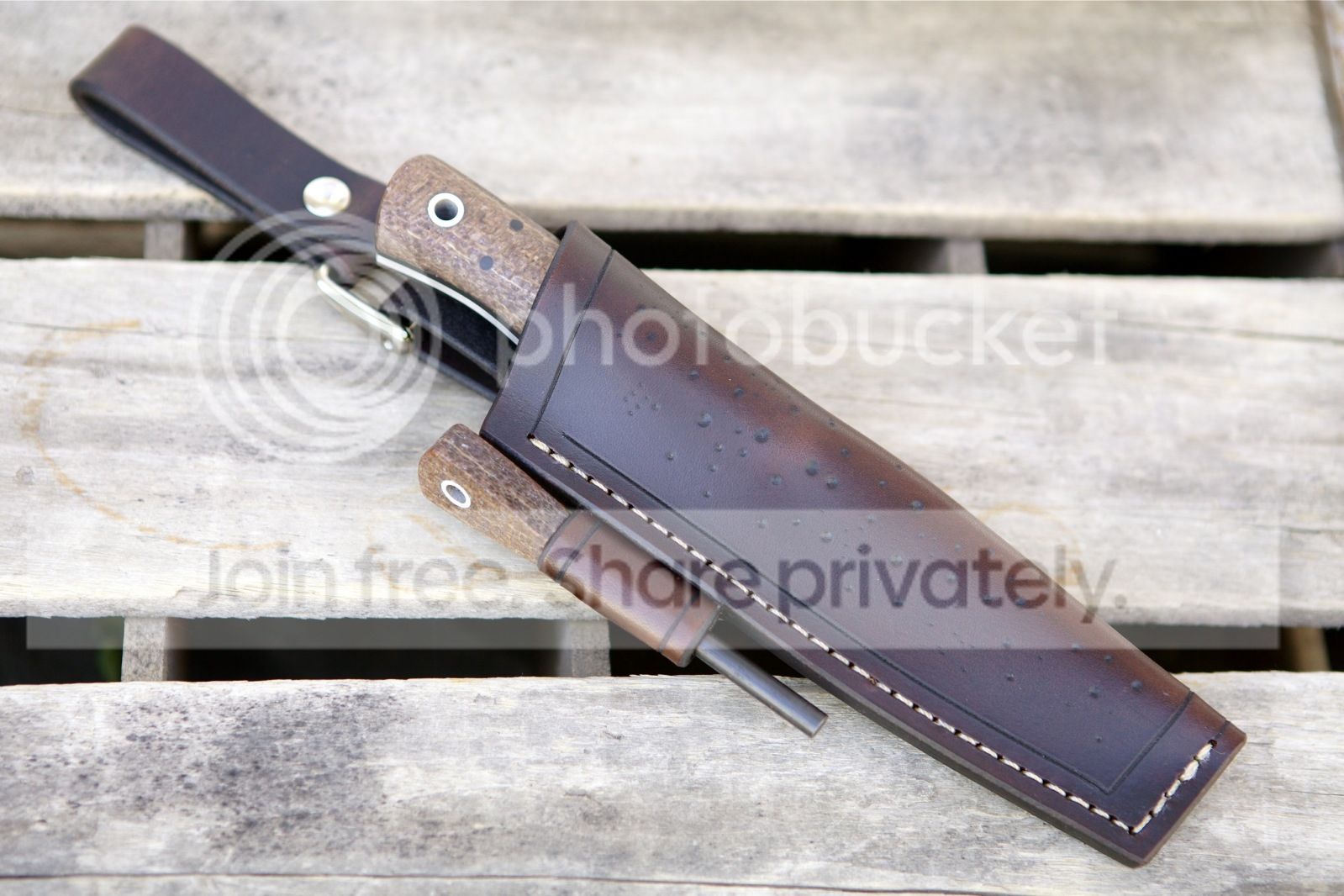
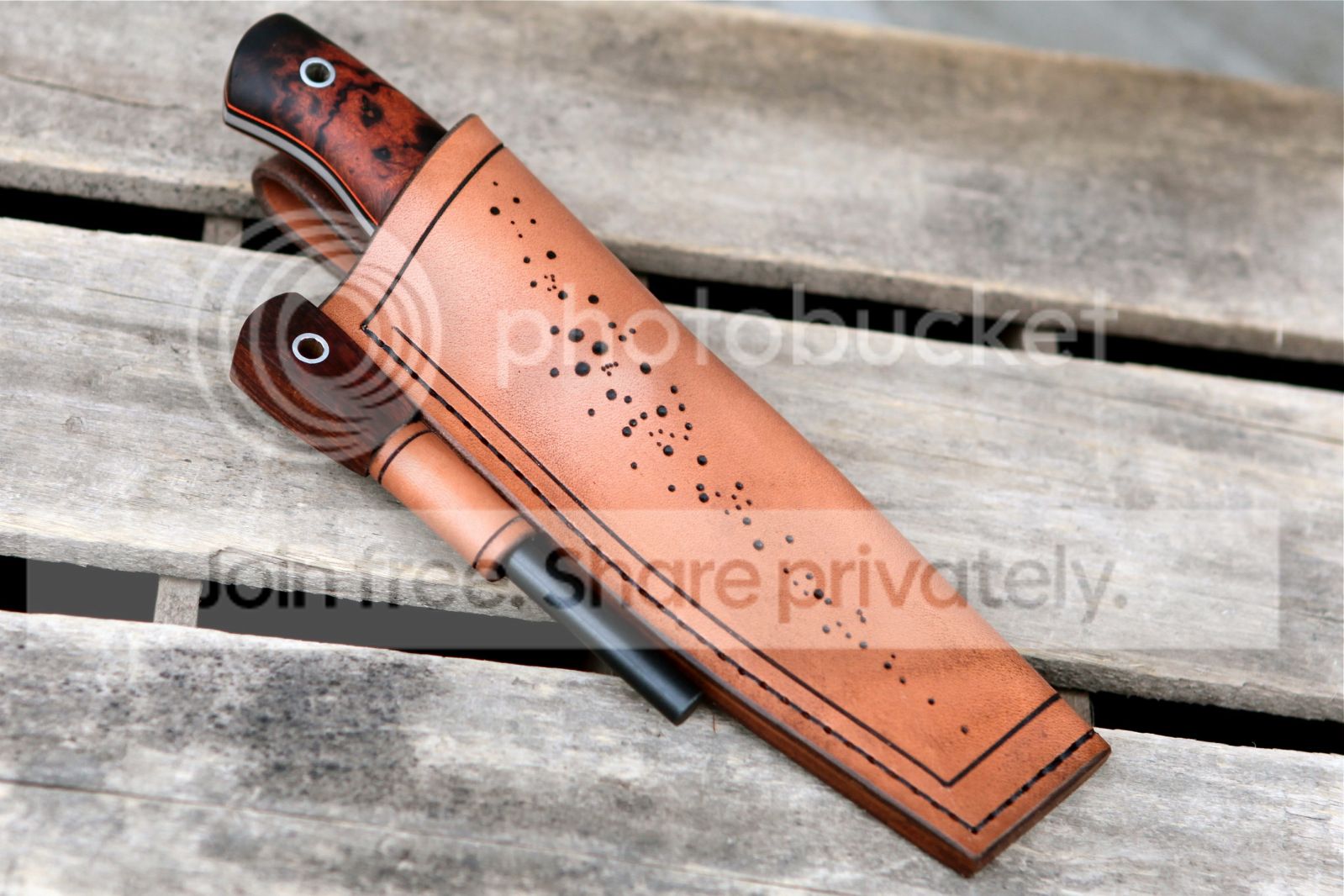
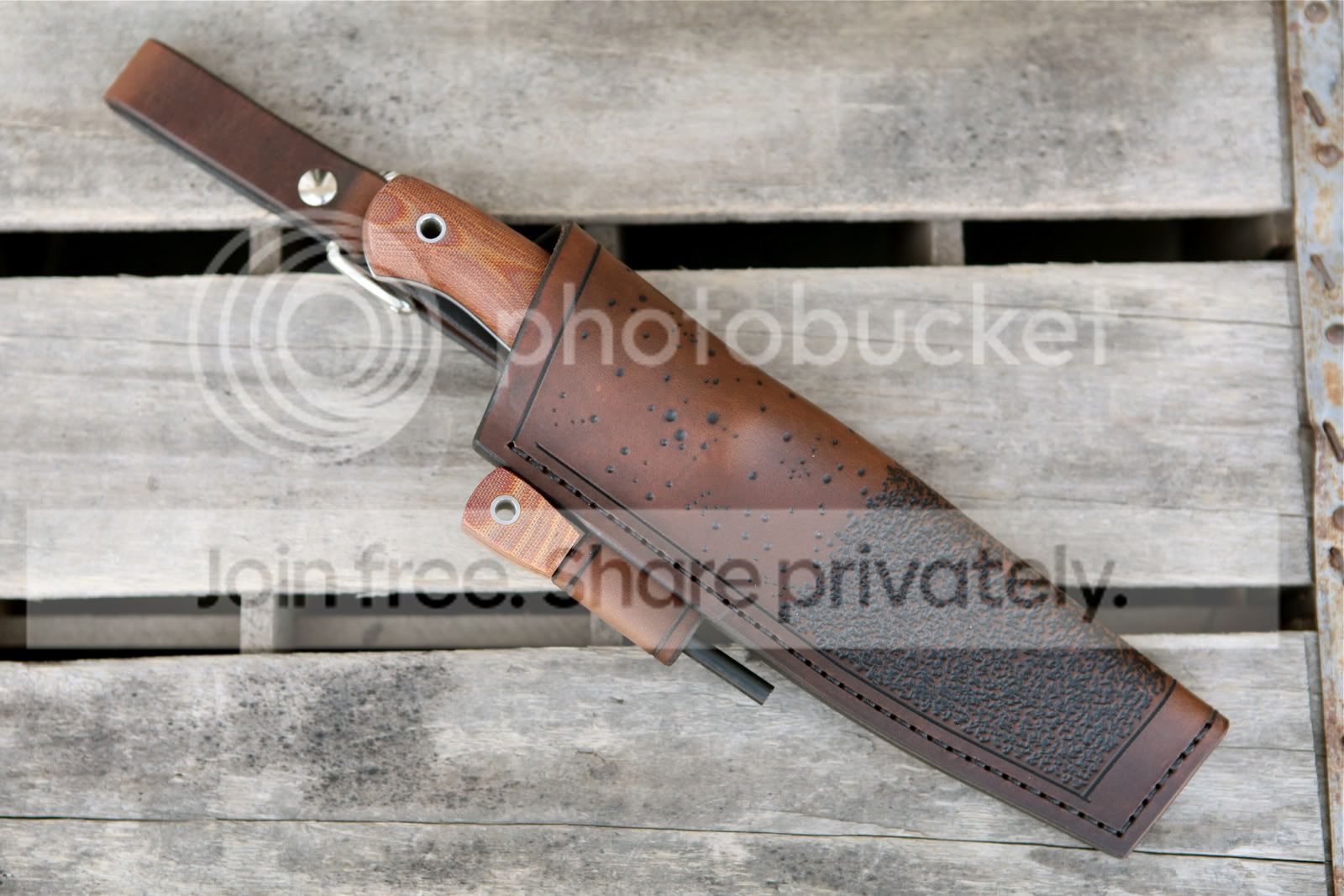
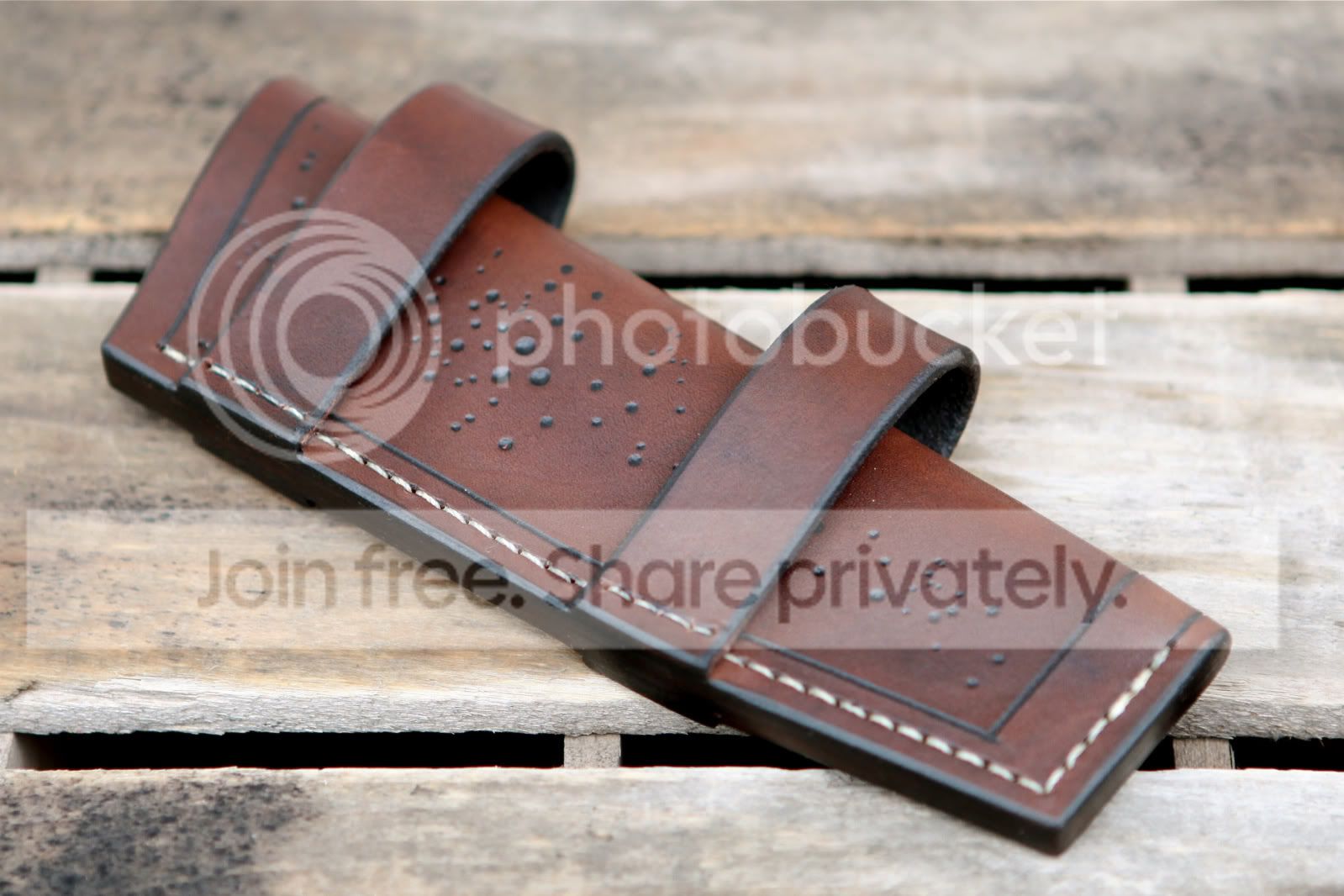
Here are a few pics.

bbda55d2.jpg


4564f6db.jpg


This picture is hard to post because the whole setup was "lost" in the USPS system somewhere. I'm sure some slimeball is really enjoying his free knife.
673229a4.jpg


c0134879.jpg
 
Great decision to buy the Wild Rose videos. Chuck does an amazing job and is a natural feature. My sheath making skill jumped by 200% easily after just watching them through a few times.

--nathan
 
I like 9-10 oz. leather, I've worked a fair amount with lighter but 9-10 is just good and solid. It can be skived thinner for welts and such. Fiebing's oil dyes are good as mentioned above. I use some Eco-flo too, I see that several people find it inconsistent but if you adjust your method to it, it comes out even and looks nice. It applies best to lightly cased leather, with a small sponge, and should be wiped on quickly and evenly. Several passes should yield an even, fully dyed color.

Don't underestimate your belt grinder as a leather working machine. They work well for trimming edges even, polishing and beveling edges, even skiving in a pinch. Just use sharp belts and low speed.

When you get to buying a bigger chunk of hide, I recommend Springfield Leather online. I got some Hermann Oak 9-10 utility leather from them recently, it's very nice stuff and was priced right. Unlike some of the other good leather merchants, they will sell you any size from 2 sq. ft up to full sides. Friendly people too.
 
I didn't know they would sell smaller pieces. I need to give them a call. Thank you sir

I like 9-10 oz. leather, I've worked a fair amount with lighter but 9-10 is just good and solid. It can be skived thinner for welts and such. Fiebing's oil dyes are good as mentioned above. I use some Eco-flo too, I see that several people find it inconsistent but if you adjust your method to it, it comes out even and looks nice. It applies best to lightly cased leather, with a small sponge, and should be wiped on quickly and evenly. Several passes should yield an even, fully dyed color.

Don't underestimate your belt grinder as a leather working machine. They work well for trimming edges even, polishing and beveling edges, even skiving in a pinch. Just use sharp belts and low speed.

When you get to buying a bigger chunk of hide, I recommend Springfield Leather online. I got some Hermann Oak 9-10 utility leather from them recently, it's very nice stuff and was priced right. Unlike some of the other good leather merchants, they will sell you any size from 2 sq. ft up to full sides. Friendly people too.
 
I typed a long reply and lost it when I hit the "Reply to Thread" button.

I recommend Fiebing's professional leather dye. The "regular" Fiebings dyes are also very good, if the color is not available in the oil based dye. I had poor luck with Eco-flo and will never try it again.

You will want to get some thread in advance. The most economical way (for quality) is to purchase Barbours Pure Flax Sinew, size 5, Natural color. Left or right hand twist will do for hand stitching. It can be purchased at Campbell Bosworth Machinery Co. It is a bit pricey, but will last for many sheaths. LINK HERE

You will need some kind of wax to lube your stitching thread. If you follow Chuck's recipe, you can get the pine tar and bees wax in bulk (and much more cost efficient) from Jas. Townsend and Son, Inc.

Al Stohman's book "The Art of Hand Sewing Leather" is invaluable. It can be purchased at Tandy.

Good luck,

Mike LoGiudice
 
If you have a sales tax license for a business, such as you'd need to sell at craft fairs and farmers markets, you can get a wholesale membership with Tandy. It's about half price, pretty awesome.
 
Al Stohman's book "The Art of Hand Sewing Leather" is invaluable. It can be purchased at Tandy.

I agree it's useful.

I was disappointed after I bought it though.

I paid $17 (yes as Canadians we get hosed).
It's a 72 page folded booklet with a stapled spine.

See if you can get it at a library, or tey one of the free ebooks before you outright buy it.
It's been around for a long time and there should be lots of chances to find it.

Tandy at half price? that makes their prices more sensible, otherwise they just seem high for what you get.
 
Thanks for the help folks. I got Chris Crawford basic pouch sheaths in a trade. I am gonna watch ur tonight and hopefully try my hand tomorrow at making a leather sheath.
 
I like waxed nylon thread better than natural fiber thread. It's stronger, which is nice if you've ever broken a thread halfway through a seam, and can be melted to finish after cutting. It comes in a bunch of colors, I just use white and black. If you buy thread at Tandy or several other places, you'll pay too much. Here's a link to a thread retailer with good prices on .020 waxed nylon thread tubes if you want to stock up. It's what I use.

http://www.thethreadexchange.com/miva/merchant.mvc?Screen=CTGY&Store_Code=TTE&Category_Code=waxed-thread-size-207

ETA: Poly and nylon are interchangeable in this size. Same characteristics.
 
Last edited:
Hey guys is the little grooving tool needed for make nice stitch lines or does it just make it easier?

Thanks for the heads up Salem. I have some I bought from a hobby lobby but when it runs out I will definitely look there!

I like waxed nylon thread better than natural fiber thread. It's stronger, which is nice if you've ever broken a thread halfway through a seam, and can be melted to finish after cutting. It comes in a bunch of colors, I just use white and black. If you buy thread at Tandy or several other places, you'll pay too much. Here's a link to a thread retailer with good prices on .020 waxed nylon thread tubes if you want to stock up. It's what I use.

http://www.thethreadexchange.com/miva/merchant.mvc?Screen=CTGY&Store_Code=TTE&Category_Code=waxed-thread-size-207

ETA: Poly and nylon are interchangeable in this size. Same characteristics.
 
You don't "need" it but it makes it easier to get a straight stitch and leaves a cleaner look in the end.

Hey guys is the little grooving tool needed for make nice stitch lines or does it just make it easier?

Thanks for the heads up Salem. I have some I bought from a hobby lobby but when it runs out I will definitely look there!
 
That, and your stitches will sit flush with the surface of the sheath, and so will wear out much more slowly. A stitch spacing wheel or spacing punches help a lot in tandem with the groover.
 
One thing you can do if you have a set of dividers is use those to trace out your line so you have the proper spacing from the edge. Then if you have any available a piece of stainless steel rod or bar shaped to form a push beveler of sorts then you can wet the leather slightly and use this push beveler to form the groove, kind of like wet forming the groove.

Now however the spacing of the threads (where you will punch your holes) will be much easier and quicker with a wheel, however you can take your wing divider and shorten it to the proper length and scissor walk it along on the groove you have made. Does basically the same thing as the wheel just takes longer.

Oh and just to add about thread, good linen like barbours that is properly waxed will last just as long or longer then the leather project you use it on. I personally think it holds better then nylon when hand stitching. If I could afford a machine that could actually use linen thread I would, just needle and awl machines are mighty pricey and take a while to get a hang of.
 
It's a bit of a tradeoff. Waxed linen has lower stretch than nylon, but also lower breaking strain. Good points about the dividers.
 
Back
Top