let the fun begin!!!

Joined
Feb 18, 2016
Messages
2,209
just ordered some 1095 from Texas knife supply for only 8 bucks, granted it's only 12 in so in theory I can make 2 6in knives with it. but I'm just excited that my first piece of steel is on the way. and Darrin Sanders already said he would do the heat treat so that's not something I'm concerned about.
 
The excitement is good, but don't let it push you to make mistakes.

Make a plan - write it down - check it as you go.

Read the tutorials on making a first knife ( there is one in the stickys).

Take your time. Rushing to finish the knife in a day is the ruin of most first knives. Shoot for a week. Also, do only one knife at a time in the beginning. No point in making the same mistake multiple times.

Plan each step. Consider what materials and supplies you will need, how you are going to do that step, and when/how you will know it is finished.

Keep it simple. A first knife should be as simple as possible. A drop point hunter with a 3" blade and a 4" handle is perfect. A first knife is all about edge and handle. Guards, fancy shapes, whistles and bells, etc. can all wait for knife #10.

Don't limit the knife to the bar of steel. The tendency is to take the bar and make a knife out of that shape. This often ends in what I call a "sharpened bar of steel" look. If you only use 7" of the bar, so be it. Some time you will use the other 5". If the knife is curved, or less wide than the bar ... that is a good thing. New makers seem to feel they are wasting the steel, but actually, the steel is usually the cheapest part of the knife.

Draw a sketch of the knife you want to make on graph paper. Then trace the bar of steel shape around it. That will show you what you need to remove from the bar to get the knife. Draw that shape on the actual bar of steel. Many people reduce the sketch and glue it right on the steel bar.

Tip- The white paint type metal markers are the best for drawing on the steel. They stay on a long time ( even through HT), and are very visible. Places like Fastenal carry them, as does K-Mart and most craft stores. Also, write the steel type in the tang with one of these markers when sending the blade out for HT. Put your name or initials on the other side. Mark all bars of steel and cut off pieces with the marker to identify them later on. Do this immediately when you receive the steel and when you cut a piece off. Every smith who has been around a while has a pile of steel he doesn't know what it is because he was going to "mark it later".

Do all the steps fully . Don't skip ahead or say, "That's good enough".

Post your plan and photos of your progress here so others can help you fine tune any things that may cause problems later.

Make any detail or accent features last thing after the bevels and shape are done. Jimping, choils, tang holes, finger grooves, etc. These may need to be moved as you shape the handle and bevels. If you cut them in too soon, they may end up in the wrong place. These items are done last thing before HT.

 
Stacy, that post should be a READ IT BEFORE START in everything, not only in knifes!

Nothing to add..
 
I agree, that is very good advise. It's good to be reminded, even if it's not about knife #1. It's very easy to get ahead of yourself and screw things up - just by excitement. ;)
 
thank you stacey for that info I do appreciate it. so since this is my first knife should I just use files or is it safe to use my 4.5in angle grinder with some flap disks?
wU4YUS.jpg

this is my design debating if I want to do wood handles or just wrap is in leather and epoxy.
 
I think your design lends itself more to handle scales than a wrap--so I would vote for wood--or perhaps Micarta or other synthetic..but definitely handle scales!
IMO you can use your angle grinder, just be careful and go slow, you can make the large cuts and get close to your pattern outline with it, and I would go to files for creating the bevels.

Good luck! it's an addictive journey!
 
I think your design lends itself more to handle scales than a wrap--so I would vote for wood--or perhaps Micarta or other synthetic..but definitely handle scales!
IMO you can use your angle grinder, just be careful and go slow, you can make the large cuts and get close to your pattern outline with it, and I would go to files for creating the bevels.

Good luck! it's an addictive journey!
ok awesome thank you for the advice!
 
I don't mind wrapped handles as I have a line of knives I wrap. But I think the knife has to be designed for being wrapped. I don't like the epoxy look, looks just off and yuck. Guess it just looks lazy to me, like you did not want to spend the time to do a proper handle so You just wrapped a cord around it and slapped on some epoxy. But that being said there are some very good looking wrapped handled knives out there. On your design I would just use 2 pins in the handle scales. Nothing wrong with more but 2 is what's needed and any more then that is setting your self up for lots more work and for your first knife I say go simple.
 
I don't mind wrapped handles as I have a line of knives I wrap. But I think the knife has to be designed for being wrapped. I don't like the epoxy look, looks just off and yuck. Guess it just looks lazy to me, like you did not want to spend the time to do a proper handle so You just wrapped a cord around it and slapped on some epoxy. But that being said there are some very good looking wrapped handled knives out there. On your design I would just use 2 pins in the handle scales. Nothing wrong with more but 2 is what's needed and any more then that is setting your self up for lots more work and for your first knife I say go simple.

ok I can dig it. that makes since. wood or mircata it is. thanks gents
 
. I don't like the epoxy look, looks just off and yuck. Guess it just looks lazy to me, like you did not want to spend the time to do a proper handle so You just wrapped a cord around it and slapped on some epoxy. But that being said there are some very good looking wrapped handled knives out there.

You must be looking in the wrong places. When you see the wrapped epoxy handles of Ben Tendick, Matt Gregory and others the last thing you think of is yuck :)


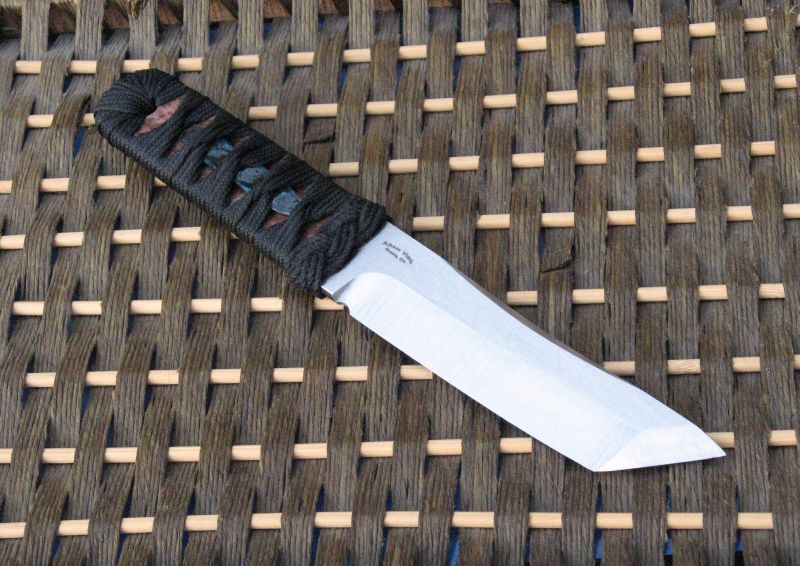
Here humbing is one of my wrapped expoxy handles


W4zspiI.jpg
 
That does not have the epoxy look, it looks great. What I mean is the wrap where you can see the layer of epoxy just gooped on.
 
Last edited:
That does not have the epoxy look, it looks great. What I mean is the wrap where you can see the layer of epoxy just gooped on.

Thanks,

When it is goopy it simply is because they do not know how to do it correctly :)
 
Yeah I guess that's true, sorry I did not mean to affend anyone. The ones I'm referring to are where it's just wrapped around like a spool and coated with epoxy.
 
Yeah I guess that's true, sorry I did not mean to affend anyone. The ones I'm referring to are where it's just wrapped around like a spool and coated with epoxy.

No, I understand and in fact some people do not even realize it is impregnated with epoxy.

I just did not want someone reading this to get the wrong impression.
 
That one BTW is owned by Joe Paranee and he climbs trees with it, soaks it in water and all kinds of manly shit in his hunting adventures.

Still looks brand new :)

That is how tough and clean those impregnated handles can be. I have see some after 30 years of outdoor use still look almost brand new.
 
Your design is a bit too curvy.
Make a 7" straight line on some paper. Make a mark 1/4" above the center. Draw an arc from the ends through the mark. This will give you a slightly curved line.
Use that line for the spine of the knife (tip to handle butt). Now draw the blade edge, and lastly draw the handle bottom. You can make the blade spine straight, but have the handle curve down slightly.

Look at the Gallery and the Exchange for some photos of a drop point hunter. That dip you drew in the spine may seem cool to you, but is a poor feature. Keep the spine a straight line or a slight curve.
 
Your design is a bit too curvy.
Make a 7" straight line on some paper. Make a mark 1/4" above the center. Draw an arc from the ends through the mark. This will give you a slightly curved line.
Use that line for the spine of the knife (tip to handle butt). Now draw the blade edge, and lastly draw the handle bottom. You can make the blade spine straight, but have the handle curve down slightly.

Look at the Gallery and the Exchange for some photos of a drop point hunter. That dip you drew in the spine may seem cool to you, but is a poor feature. Keep the spine a straight line or a slight curve.

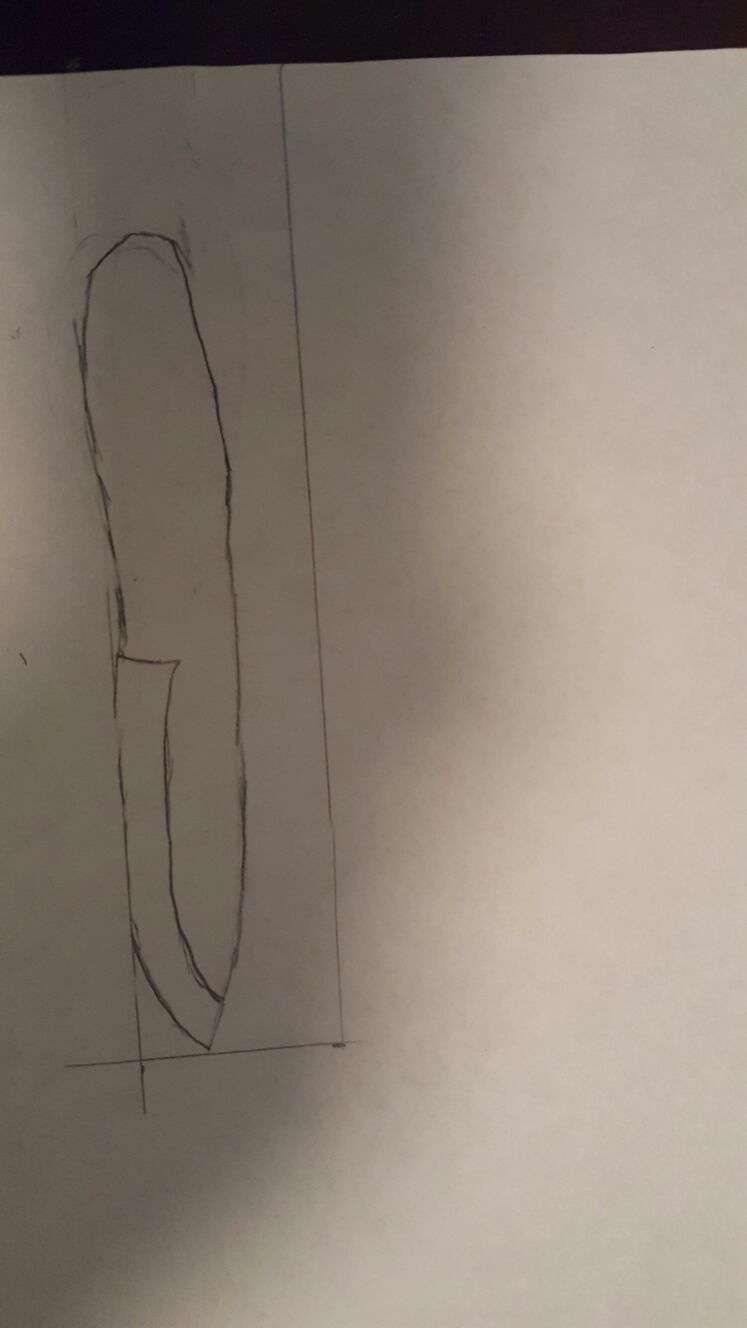
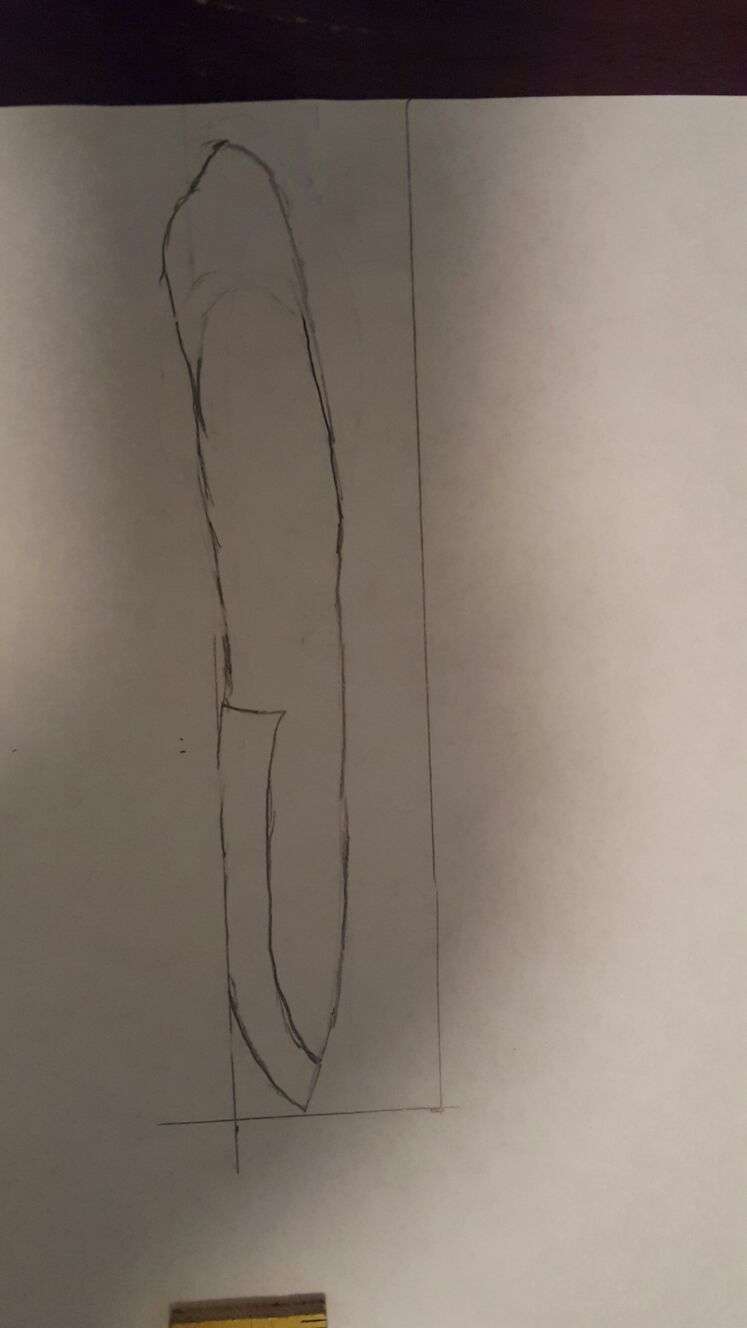
are these better
QYp6j1.jpg


PjrNlM.jpg
 
Last edited:
You must be looking in the wrong places. When you see the wrapped epoxy handles of Ben Tendick, Matt Gregory and others the last thing you think of is yuck :)


Here humbing is one of my wrapped expoxy handles


W4zspiI.jpg

nice work. I was actually thinking of thicker pieces of leather wrapper to give it a midevil feel
 
are these better

QYp6j1.jpg


PjrNlM.jpg


The first one looks OK. The second one looks better, but the handle is too long. If you moved the handle butt of that sketch up to where you erased an earlier try, it would be the one I would choose. Try drawing it that
 
Back
Top