Let there be light

That would be a good plan. Check the kelvin output of the bulbs you get, as all are not the same.

 
I've been slowly converting all of my shop and home lights to "daylight" LED bulbs. I just did all of my 48" t12 lamps for about $120 with some direct wire 6000k daylight LEDs. I was able to use the same fixtures; you just remove the ballast, put 110 on one side, and neutral on the other.
I previously had 5000k T12 flourescent daylight bulbs, but the LEDs are quite a bit brighter, more consistent light, and they're nearly half the wattage of the flourescent bulbs. It's also nice that they don't care about cold and are instantly at full brightness regardless of temperature.

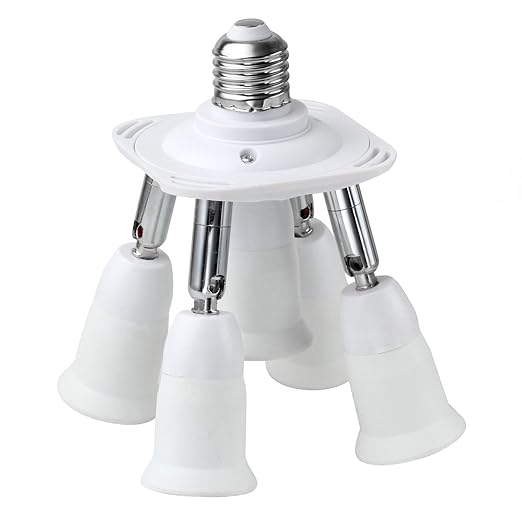
I'll probably get something like this for my overhead sockets, and fill them with 60w, 75w, or even 100w equivalent LEDs:

611YdgW-RTL._SX522_.jpg

Should spread the light out a lot better than a single bulb, and with the directional sockets, I can dial it in to certain areas a little more precisely.
 
I strung up a 100W-equivilent daylight LED bulb above each corner of my small square shop space, it works great and burns very little electricity. Huge improvement over my old CFLs.
 
I have 48 4ft hi cri bulbs in my shop and thy are grate but sometimes I need more light around the grinder.
 
I've been slowly converting all of my shop and home lights to "daylight" LED bulbs. I just did all of my 48" t12 lamps for about $120 with some direct wire 6000k daylight LEDs. I was able to use the same fixtures; you just remove the ballast, put 110 on one side, and neutral on the other.
I previously had 5000k T12 flourescent daylight bulbs, but the LEDs are quite a bit brighter, more consistent light, and they're nearly half the wattage of the flourescent bulbs. It's also nice that they don't care about cold and are instantly at full brightness regardless of temperature.

I'll probably get something like this for my overhead sockets, and fill them with 60w, 75w, or even 100w equivalent LEDs:

611YdgW-RTL._SX522_.jpg

Should spread the light out a lot better than a single bulb, and with the directional sockets, I can dial it in to certain areas a little more precisely.
Nice Where do you get it ?

Home depot has a 2x1 Y splitter for five bucks ish.
That one's more better
 
Nice Where do you get it ?

Home depot has a 2x1 Y splitter for five bucks ish.
That one's more better

I bought the direct wire bulbs from Amazon. 16 medium bi-pin 48" bulbs for $120 shipped. I believe the brand is Barrina, but I'm sure most of the Made in China bulbs are about the same. I have zero complaints so far. I've ordered stuff through work from sites like 1000bulbs.com, and they seem to have around the same prices.

The splitter I found on Amazon as well. They run about 11 or 12 bucks. I haven't ordered them yet, but I've seen a couple of guys on youtube that seemed to like them for somewhat of a quick and relatively low cost fix. Nothing to mount or wire, just screw in a few bulbs and go.

Seems like LED lighting has really taken a leap forward in the last year or so for what you get for the price. IIRC, I priced a similar conversion a little over a year prior, and it was around double what I paid for the Barrinas.
 
Wow! You guys have electric lights? I have been engaging the clutch on my stream side water wheel to get the grinder going and lighting about 6 or 8 candles when I want to grind at night. I'm sorry it's so confusing to get the right light. Why not grind when the sun shines? I'm kidding...I use 12 four foot 40 watt fluorescent bulbs over my shop area of my garage and I use an architects style lamp focused on my wheel. I think it works fine. Larry
 
Check out the UV output of those halide lamps.

Also, the spectrum of halide lamps is in the mid-spectrum peaking at yellow. The peak is also double what the other color ranges ar, so it is only putting out 50% green, 30% orange and blue, and 10-20% of red and violet. The UV is around 20-30% , which means you get a good dose of UV while only seeing yellow. As you see, they do not give a wide spectrum of white light.

I was concerned by your statement so I started researching this. Come to find out metal Halide do output large amounts of UVA and UVB light. But that is why the bulb has a second glass envelope around it. This second layer is designed to block this wavelength of light. I was reading an article about kids in schools getting exposed to large amounts of UV light because the bulbs where not in a enclosure and the outside glass envelope would get broken by balls in the gym.
https://www.fda.gov/Radiation-EmittingProducts/RadiationSafety/AlertsandNotices/ucm116540.htm
 
I have 48 4ft hi cri bulbs in my shop and thy are grate but sometimes I need more light around the grinder.
JT, the lamp Chris Williams puts on his Tag 101 Grindering machine really helps when I’m working on that Machine and there are Magnet base flex arm lamps like it around. ... Remember I use one of those . As seen on TV LED super bright head lamps when grinding to put the light exzacty where I want it on my Platen!, work bench, Works like a charm!;)
 
One thing people forget is that their eyes acclimate to the ambient light. If the ambient light is just too bright for the eyes to handle, the retina gets desensitized. Go outside on a bright sunny day and work in the yard for an hour. Your vision is great and you see every detail of flower. Walk inside and you may not be able to read by the inside lighting, and shadier corners may look black. While you will be able to see OK in a few minutes, your vision may not return to full clarity for an hour.

The same can happen in the shop. Too much bright light will make you see great in the main areas, but step up to a place where your body casts a shadow or there is less overhead lighting ( like the grinder area) and suddenly you can't see details at all.

The solution isn't more lighting,it is better lighting. First, the lights should cover the ceiling evenly in all areas, not in only a few spots. Tube LEDs and rows of smaller lights do this well. Track lights over the grinder area allow placing spots, floods, etc exactly where they are needed.

White or light color walls and ceilings are the first step. Beige or daisy yellow may work fine in your bedroom, but use pure white paint in the shop. Semi-gloss is best, as it disperses the light well.

I just did some quick math -
You need about 80 lumens per square foot of light to see clearly in a normal room. Twice that would be the max needed for clarity of fine detail in a shop or workbench area.
Add up the lumens from all the bulbs and divide by the square footage of the area. If the shop is large, break that down into 10X10 segments and see what the light load is. Roughly, a 10X10 area with white ceiling and walls will be well lit with 8000 lumens , and super well lit with 16,000 lumens. You could get that from eight to ten 18 watt LED bulbs, but would get better vision and less shadows from twenty 10 watt LED bulbs. Four 4 foot LED lamps would also provide it.

As ceilings get higher and more "stuff" blocks light in a shop, there will be a need for more light. If you have 10 foot ceilings, or lots of dark equipment, adding 25% to the max would take it to 20,000 lumens for a 10X10 area. And that would be lit up like a snowfield in Alaska on a sunny day.

Here is a tip for wiring a new shop lights. Put the lights in zones with every other light on Zone A or Zone B. Add a Zone C for the bench lighting. This not only allows savings on bulbs and electricity, it allows having the light needed for the task. Add as many zones as you want, but three or four will do all but a warehouse size shop.
If you wire the zones with 3-way switches, you can turn any zone on from the wall plate by the door, or from that area by putting a switch by the grinder for C, and switches at the other end of the shop for A and B.
 
Back
Top