
let's talk about coining

Joined
Jun 11, 2010
Messages
489
I've been planning my next project, and it involves coined spacers and liners to set off my blued steel frame handle and fittings. There are several ways to do it, I know, but I'd like to know how the real pros go about this. Checkering file? Knurling wheel? File and eyeball? Related: assuming one of the first two methods, what TPI do you like and why? I am not committed to any method, but am interested in finding the best one.

Please weigh in, and please add pics where possible. Just to kick things off, here's one I dredged up from an old thread of Ken Erickson's using a knurling wheel:
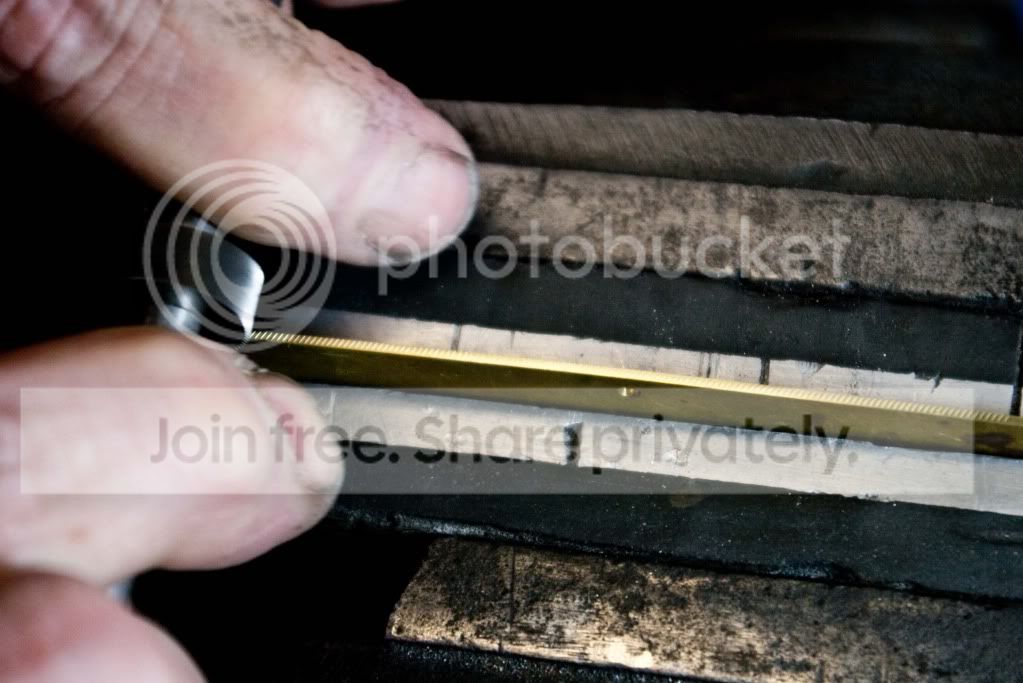
IMGP9836_edited-1.jpg
 
I use checkering files and knurling wheels. It just depends on the job. Knurling wheels are great for liners.
 
Jewelers use a set of knurled wheels called "millgrain" tools. They are just smaller versions of the knurled wheels machinists use.
 
I have used 20 tpi and 30 tpi metal checkering files with good success but once in a while the circumference of a round part such as a hidden tang spacer will cause problems with an overlap at the end of the run and show an unsightly "half" groove. When this happens the part has to be ground down smaller or replaced again with a larger one. For this reason I stopped coining spacers. Liners are much easier and give good results.

Another problem with using checkering files is the coined edge cant be touched again after its finished except for some fine sanding possibly. This means that everything has to be completely finished and ready for final assembly.

I now use a very thin file called a "screw slot" file to make square bottom grooves instead of "V" bottom grooves like the checkering file. I bought mine from Brownells but you can grind off both sides of a good mini file. I made a small spacing guide from an old small file to aid in placement and as a file guide. These grooves can be much deeper than a "V" groove and can be sanded and shaped slightly if needed after final assembly. The grooves can even be filled with epoxy for a smooth look.
 
Last edited:
Travis, thanks for starting this--- I had never seen the knurling die trick! Very cool!

When I have done coining around spacers, I used a 20 TPI checkering file. What Bruce said about overlap is certainly a concern!

I practiced quite a bit before putting the checkering file to the real thing. I had an old issue of a knife mag where Jerry Fisk described how he did it, and Jerry recommended going all the way around the spacer lightly first... that way you can make sure things line up, and you can adjust a little by how deep you run the file into the part.

That always worked really well for me. I was sure I had some photos laying around, but this is the only one I could find... this is a trip in the way-back machine--- the knife was made nearly 10 years ago. But it shows the coining pretty clearly. :)

shreddfighter.jpg
 
Back
Top