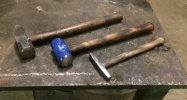
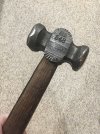
^^^ That little one is a tack hammer. It is probably magnetic on one end to hold the tack while you set it on the first blow then switch to the opposite head to finish driving it in.
I suppose I have an epiphany waiting for me someday when I try expensive custom hammers.
I have a lot of hammers and purchased most of them at local stores. The exception is a railroad engineer's hammer I bought off Ebay because it had a straight pein. I have an 8 lb sledge that I cut the handle down for big jobs and for striking my maker's mark, a 4 lb sledge, a 2.5 lb cross pein, (5)3 lb cross peins with slightly different flat faces and a variety of pein profiles, (5) 2 lb engineer's hammers with flat faces on one side and a variety of rounding profiles on the other faces, a variety of ball pein hammers from 4oz to 32oz ( a 24oz Vaughn being my favorite), A masonry hammer with the pick part cut off of the back end making it more of a dog's head type and a tack hammer like the one above. They all get used.
Maybe I'm missing something. You guys that are more knowledgeable about hammers can explain. As far as I can tell, there are three things that are important with hammers- weight, profile and technique. I buy hammers in the weights I want, I dress or profile the faces for the tasks required and then I use the hammers in a way that makes the best use of those modifications. That can be done with hammers found online, at local stores, swap meets and garage sales or those found at the junk yard. A lot of my hammers came from Harbor Freight. They are cheap, come in a variety of weights and shapes and I can easily shape them any way I want.
The important thing is that your main hammer be comfortable to swing for long periods of time. It should have enough weight to move metal but light enough so that you can place your hammer blows exactly where you want them.