I kinda pooped in another thread with this loooong reply. It is better suited for a thread like this....
The only experience I have is real world application. When I started making knives they were only for my personal use and I wanted the strongest, toughest, most indestructible knife in the world... lol... turns out, it's not that easy to make a good knife. Immediately, passing the ABS JS performance test became a goal. A knife that could pass the test would be the ultimate survival knife. I began working with MS Wally Hayes and one of the first things he told me to check out was MS Ed Caffrey's 5160 performance test knife tutorial.(Excellent tutorial BTW.) Something that popped out while reading, was the second sentence of the paragraph on
hardening....
"I recommend edge quenching ONLY on a blade that will be used for something as important as the ABS JS test." What did that mean? Why would you ONLY want to use this great technique for a test knife? Surely, it would carry over into real world hard use.

About the same time, I began apprenticing with a Canadian Wilderness Survival and Primitive Living instructor in Northern Ontario. This guy had no respect for knives.. lol... digging, prying, chipping at rock.... I was disgusted..... but interested at the same time. THIS GUY would find any weakness in my knives.:thumbup: I started making knives to
his specs and they failed... i made them to
my specs and they failed.:grumpy: Why?.... they were bending and when I made one thick enough to resist deformation, it was too bulky. I was stumped. I sought guidance. Wally told me to fully harden the blade and draw back the spine. I told him that the last thing I wanted was my knives to break when I bent them. He quickly replied, "Well, why the hell are you make a knife that will bend, when you need it to stay strong? Make a stronger knife.... one that won't bend and you can't break.... make the tool suit the task." That's when it hit me and Ed's sentence suddenly made perfect sense. The ABS JS performance test
requires the blade to be flexed 90deg. It doesn't matter if it takes 5ftlbs of torque or 500! It
MUST flex and not break. They are testing your skill as a maker, not whether you make a good knife. When would you require a blade to
flex that much during actual use?(okay... OTHER than a fillet knife... lol.)
I began taking bars of 5160 and running tests on pieces 1/8", 3/16" and 1/4" thick. Unground, heat treated and tempered to varying hardness. I didn't have a Rockwell tester, so simply went with tempering temperatures (my oven only went to 525F, after that, I went by colour). The 1/4" bars were rather uneventful... whichever hardness or structural state I had them in, I still couldn't bend them by hand. It started getting interesting with the thinner stock. Once more, I had to get used to the sound of metal snapping. This time around was different than my JS test quest, though. I was very careful to be aware of the amount of force I was placing upon the steel. I found that the fullhard bars took MUCH more force to flex to the same degree as the unhardened pieces and if I tempered enough, would withstand even more force. I upped the tempering temps until I felt I was losing strength and the steel would take a set more readily(this was WELL into the grey colour
my guess would be 700-900F. The soft untreated bars deformed at even the smallest degree of flex and offered very little resistance in comparison. One test, that I wish I would have done at the
beginning was to take two identical, triple normalized bars, fully harden one, shine them both up, temper to peacock blue and flex each to 45degs(noting force applied/resistance and degree of set.) Then continue flexing back and forth(45deg, L&R) like a dogs wagging tail. Realign to center and repeat the 45deg flex, once more. The result is predictable but no less shocking. The unhardened blade now flexes like lead with VERY little resistance and immediate set. The hardened and tempered blade feels no different than it did the first time.
That test ALONE would have convinced me to further research a homogeneous heat treat.
At the same time, I began educating myself on the mechanical properties of each micro-structure within steel. It was very reassuring to see that the basic results from my low-tech approach coincided with the research done by the steel nerds in lab coats. (minus the metallography) I must say, that delving into modern metallurgy is a huge undertaking and I've only scratched the surface. You won't find me quoting data sheets or typing out long runs of eloquent terminology..... I'm just not there, yet. But man, I have been bitten by the bug.
My experiment taught me a very important lesson..... Unhardened prybars dont pry, they bend and have a short lifespan. My quest for the unbreakable knife led me to a blade that was lacking performance attributes in areas that I deemed important. Sometimes, less extreme treatments can yield the most desirable results.
It would be silly for me to state that the edge quenched blade is inferior to the fully hardened blade based on regular performance. Most users will never push their knives that far into the realm of abuse. I judge by what I can experience. I take into consideration the opinions and reasearch done by folks I have respect for but at the end of the day, I need to know how it affects the end user.
Lateral strength affects my end users and Fully Hardened blades address the issue,
in this instance.
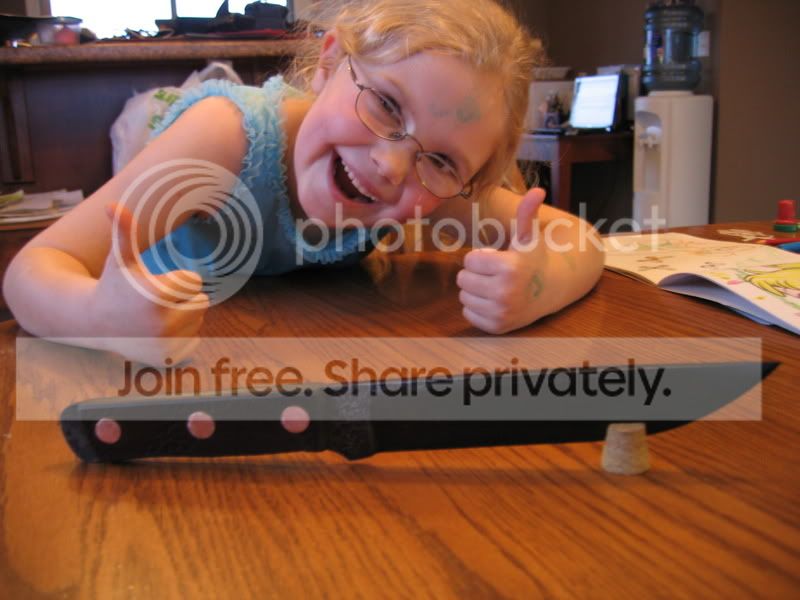
This was the last knife I sent to my wilderness skills mentor. (almost 4yrs ago, this month.) It was only meant to test the blade so the F&F are rough. He refuses to send it back or receive a new one, for fear of losing the best knife he has ever tried to break
.. That means a lot to me. It didnt even come with a sheath but he said it fits in an old BK&T one. (that is embarrassing)
Modeled by my lovely Blue Spotted House Monkey