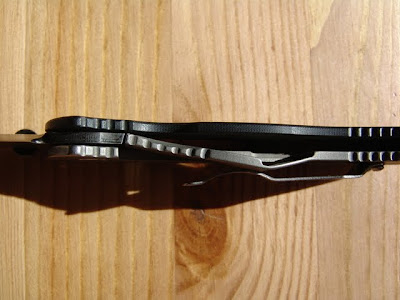
My long explanation:
A proper liner lock will disform before slipping or catastrophic failure taking place.
A recent few posts I did regarding frame locks, but same principles apply to liner locks geometry.
"There are a few things I want to cover, based on my talking with custom makers and reading Bob Terzuola's book: The Tactical Folding Knife (hereafter BT), where he explains in detail the aspects of a good liner lock and the same principles are applied to framelocks.
Three points of contact:
1. Stop pin
2. Pivot pin
3. Interface between blade and spring (ie, lockface/lock engagement area hereafter referred to LF) Spring is also the liner lock, framelock.
This forms a triangle.
Now, the LF is the area lets focus on first.
BT. refers to the angle of the lock face to be between 7.5 and 8.5 degrees. Les then 5 degrees and the spring will jam. More then 10 degrees and the spring will start slipping off the LF.
Now the start of a radius lock face, the maximum therefore cannot exceed 10 degrees or else the lock will start slipping when the lock wears to that point. As mentioned as lock roll in the video when referring to the Strider.
Now.
Do not thing the angle plays the only role in the lock slipping. The finished LF can have a rough spot, not be polished enough, the spring's interface between the LF can also play a role.
Let us examine this from the Emerson website.
http://www.emersonknives.com/ekKnifeAnatomy.php
If the LF connected to the spring more in the middle or at the top of the spring where the detent is on most (point nr 3 closer to the pivot pin nr 2) then you would experience blade roll. This is when you have vertical type play but what happens is the blade actually rolls on the spring because the spring connects in the wrong place with the LF.
The picture shows the extremes of the different designs, you can have a lock that engages more then the bottom 0.90-.125" of the spring. Chris Reeve has proven this, but, you can also have a knife that engages only on that bottom 0.90" (point of contact in the picture)
Not every lock is the same. The basic ingredients are the same, but the final application is what the maker chooses. This can be seen even with Spyderco difference between the Military and the Gayle Bradly.
Now that is just the geometry of the lock.
The spring itself if it is Titanium can be heat treated or carbonized. Strider and Hinderer do the latter. This helps tremendously with wear on titanium and if done right will last you a life time. CRK and a few custom makers that I have do Heat Treating of the lock. Wear is about nun and equal to (if) steel was used.
HOWEVER. Titanium is NOT PERFECT and it can have flaws in it when received from the supplier. EVEN aerospace titanium (grade 5 titanium). These flaws only become apparent when it is used and is sometimes not even noticeable until it begins to form a problem. This is where a good warranty comes into play.
Steel used as a liner is not always the answer as well. Different steel interfaces can result in slipping. Steel on steel requires a lot of research to find what can be used and heat treated as a spring and still provide excellent wear resistance and safety.
Finally, lockup percentage is a strange thing and depends on the final user. I prefer later lockup as it usually means less chance of slipping off the LF.
I hope this helped you in some way."
At the end, if you either use Ti or Steel, the LF geometry is key.
I have Ti lock custom that I have flicked vigorously, the maker asked me to test the lock face.
Here is a video towards the end.
http://www.youtube.com/watch?v=YgNHm...1&feature=plcp
Start watching from 2.27 minutes.
BT also writes in his book there is no significance between steel and Ti if done right. A Sebenza will wear for a while and then stop. Most quality locks do this. Chris Reeve also wants a later lockup as he feels it provides a safer lock and less chance of slipping. I tend to agree. Besides. If any quality product wears out so fast, they should cover it under warrenty.
I have seen a 18 year old Sebenza. No issues. I have a Military with the steel insert. No issues. Both locks apply different end results, but the basics are the same resulting in great locks that can last you a live time.
BT also feels that the strength to weight ratio of Titanium is excellent compared to steel.
Not really. The routing that is done is to make the disengagement for the user more comfortable. STR has made Ti framelocks without any cutouts (routing) because the user wanted it only to have it returned later on because the user complained it was to difficult to disengage.
The cutouts (routing) also provide a "safe burn" for those "accidental moments" when the lock does fail due to excessive force on the blade.
A Emerson HD-7 showed this perfectly.
http://strsbackyardknifeworks.blogspot.com/2009/07/bins-horseman-hd-and-jryan-edc-folder.html
In short
"Contrary to how many readers may feel about that picture above. That my friends is a design that deserves praise for defeating the way it was engineered to go. That HD7 above did its job and so did the designer/maker of the knife. I doubt any sutures or ER trips costing great amounts of money were needed with that defeat. We should all pray to be so lucky should we be the on the unfortunate end of a defeat ourselves one day."
The cutouts are the weakest link in a Framelock IMO.
I have been surprised by some framelocks. A kershaw vapor that I had would disengage with some force on the spine when not held in hand. When I gripped it the lock did not move as ones fingers actually force the lock in.
Titanium that is used in framelocks have to be at least grade 5 quality. It has natural spring tension if I can remember correctly.
Dwayne
Emerson knives start live out so early because it is the Mr. Emersons personal choice for his locks. I know of custom makers that also do this.
However, in my experience it is Ti liner locks such as Emerson knives (and there are many others that also do this) that are not heat treated or carbodized lock faces of the springs that tend to wear much faster. In these locks the geometry of the lock has to be as close to perfect as one can get.
Chris Reeve.....well this is interesting because he is credited as the father of the "framelock" or R.I.L.
The reason why his knives do not really have a break in period, or if it has it is very little is one thing: Tolerance.
CRK also does what I feel is good practice in that they adopt the blade to the spring, not the spring to the blade. In other words, when they fit a blade to a lock, they have multiple handles that are pre-assembled, checking in which handle the blade fits best and then if required they grind the blade LF area to mach the spring. They never fiddle with the spring or springs LF area after it has been heat treated and bead blasted to mach the blade. This is good practice IMO and great makers do this.
The only real advantage steel has over Ti is not in its wear resistance, but IMO in its impact resistance if one wants to beat the :spyder: out of the spyderco or other knife.
(I wanted to ad that my knowledge is not perfect and if any maker wants to correct me I am willing to learn, I am just sharing what I have learned from makers and books)
It does not really matter if the company is Emerson or not, the quality control needs to be good and with what ever company there have been a few melons going through. This is wear warranty comes into play.
The thing why Emerson knives wear so fast is due to the wave feature. If you wave that knife 20 times a day at full speed then the lock will wear faster.
The second question I dont fully understand, could you elaborate on it a bit before I attempt to answer it in full?
If you are referring to why CRK knives start locking up at 50%, that is his preference (mine to) and the LF is designed and executed that way.
The initial wear on a CRK is minimal due to the close tolerances on the LF and the entire knife. However, sometimes there is a rough spot on the LF that just wears smooth and the lockup will increase from 50%-60% within a few days, or weeks, but after that it would wear very very slowly. CRK wants the lockup to be between 50%-75%, but this is different on the Umnumzaan. On the Um it looks closer to 90% but it is actually 75% and I have yet to hear a complaint about the Umnumzaans LF or geometry.