
Linerless slipjoint

Joined
May 15, 2015
Messages
20
So I had a go at making a slipjoint and this was the result.
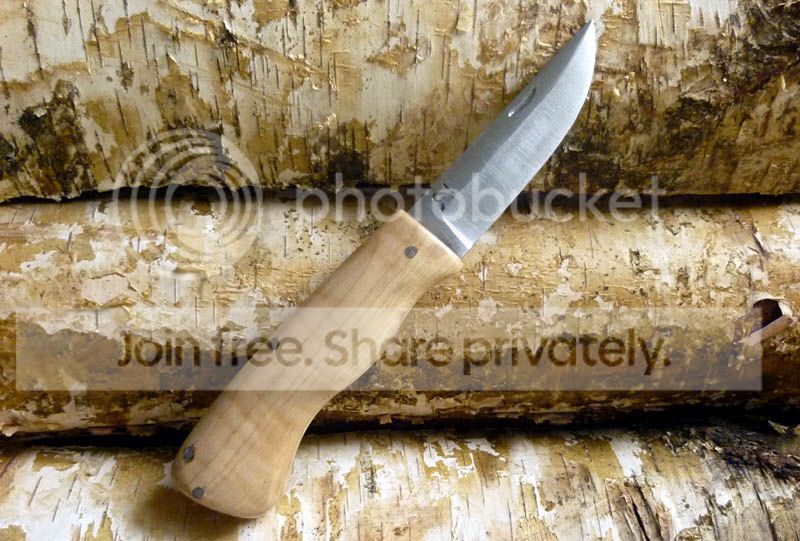
folder_open_zpsh9b30ooj.jpg


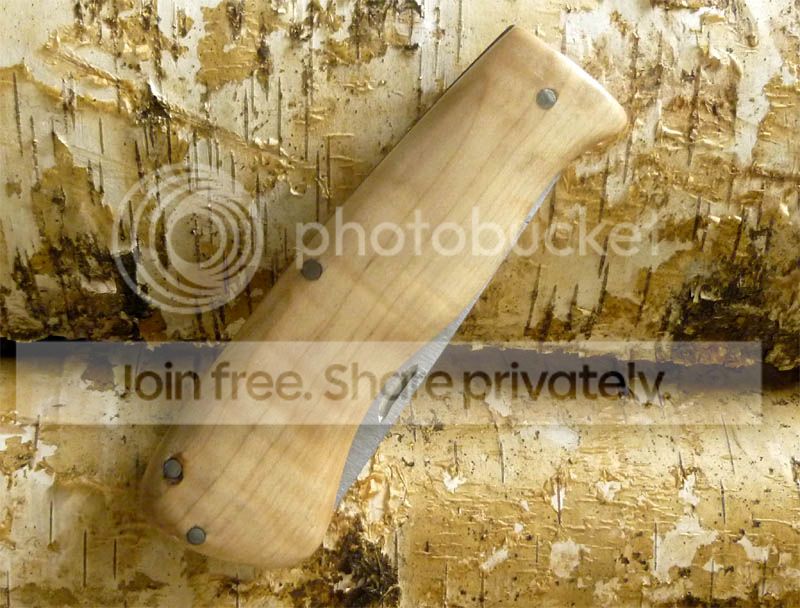
folder_closed_zpsnkw22iew.jpg


The blade/spring are 1084 with a curly maple handle. I looked around and didn't see a lot of linerless slipjoints made of wood, but I did see a lot of friction folders made of wood so I figured it's strong enough? Guess I'll find out.

From what I could discern, it looked like while a lot of pins on linerless slipjoints are peened, plenty are just press fit and ground flush, which is what these are. Did I get that right or is there a better way?

There's some darkening of the wood around the pins which I think is from heat of grinding, so... grind slower next time, I guess.

There are some things I'd change, but I'm pretty happy with it overall for a first attempt. Comments?
 
Good that you came up with something that you like and works ! On the other hand I wouldn't run out and make more for sale. Simply put, it's very much on the bulky side.
Frank
 
Last edited:
Yeah, I have no aspiration whatsoever to make knives to sell. I've worked in a couple creative industries and have had enough of catering to what some market or other wants. I just want to make what I like. That said, if someone else likes it too, that's cool.

This is basically a folding version of the puukos I usually make, so yeah, the handle is a lot bulkier than what most people want for a folder.
 
Without liners, bolsters, or peened pins the lateral strength of the blade joint is very low.
I can't see why you wouldn't want to use liners, but it's your knife. Not peening the pins makes no sense to me. You put the pins there, why not peen them?
The knife looks fine.
 
I'm not inherently opposed to liners, I was just looking at a bunch of wood-handled friction folders that didn't have them and it seemed like the forces at work in a slip joint wouldn't be all that much different. Maybe to the extent that the stub of tang on a friction folder slides between the handle scales with the blade open, it distributes some of the stress better, but a lot of those stubs are fairly short, so I wouldn't think so.

If there's a real reason for not using them on this particular knife, it's aesthetics. The less metal showing in the handle, the closer in appearance to the fixed-blade counterpart.

As far as peening the pins, my process was to to hammer all the parts together (with the scales rectangular) and then grind the handle to shape as I normally do on a fixed blade, which left the pins flush with the surface of the wood. I looked at a number of WIP posts on various message boards and nobody went into detail about how they installed their pins so I just guessed at the process based on what the result looked like. I'm certainly open to doing things in a better way if someone can point me in that direction.
 
the thing about a slippie handle is that the frequent opening and closing puts stresses on the pins holding the pivot and spring, making them more prone to loosening than in a fixed blade where the pins don't experience those stresses. So peening of pins is more important for some slipjoint pins than it is for fixed blade pins. Friction folders don't experience stress from opening/closing because the pins aren't subject to forces from the spring pushing them away from each other -- there is only the minimum pressure when the tang pushes the scales apart with the blade open, however that's not much.

But your handle may be thick enough that it won't ever matter. It does look comfy to use!
 
Last edited:
I don't understand why you are under the impression that pins are not peened if they are flush with the surrounding material.
They are, just the hole is tapered near the surface and after the pin has been peened, it is sanded flush.
 
RobN specifically said the pins weren't peened.
I fully understand that peened pins can be flush. After all- I have been doing this for 45 years.
 
It looks good, and the puukko style is noticeable.

Thoughts for the next one:
The issue is that the liners carry most of the force applied on the pins when opened and closed. The center pin on the spring, the pivot, and the end pins all distribute the force created when the spring is flexed. What you have made will probably work OK for a long time, but the pivot and center pin would slowly try to oval the holes. Even fairly thin brass liners will help carry that load. Stainless or Ti will be even better.


Now you got me thinking of building a folding puukko with an antler bolster/butt and traditional looking handle, .... with Ti liners. Hitachi san-mai - white steel core with plain iron sides - would be perfect.
 
I fully understand that peened pins can be flush. After all- I have been doing this for 45 years.

I think he was addressing me. For my part, I'm not under any particular impression. I'm just trying to reverse engineer the process of putting these things together from what I see in the end result, since no WIP I found showed the installation of the pins.

I had thought of peening the pins and then grinding them flush, but I couldn't figure out how I would shape the handle with the pins in and still have the pins proud of the surface such that they could be peened. Nor could I think of a good way to shape the handles before assembling the whole works. My original plan was to assemble it, grind it to shape and then drive out the first pins with new ones, cut those just proud of the surface and peen them, but after shaping, that no longer seemed like a viable plan, so it remains as it is.
 
It looks good, and the puukko style is noticeable.

Thoughts for the next one:
The issue is that the liners carry most of the force applied on the pins when opened and closed. The center pin on the spring, the pivot, and the end pins all distribute the force created when the spring is flexed. What you have made will probably work OK for a long time, but the pivot and center pin would slowly try to oval the holes. Even fairly thin brass liners will help carry that load. Stainless or Ti will be even better.


Now you got me thinking of building a folding puukko with an antler bolster/butt and traditional looking handle, .... with Ti liners. Hitachi san-mai - white steel core with plain iron sides - would be perfect.

Hmmm... I wasn't thinking of the force of the spring when I made it, only the forces that would bear on it when cutting, which is where the comparison with friction folders came from. Seems like they would be similarly stressed in use. The one I was mostly looking at was the Svord peasant knife, which has similar dimensions and can be had with a wood handle.

I tried giving it the "dig a hole through a 2x4" test that I've been using on the puukkos and discovered quickly that some of those cuts will cause the blade to shut :-( So... not as useful for wood carving as a real puukko (although, it held up fine otherwise), but useful for situations where the sight of a fixed blade would scare people, which was basically the point.

I was trying to figure out how to incorporate a bolster. That would be another advantage to using liners, I think. I could solder a brass bolster to them. Brass is a very common material for puukko handles, too, so maybe it wouldn't look too out of place. I like the antler idea. I haven't used any of that myself yet.
 
Should you want to change out the pins to peen them, or on your next knife-
Here's how to do it. You pretty much had it figured out. After shaping, take the exact size pin and taper one end slightly. Place the tapered end on the old pin and use it to drive the old pin out.
 
Super cool design, I really like how close it is to a fixed blade.

It would be cool to see more with liners and peened pins, I think we all see a lot of skill and even more potential. I know it is for you and I think it will probably be fine for general use. Slippies are tough to make and that is cool!
 
If the lack of liners is driven by aesthetics, maybe you could try making a 'hidden liners' which would be inset in the wooden handle, but all pins and pivot going through them, like on Spyderco Endura and similar knives... With wood handles though, it might require more effort and precision than they do with poly handles (which are presumably cast to the final shape), but might be worth considering.

FPODG01G5FRAQ3J.LARGE.jpg
 
Yes, I've considered that. I picked up some stainless sheet yesterday, so I'll see what I can come up with.
 
Back
Top