
- Joined
- Dec 25, 1998
- Messages
- 7,394
Wilderness and survival newb here. I would like to put together a list of the essential necessities that one should have before going into the bush.

The BladeForums.com 2024 Traditional Knife is available! Price is $250 ea (shipped within CONUS).
Order here: https://www.bladeforums.com/help/2024-traditional/


Where are you located at??

Hi Shootist-
I'd say welcome aboard, but it's hard to say to someone with more than twice my post count!
If you google 'The Ten Essentials' you'll got a lot of good info and starting points. That's what a lot of people call the minimum you should go out with.
I prefer to do it based on broad needs categories. Meaning break it down to shelter, water, food, tools, emergency, etc.
Some 'no question' basics:
-Cutting tool (even just a swiss army knife)
-cordage (paracord ideally)
-fire starting materials x 2 (lighter, matches, firesteel, etc)
-shelter material (milspec poncho, nylon tarp, garbage bags, etc)
-a small pot (cooking, boiling water)
-water purification tabs
-flashlight
-compass/map
-first aid kit
-canteen
Those assume that you've got a decent set of clothes on to begin with, too.
You can get all this for not a lot of scratch, too. Some good gear starting points:
http://www.bensbackwoods.com/servlet/StoreFront
http://campingsurvival.com/
http://www.cheaperthandirt.com/default.aspx


My “Top 10 Essentials” For Outdoors
First, I must admit, I don’t think of my “essentials” as single items, but more of an area of importance and categories. For me (and my family), I make sure we cover the basics, and the concept of the basics is understood. The order really depends on your location and time of season. For some water will be one of their top priorities, whereas in a winter clime with unpredictable weather, shelter will be near the top as would the means to get a fire going. So, there’s been a ton of “essentials” lists posted, in magazines, on websites, etc, but in the end, only the individual heading out can identify his/her essential items needed to mitigate becoming a bad-ending survival story; these are my basics regardless of a day hike, weekend or exteneded backpacking trip. Again, these are “my” essentials, and some items will differ from a lot of other people out there. I just thought I would spell out my reasoning and categories for my “top 10” essentials.
1. Appropriate Clothing

Many essential lists have “layered” clothing, some list rain gear, etc. I know there are some regions where you can hike from snow to 90+ degree temperatures in one day (Wenatchee, WA comes to mind). So, given that most people are not so spontaneous as to run out of the shower in their birthday suit directly out into the desert, swamps or mountains; most understand that you need to don appropriate clothing. In colder climates or times of the year, layers work best. Plus you’ll want to avoid cotton. In rainy seasons or parts of the country, a rain jacket is a wise addition. Likewise, if heading out in the blistering sun of Arizona or SW Texas, a good hat and long sleeves are prudent measures. So, other than “dressing for the occasion”, I still like to add some constant companions.
- Wind or rain jacket (I’ve become quite fond of the Soft Shells plus they’re light)
- Hat; handy for several reasons from retaining heat to protection from sunburn
- Gloves; prudent protection from the environment and keeping your digits protected
- Sunglasses; my eyes are important to my survival, I plan to keep them well protected
- Decent footwear; anything that provides adequate support and you can walk comfortably in
- Watch; it’s a just a part of my daily dress, so it’s something that I’ve included
2. Knife/Tool
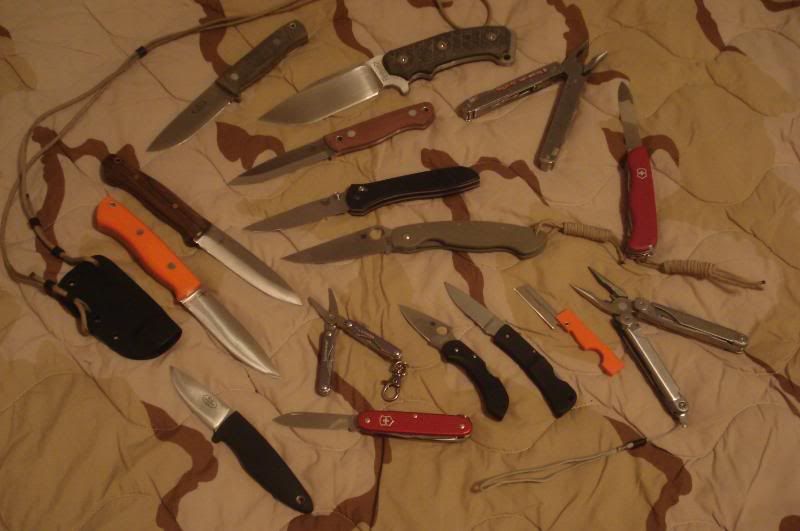
For me, a knife is essential; however, I know there are many that would argue it’s not as important as shelter, water or fire; different strokes for different folks. I list knife AND tool and most of us would argue the advantages of a fixed bladed knife over a folder but not all scenarios or personalities lend themselves to this preferred carry. Having a knife or tool is the number one rule…whether it is a Swiss Army Knife, Leatherman or locking folder, having a knife (and of course the skill and knowledge to use it), is half the battle. Since this is more of a discussion on essentials, I don’t want to get bogged down in knife choices and selection, however for me, I typically carry a decent sized (4-5”fixed blade, locking folder and a SAK or multi-tool of some type. I do believe in redundancy. Furthermore, a small razorblade or mini folder (such as Spyderco’s little Dragonfly or Gerber’s LST) in your Pocket Survival Kit is an additional level of security.
3. Water
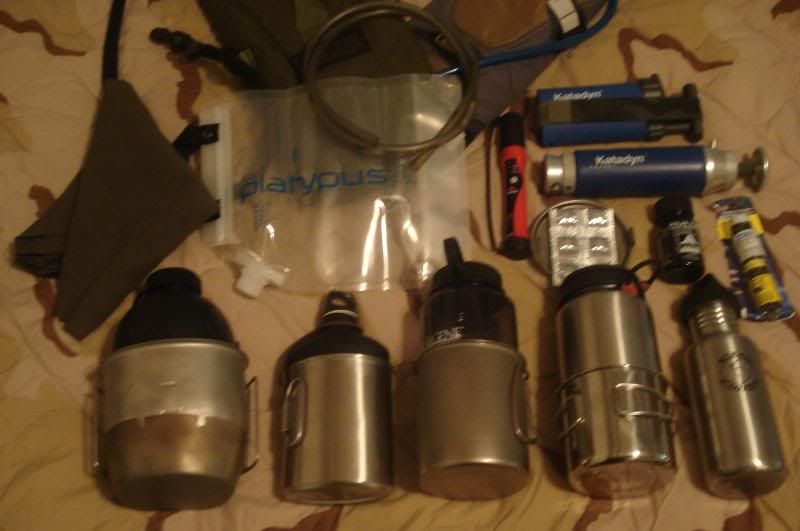
Water is critical as our bodies just won’t function well after a few days without it. Water is an essential, but there are a couple of parts that I’ll identify for my concept of “water” in my essentials list.
- Water carrying. This may be anything from a water bottle to a Camelback.
- Acquiring water. If you have a water source and a small cup, water bottle or Ziploc bag, it’s relatively easy to acquire water. Of course, there are other methods such as using a couple of clear garbage bags (which I keep a few in my daypack) for transpiration-collection. After attempting a solar still once, I don’t think it’s worth the effort…as my Battalion Commander says, “the juice just isn’t worth the squeeze”.
- Water filtration/purification. This is an integral part of hydration. I’m a big believer in redundancy, but your activities will dictate what you can physically carry. You may not be able to carry a full sized filter, but a few Potable Aqua tablets or a few of the Katadyn chlorine tablets. If you’re in an area where there’s a lot of sediment and detritus in the water some type of pre-filter is advisable, such as an ***-rag or coffee filters. Personally, even on day hikes, I will carry a filter; Polar Pure is my primary backup and I have about a dozen of Potable Aqua tablets in a small vial in my PSK. Purifying by boiling is another method; of course a container is quite helpful. I know you can improvise with a cotton duct hat or folded bark/woven leaves and hot rocks, but a simple steel or tin can goes a long ways to efficient collection and boiling. More to follow on the steel cup.
4. Fire
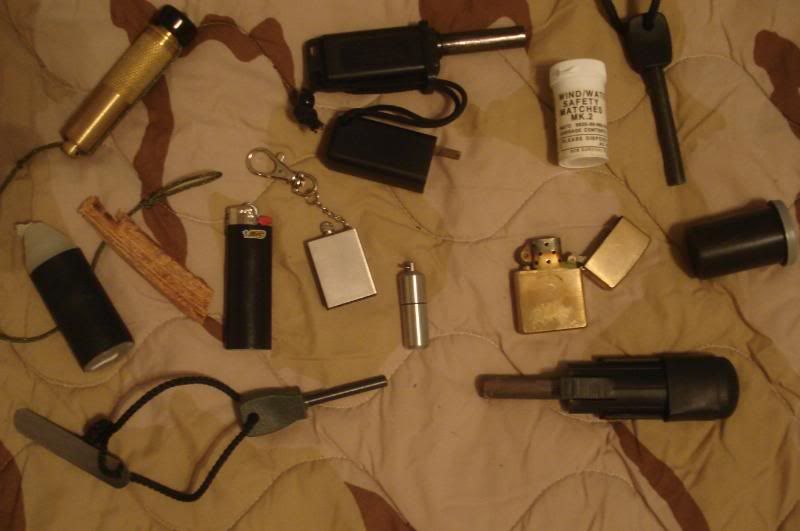
Fire can be both an essential life saver and major morale booster. Not only does it provide necessary heat in colder weather, it can act as a signal for rescue-searchers. I think most of us understand the importance, but I want to address the redundancy for fire making. Of course there is the ignition source, whether it’s a Bic lighter, fire-steel, match or even a magnifying lens and you need to make sure you carry a couple of different sources for backup. Next is the ignition fuel source. I know cotton balls and Vaseline are popular and one of my primary choices, but I also like the Sparklite tinder bundles, trioxane fuel bars, waxed paper and a piece of fatwood that I can make shavings from. Throw in a couple of tea light candles, and you have a decent fire-starting package. I mentioned redundancy, and if you go back to how you carry gear in “lines”, where Line One is your EDC and what you always have with you, I like to carry a lighter and a small ferro rod. In my PSK, I have a Sparklite and a few bundles of tinder along with a Fresnel lens. In my daypack, I’ll carry another lighter, matches and my Vaseline cotton balls along with a few bars of trioxane and a small candle or a few tea-light candles.
5. Shelter + Cordage
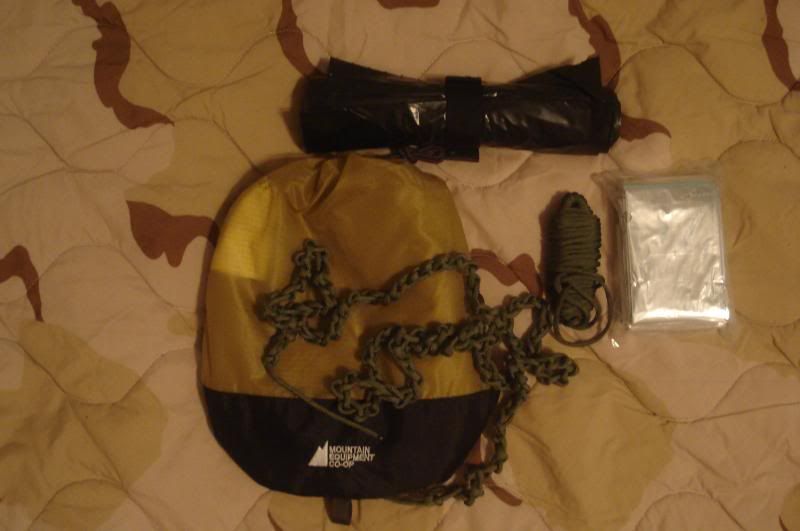
Part of my EDC is a few hanks of braided 550 paracord in my cargo pocket, so that’s always with me. Shelter can be made from a man made cover such as a tarp, garbage bag or could be constructed with vegetation (and some 550 paracord comes in handy for some shelter types). I usually keep my “shelter” and about 40-50 feet of 550 paracord together and it doesn’t take up much room. A simple large garbage bag is easy to add to a coat pocket or even a couple in a day pack. Inside my Camelback Talon, I have a couple of large garbage bags and a small Silicone impregnated nylon tarp with about 30 feet of 550 paracord.
6. Illumination/Signaling
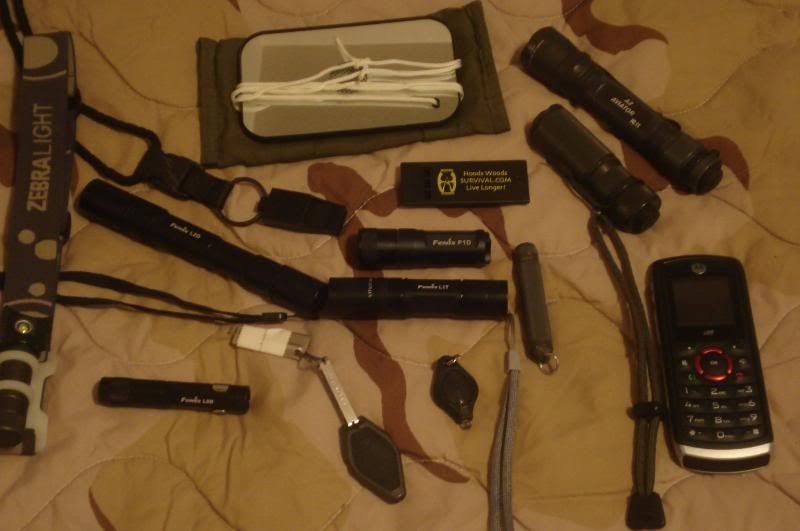
I know most top ten essentials list a flashlight as a separate item. With the new LED flashlights with the various modes of operation, that illumination tool can easily double as a signaling tool. Given that your essentials are there for a significant purpose, I see the ability to signal in a survival situation as extremely important. There are visual and sound-based methods and devices, some geared for darkness (i.e. strobe) and some during sunlight hours (such as a signal mirror). Again, I like a little redundancy, but you can also have dual use items, such as a programmable LED light that has a strobe function. So, for my package of illumination and signaling, I have a couple of LED lights (Fenix, Novatac) that also incorporate a strobe function. A whistle and a signal mirror are excellent companions for the signaling group. More common additions are Walk-about FRS/GMRS radios and cell phones…both are great additions if traveling in groups or alone, but don’t ever forget the basics.
7. First Aid Kit / Skin Protection
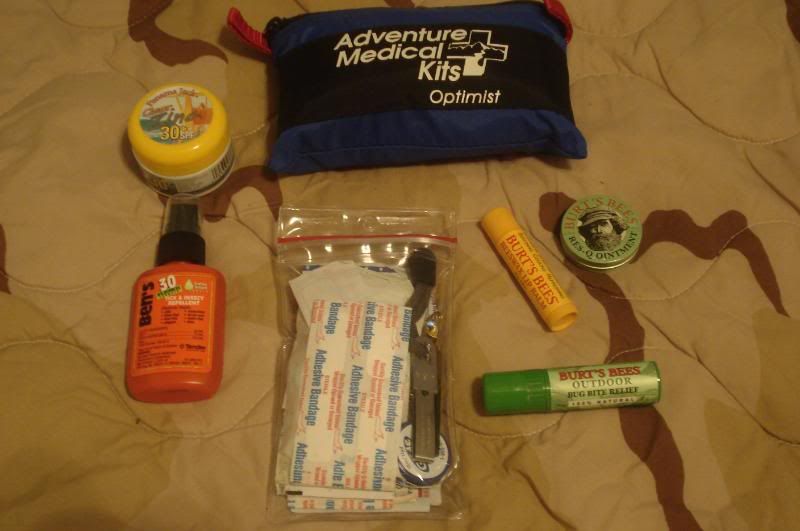
I don’t want to go into the whole First Aid kit composition, but most standard, small backpacking kits are more than adequate and as long as they leave a little room for additional times, such as prescription drugs, you are more prepared than most. I usually like the larger 2X3” Band-Aids, Burn-Gel, and extra mole skin. Although most kits are geared towards scrapes and minor burns, if you have room (and appropriate training), you can expand to cover more severe wounds. This is an essentials kit, so don’t make it so large that you leave it behind; it’s all about balance. A couple of additions to this category are items you sometimes see separately, and those are sunscreen, insect repellent and Chapstick (I prefer Burt’s Bees). These are all essential in most areas if you’re planning on spending a lot of time out in the elements or in areas with a lot of blood sucking insects, and a little tube of each is compact enough to throw in the kit.
8. Navigation
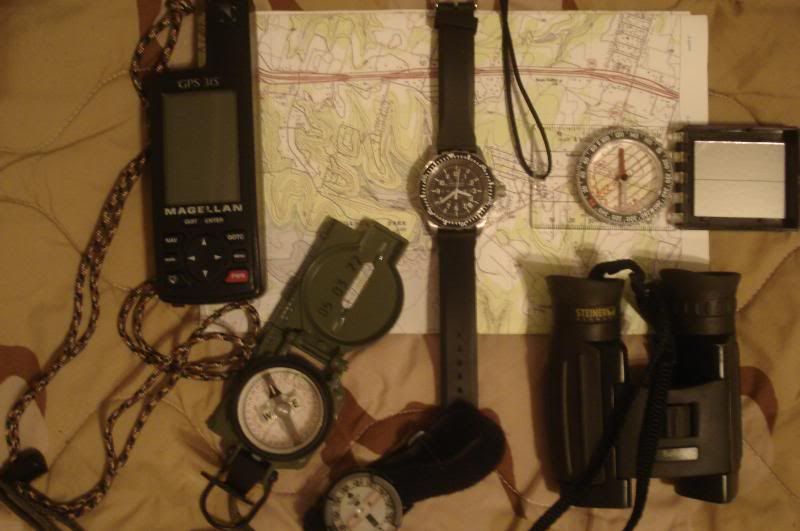
Depending on your activities, navigational tools may be much higher on your priority listing, although a map of your area and compass should always be an essential part if you’re planning anything outdoors. I personally keep a Suunto M9 wrist compass on me at all times, and if I’m doing any hiking, I’ll have a regular base-compass in a pocket. Maps are more useful with a compass, but even a compass alone can keep one from going in circles, staying on track or help to dog-leg a non-passable area. I also like the GPS, but I don’t think you should dump the compass entirely…again, a little redundancy, but always think simplicity…the compass doesn’t use batteries.
9. Metal Cup
I like listing the metal cup as a separate item. I know it’s hard to think about throwing a cup in your pocket, but if you have a small waist pack or Camelback, it’s a simple process to use a snap link and attach one to your belt loop. I prefer stainless, but aluminum or titanium will work; avoid the double wall mugs as you can’t use them directly in the fire for boiling. I have several and there are several to choose from. A metal cup can be used to signal (preferably stainless steel), dig, boil/purify water, serves as container to collect nuts, berries, it can be used to cook in…there are a ton of uses for a good metal cup, hence, it’s in my “top-10” essentials.
10. Self-Defense/Protection
I’m a little torn for my number 10. I always bring trail snacks, even for day hikes, and I usually have a Clif-bar or two stashed in the bottom of my Camelback, fanny-pack or shoulder bag. For a 72-48 hour scenario, food isn’t really that critical, UNLESS, you’re in a severe climate where calories mean life or death. For most situations, shelter, water, a fire and appropriate clothing will get you through the first few days without too much harm. Hence, I’ve opted for something that is a little more important to me.
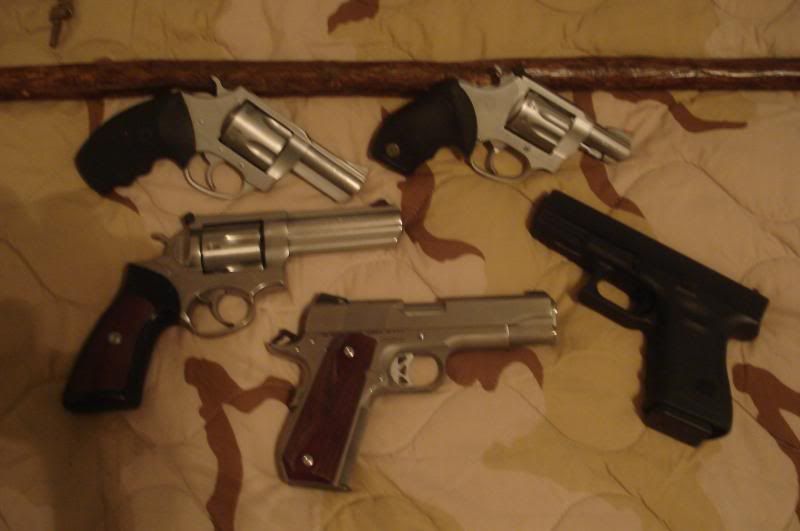
Survival can mean many things to many people and I’ve always felt comfortable with a self-defense item, whether it is a hiking stick, Mace or a CCW-firearm. This category isn’t a survival hunting weapon; this is something you have to provide yourself protection from both two-legged and four-legged critters. I’ve had my close calls and scares to where I’ve just accepted this category as one of my “top 10” essentials…I know some won’t agree, but then that’s why I called it “my” top-ten essentials. For me, a knife is more tool than weapon; sure it can be used effectively, but I like to keep threats at a distance and a hiking staff is an excellent choice and more preferred over a knife. There are commercial versions or hand made versions. Not only does a hiking stick provide stability on rough trails or off-trail, it can be an effective weapon to keep snakes, dogs or other aggressive critters at bay. For a backup, I like a CCW, and it fills that niche well and can even be used to signal or hunt game if in a real dire situation. If you’re in an area where CCW is unauthorized and you’re trying to obey the idiotic laws, pepper spray is a good distance-weapon alternative. For any of the above, a little training goes a long way, even with a walking stick.
So, there’s my ramblings of the evening here in Iraq. I’ve seen posts come up on the ubiquitous “10 essentials” and most backpacking or outdoors websites and publications have there list…but this list is a very personal thing. The top 7-8 are pretty common, but there are always a couple that are very personal in nature and fill the need of that particular individual.
I thought of another area, but it’s not really part of my “essentials” I do have it as part of my EDC and in kit-form for my day pack. A repair kit; sure my PSK has some thread, dental floss, needles, small role of duct tape (and I carry a flat role in my back pocket as well), but it does need mentioning. So, a little Shoe-goo (or other silicone adhesive/sealant), sewing kit (needles, heavy thread, safety pins), duct/100mph tape and few zip-ties can be in a compact package in your waist pack, Camelback or day pack and can handle most of your field repair needs.
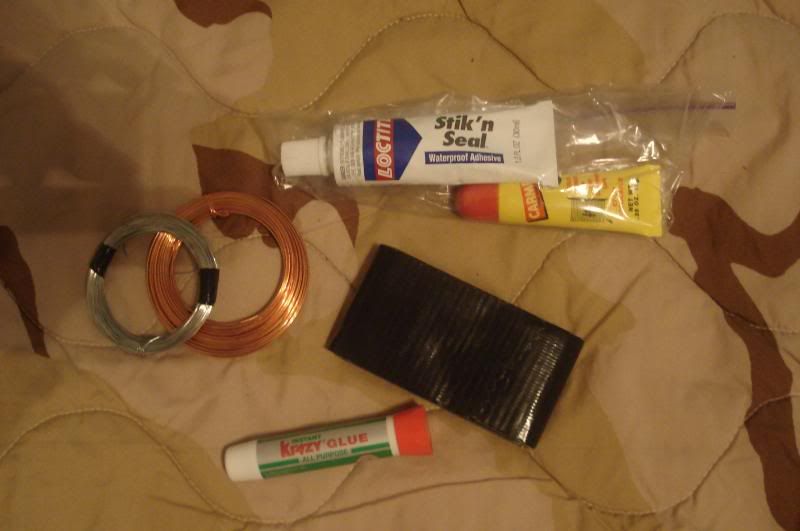
Make your essentials “yours”; make them as much a part of your EDC as you can…habits can be good things if you make carrying them routine regardless if you’re going on a day hike or going to the convenient store. Use your items and know what they are capable of and if they can pull double-duty!!!! I’ve carried stuff before that was never used…they were eventually dropped or replaced with another item that could do double duty. Find out what works for you and develop your own system to ensure you have these essentials on your or within reach at all times. Being prepared takes some preparation, but it’s more of mindset and attitude than a pocket full of items.
ROCK6

I make sure to always have Benadryl with me since I get a pretty bad reaction to bee stings.

I'm not insulting you or preaching to you about this stuff. Anyone can have a blind side or whatever. If you have having really bad reactions to bee stings and you have noticed ever since you started having bad reactions to them that they have become even a little bit worse each time...you might want to seriously consider two Epi-Pens in that pack and making sure that you are not 30 minutes away from a vehicle or 60 minutes from walking out to where an ambulance can meet you. The next one you get might be an unsurvivable event even with Benadryl.


+1:thumbup:Rock, that was an excellent post :thumbup: Lots of useful info in the other posts as well!
Don't forget a tactical wheelbarrow to carry all the stuff in

Who's tactical?

