
Little Bird and Trout

Joined
Jul 1, 2013
Messages
451
A few of the others I've been working on took a turn for the worse....due to operator error... So, to make myself feel better, I started this one a little bit ago. I had some bigger pieces of 15n20 laying around and decided to cut a knife out a while back. It was sitting there, so I decided to get to grinding on it. Somehow, I didn't completely mess it up, though I wish I did better on the plunges and a few other things. This knife is pretty thin and has a fair amount of flex to it. With it being so thin and all the extra holes I drilled in the tang, it's super light.
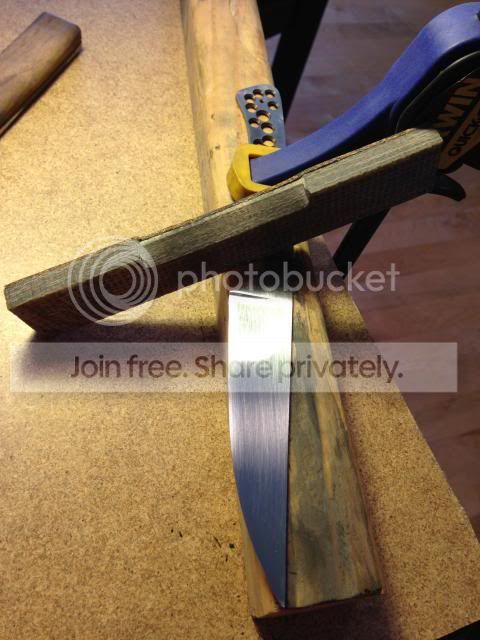
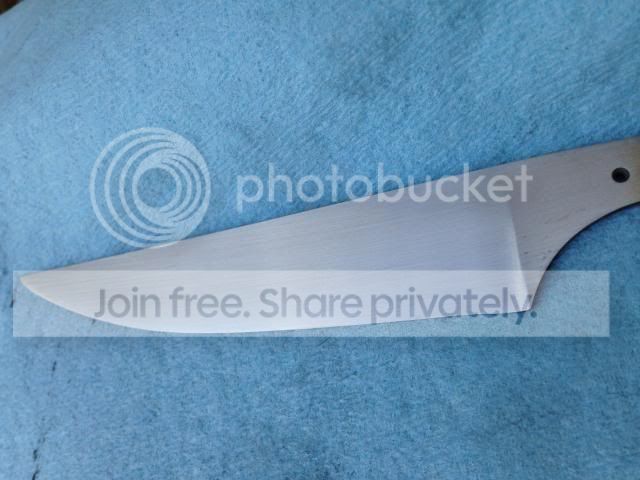
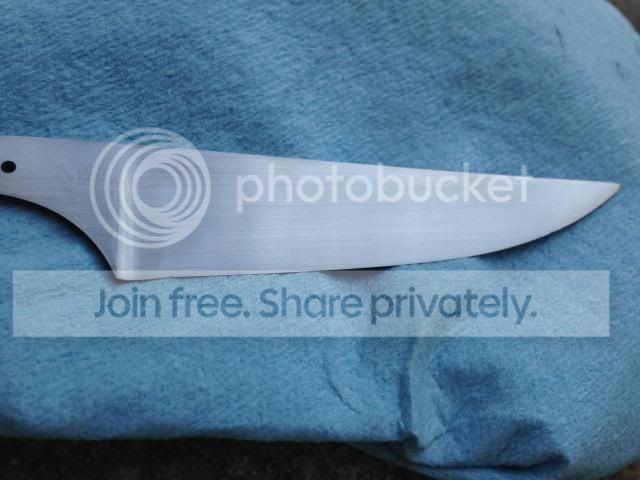
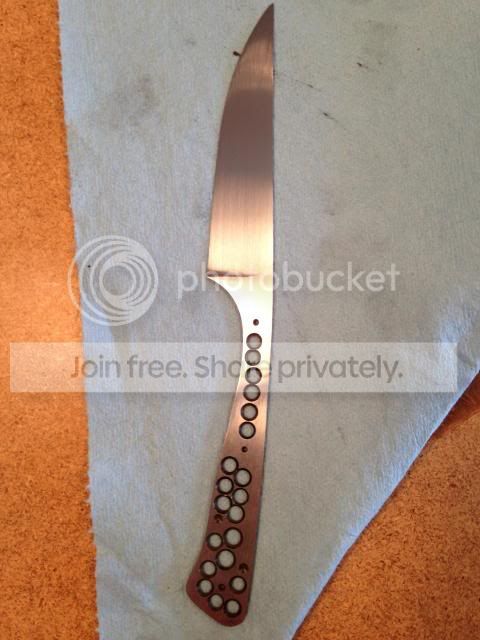


Took it to a nice 600 grit finish, no j-hooks or anything, for once. Picked out a piece of African Blackwood with some figure to it that I think will look nice on it. Still a little ways to go, but might actually hit the finish line with this one.


Jeremy
 
Looks good....and practical.......an excellent combination. Blackwood should make it POP!
 
Thanks for the thoughts-simple but useful is definitely what I was hoping for on this one. And I'm definitely staying away from blocky-blocky is bad :). I cut the scales last night and I'm pretty sure I've convinced myself to go with 3 domed 1/16" pins. I took some stock I had, put it in the vise and started doming. It's really soft drill rod and I think I'm going to give domed pins a try for the first time. Even etched my name in this one... Hoping to keep it going in the right direction.

Jeremy
 
Making a little progress. I got my name etched in it and getting ready to get the scales drilled out. I ordered some of those little clamps that Gareth Bull used in his folder WIP. They're great to hold everything securely so the scales don't slip around when drilling. This is a pic of the under side and you can see the cap screws:


And from the top. I used a piece of scrap from the 15n20 I cut the blade from for a shim under the one jaw up front. These clamps are also really helpful if you have some odd shaped scales. If the blade is flat, you can just have the screws hold the weird shaped bone, antler, etc. tightly up against it and the holes will be straight.


Going to get them drilled, front of the scales finished, then epoxied on with dummy pins. I'm planning on using some petroleum jelly like I believe I saw in one of Nick Wheeler's videos so I can pull them out after the epoxy is cured up. Then I'll finish out the scales and try the domed pins. Any suggestions are really appreciated.


Jeremy
 
Where did you order those clamps from? I know of the linerlock WIP you speak of, but Gareth never mentions specifically in that thread where to get them other than some knife maker in SA.
 
Thanks for the link Jeremy. Are yours the small version (10mm/44mm)? As you mentioned, I can see where these would be beneficial for certain applications. Not to mention, I love helpful little tools like that.
BTW, that's a nice little bird and trout and I love me some African Blackwood. Be sure to post pics when it's done.
 
Shoot-forgot to mention that. Mine are the smaller ones and I believe Gareth's are, too. They're super useful. If you have nicer material, you can just put leather or something to cushion between the scale and the screw so nothing gets marred. Just makes life a little easier and with all the screw ups I make, anything to minimize them is a good thing ;).

Jeremy
 
I was in the garage fixing my drill press and ended up deciding to work some more on this. Then it got late... So, here's what's going on at this point. I drilled the holes through the tang into the wood scale. Then I matched up the two scales and put them in the clamps and proceeded to drill through the first, into the second.


Then, because I've been known to really screw things up, I marked both scales so I knew which way was up...


I cut some temporary pins and pushed them flush on one side. Then off to the band saw where I cut OUTSIDE the line I'd traced on one of the scales. Ask me what happens when you try to cut too close to the line... Everything went fine on this one and you end up with something like this:


Then I put one scale on the knife and figure out what I want the front of it to look like. After I get it drawn how I want, I take it to the belt sander and SLOWLY grind the profile I want. If you're not careful, you buzz right past where you want to go and get a shorter scale, or get to start over...yup-I know about that one, too. Then, I put the pins back in both scales and even the second up with the first:


I took the front of both scales up to 400 on the belt, then started hand sanding. After not much work at all, things start looking fairly nice.


A bit more prep and it'll be time to epoxy it all together. Then, profile the scales down to the tang and contour things nicely. Last will be (hopefully) my first domed pins.


Jeremy
 
Well, things haven't gone so well with this one. I was concerned about the edge holding on it and after some tests, head scratching, and phone conversations, I came up with a game plan. It couldn't stay the way it was, but the plan was a risky one. Didn't have much to lose, so I re-hardened it. Initially, I thought things may turn out. It was really thin and I pretty well thought I'd end up with a knife ruined out of the quench. It came out with some noticeable warp, but without a crinkly edge. I began working towards straightening and later caught a slight wave in a portion of the edge....

I decided to finish tempering and will get it sharpened back up to at least do some cutting tests. After all, that was the whole point of redoing this. I guess a useable knife would've just been icing on the cake. After seeing if the cutting goes well, I'll likely then break it to look at the innards. If nothing else, I want to at least learn every bit I can from this knife.

I've already got more with the same profile marked out on some more 15n20, so hopefully soon I'll be doing a better job on some similar blades... But, time will tell :D .


Jeremy
 
Did you temper it in the oven while clamped to a straight piece of steel? This will quite often correct a warp in your blade. There are a couple tutorials on this site about it. Hate to see a nice looking knife like that go to waste!
 
With 15N20, I have found clamping to a flat piece of steel isn't quite enough. Put a dime or nickel under the blade and overclamp it. I also found 1h temper too short, and go with 1.5 to 2h when correcting warp.
 
Yeah, I was getting the spine warps worked out fairly well shimming and clamping during tempering. The problem that was insurmountable was a wobble in the blade edge itself. The knife was at finished 600 grit and sharpened, but something I'd done wrong in the original heat treat made the edge not hold. So, couldn't leave it the way it was and knew re-hardening could "end" it, but....leaving as is was basically a waste of a blade, too. The wobble in the blade edge meant I couldn't effectively straighten it like I could the spine warps. I'd dulled the edge before heating to try minimizing some warp, but guess it wasn't enough :rolleyes:.

I don't know...one of those frustrating moments but each one teaches me things and this one is no different. It's the first I used my new salt pot on and as with any tool, there's a learning curve there, too. Hopefully all the lessons end up making me better in the long run.


Jeremy
 
Back
Top