Little Giant Questions

Joined
Apr 22, 2010
Messages
235
I'm in the process of buying an early 50# Little Giant. I have to get new dies for it and was wondering what styles are preferred for knifemaking?

Also, I would like to raise the working height by a few inches and my thoughts are that while doing this it would be a good time to mount it onto something that might help with it's portability. The hammer will be moved at least a few more times in my life so I'm hoping to make it easier to do this. I suppose if this could also help to deaden noise this would be a plus too. Any ideas?

I'm a complete noob to forging so please excuse my ignornce and please help - any answers will be golden. :)
 
A motor-driven 50-pound Little Giant trip hammer weighs 1,800 pounds and factory specs want it to have a solid concrete foundation 49 inches long, 33 inches wide and 26 inches deep. I tried getting away with less-- have my Mayer Bros. clone bolted onto a raft of railroad ties through-bolted to each other. The motor is top mounted and the hammer sways impressively. I think the concrete foundation would give the hammer more moxie. Moving these ungainly old monsters is a struggle and I think attempting portability could be hazardous to your health.
 
though not realy portable a suitible base can be made using eight inch by 1/4 inch channel iron. weld a four foot square box out of the channel iron then weld a minimum 3/8ths thick top on it. turn it over and weld a six inch grid of 1/2 inch rebar into it then fill it with cement and let it dry. If you have your hammer present then you can drill holes for mounting bolts into the plate and install the bolts. make sure they are long enough to weld to the rebar before filling the base. flatten everthing off and let it dry a minimum of two weeks before use. you can weld heavy duty casters, that screw down onto the base to facilitate moving or just weld tabs on and anchor the base to the floor. if it don't sit quit evenly on the floor either use a mastic and mortor it down or set it on a piece of thin beltting. put a piece of thin (no more than 3/16) belting on the base and then bolt down your hammer.
 
A motor-driven 50-pound Little Giant trip hammer weighs 1,800 pounds and factory specs want it to have a solid concrete foundation 49 inches long, 33 inches wide and 26 inches deep. I tried getting away with less-- have my Mayer Bros. clone bolted onto a raft of railroad ties through-bolted to each other. The motor is top mounted and the hammer sways impressively. I think the concrete foundation would give the hammer more moxie. Moving these ungainly old monsters is a struggle and I think attempting portability could be hazardous to your health.


I didn't think about the rocking - good point. I'm worried about the concrete situation though.
 
though not realy portable a suitible base can be made using eight inch by 1/4 inch channel iron. weld a four foot square box out of the channel iron then weld a minimum 3/8ths thick top on it. turn it over and weld a six inch grid of 1/2 inch rebar into it then fill it with cement and let it dry. If you have your hammer present then you can drill holes for mounting bolts into the plate and install the bolts. make sure they are long enough to weld to the rebar before filling the base. flatten everthing off and let it dry a minimum of two weeks before use. you can weld heavy duty casters, that screw down onto the base to facilitate moving or just weld tabs on and anchor the base to the floor. if it don't sit quit evenly on the floor either use a mastic and mortor it down or set it on a piece of thin beltting. put a piece of thin (no more than 3/16) belting on the base and then bolt down your hammer.


I like the sound of this idea. I can't picture the casters under the hammer while forging but I'm pretty certain that could be a great thing if it worked out. I'd have no problem giving it a try, I can always take them off. Thanks for all of this.
 
The casters screw down to move the unit, and screw up to let it sit on the floor.
 
I have run a few 'portable hammers" and didn't like em. My 25 LG is bolted down to a 5" stack of 1/2 plywood, that is bolted to the floor, works pretty good. My old 25 was bolted to a large chunk of concrete, it hit harder and moved steel quicker. My 100 LG is bolted to a 40"x48"x36" concrete slab, it hits harder and moves steel better than some larger hammers. Your hammer foundation should weigh more than your hammer.

For dies, call Sid at Little Giant, tell him what you are doing and he'll send the right dies.
 
I have run a few 'portable hammers" and didn't like em. My 25 LG is bolted down to a 5" stack of 1/2 plywood, that is bolted to the floor, works pretty good. My old 25 was bolted to a large chunk of concrete, it hit harder and moved steel quicker. My 100 LG is bolted to a 40"x48"x36" concrete slab, it hits harder and moves steel better than some larger hammers. Your hammer foundation should weigh more than your hammer.

I was afraid of hearing this but making it work right is ultimately the most important thing.


For dies, call Sid at Little Giant, tell him what you are doing and he'll send the right dies.

I'll do that, thanks.
 
Don is right and a hammer that is solidly bolted to the floor works best. the base I described if it is bolted to the floor is very nearly the same thing. making it so that it can be unbolted and lowering screw casters so that you can move it will give the most work and still let the hammer be moved fairly easily.
 
Dave, your hammer will work good with a simi portable base, just not quite as good as it could. The caster idea from Bill is a great idea for hammer that you will need to move.

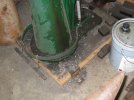
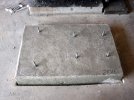
Concrete is really easy to do, but here's what I did with my lastest 25. My 100 is bolted to a yard and a half of concrete and hits harder than most 100s and some larger hammers. Second photo is new pad for new 100 LG :D

attachment.php


attachment.php
 

Attachments

  • 25LG-base1.jpg
    25LG-base1.jpg
    49.5 KB · Views: 116
  • newfoundation2.jpg
    newfoundation2.jpg
    63.8 KB · Views: 114
Thanks for all the input guys, it all helps.

One thing I neglected to mention is that I'm a renter and will most likely be for some time to come. I might not be able to bolt to the floor and I know I won;t be able to pour concrete right to floor.
 
If the hammer has the motor mounted on top, it is really not that much trouble to mount it on the side and this will eliminate alot of the sway. Sid at Little Giant also sells a motor mounting kit.

Sid offers a variety of dies for a fifty pounder. Just go to his site and look around you'll find the different dies he offers. I would recommend flats with a slight radius ground on the front and back, but that is just my opinion. Sid also offers a half flat half drawning that might work well on the work that you are planning to do.

Here's Little Giants website http://www.littlegianthammer.com/ and phone number 402-873-6603. Don't worry if Keri answers (Sid's daughter) she is very knowledgeable in hammers in her own right.

Dave from Diller
 
Don,

I see you've already poured your foundation. How do you know the bolt pattern is going to line up? If I remember right I thought the rear bolts were further away. Hmm.

Dave from Diller
 
Dave S, I know the bolts are right, because Sid sent me a pattern that he took right off the hammer :) Those bolts are 16" long too, and the concrete is 3 foot deep. Be tough to move them if needed...

Dave M, I'd bolt it down in a rental, just grind the bolts flush when ya move.
 
If the hammer has the motor mounted on top, it is really not that much trouble to mount it on the side and this will eliminate alot of the sway. Sid at Little Giant also sells a motor mounting kit.

Sid offers a variety of dies for a fifty pounder. Just go to his site and look around you'll find the different dies he offers. I would recommend flats with a slight radius ground on the front and back, but that is just my opinion. Sid also offers a half flat half drawning that might work well on the work that you are planning to do.

Here's Little Giants website http://www.littlegianthammer.com/ and phone number 402-873-6603. Don't worry if Keri answers (Sid's daughter) she is very knowledgeable in hammers in her own right.

Dave from Diller


The hammer doesn't have a motor currently as it was shaft driven originally and looks to be sitting since. A motor mount kit would be great to have, save me the trouble of fabbing something up half assed. :)

Thanks for the help.
 
Back
Top