Looking for advice on construction and materials for Sheffield inspired folders.

Joined
Sep 18, 2008
Messages
138
Hi,

I have done a few knife projects, and I am looking to make several slip-joint folders for Christmas this year. I really like the look of some of the old pre-WWII Sheffield folders. I have been finding information on 100 different ways to construct slip-joints, but I don't know which methods would be correct for a Sheffield style knife.

For instance, all of the modern folders use milled liners, thin washers, or a bushing to allow the blade to rotate easily. I don't see anything like that on the old knives. Is it not really needed unless you are just trying to make your knives stand out from the crowd and perform at the highest level?

Also materials. Nickel silver for bolsters liners and pins, or is stainless steel going to be that much better?

I will be using 1084 for the blades (and springs I suppose) so that I can easily heat treat myself, but I am unsure as to what to do for the rest of the materials.

Should I stay away from any of the following for handles; buffalo horn, jigged bone, MOP?

If anyone has any information or links on how to construct an older style slip-joint it would be most helpful.

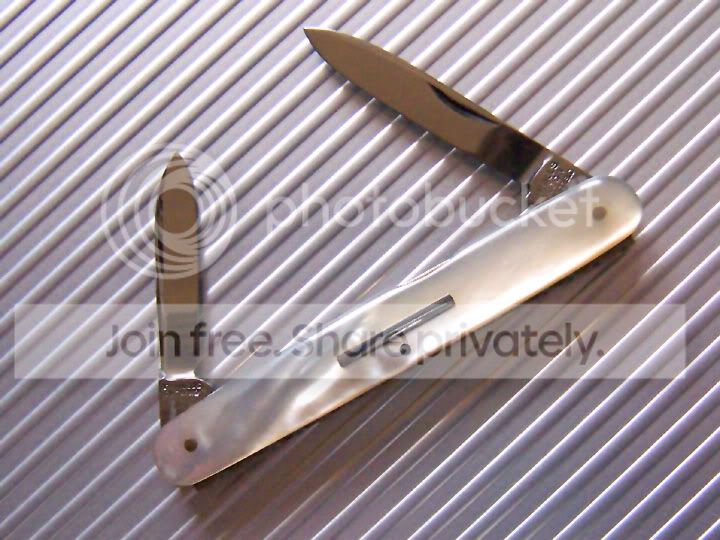
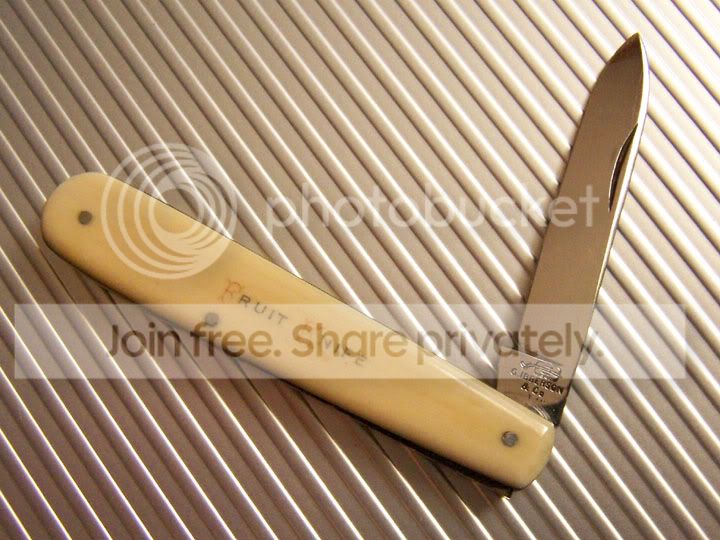
Below are a couple of pictures of the types of knives I am looking to make.

img7755i.jpg


img6798.jpg


millsopenmark.jpg


ibbersonivoryfruitknifefront.jpg
 
Well in truth they did not use washers or mill the liners but I bet some were "scalloped". You can do them without, but will mean more care in the making. and until you get real expert will not have blades that move near as smooth. As far as the nickel silver is concerned it is a far more difficult material to work with than say 410 or 416 stainless and does turn a yellow colour after a time. I say go ahead and make them as you wish. For many of us in this forum self satisfaction is what we chase. Frank
 
There is no need for blade washers. Use thin brass or nickel silver for liners. Nickel silver for bolsters-it's only slightly harder than brass.
There is no need to stay away from any handle material. Horn and jigged bone are very easy to work. Pearl is a little more difficult, especially pinning it unless you have lots of experience.
 
Well in truth they did not use washers or mill the liners but I bet some were "scalloped". You can do them without, but will mean more care in the making. and until you get real expert will not have blades that move near as smooth. As far as the nickel silver is concerned it is a far more difficult material to work with than say 410 or 416 stainless and does turn a yellow colour after a time. I say go ahead and make them as you wish. For many of us in this forum self satisfaction is what we chase. Frank

Thanks for the advice Frank! I did want to say I hope I didnt offend anyone by making it seem that I was minimizing the importance of the many fine details that a lot of the great makers impliment in thier designs. I realize that all of these details make for a world class knife.

I am curious about your mention of nickel silver as being difficult to work with compared with stainless. What sort of problems does it present? I was mainly looking at nickel silver because it is traditional, and I also like the color when it is polished. But if it is going to cause a lot of problems I may go with stainless.
 
There is no need for blade washers. Use thin brass or nickel silver for liners. Nickel silver for bolsters-it's only slightly harder than brass.
There is no need to stay away from any handle material. Horn and jigged bone are very easy to work. Pearl is a little more difficult, especially pinning it unless you have lots of experience.

Thanks for the info Bill! Would you recommend a 2 degree tapered reamer for the pins on this type of folder? Would a general purpose tapered reamer work, or do I really need the 2 degree? Also, do you have any recommendations on sizes for pivot and spring and scale pins for small and medium sized folders?
 
While true most of the custom slipjoint makers today are using stainless liners/bolsters if you want to make a period correct slipjoint by all means use nickle silver bolsters/brass or nickle silver liners. As far as relieving the inside of the frames we do that to eliminate the circular scratches on the tangs of the blades more than any other reason. You can build a very smooth slipjoint with great walk and talk without this feature. Pick up some vintage Sheffield/German/United States slipjoints and you will discover this for yourself! :)

Most modern makers use 1/16 pin stock for the cover pins, and 3/32 for the pivot pins/back spring pins. This however is not period correct. The early manufactures purchased wire in standard wire gauge size. For example, many smaller vintage knives used 14 gauge wire for pivot pins. .080 in size. As you can see this is about .014 smaller than 3/32 pin stock. On certain Sheffield styled knives I have taken 3/32 pin stock and turned it down to this size in my Unimat lathe as it is hard to purchase 410 or 416 wire in 14 gauge.

My advice to you , if your really interested in building a vintage style knife and keeping things period correct, get as many of them in your hand as possible and spend time with a dial calipers measuring thicknesses , pin sizes etc.

And most of all, good luck in your endeavors!
 
Last edited:
I don't use a tapered reamer at all, and I doubt vintage makers did either.
 
I don't use a tapered reamer at all, and I doubt vintage makers did either.

I don't know if it can be said for certain. It would have been much easier to make one reamer that you stopped at the chosen diameter than to try to make a specific straight shank tool before surface plates and dead centers were made. Just an opinion though.

I only have the guts to say that, because most of the tools listed in the book "Le Arte du Coutelliere" are tapered tools. It was published a little after the French revolution if I recall.
 
So if a tapered reamer isn't used for the pivot pin, I suppose the pin just expands near the surface of the bolsters and holds due to friction?
 
You can get used pocket knives in lots on that auction site.
I did that and took apart a dozen or so beat up slip joints to measure, compare, see what I liked about them and what I didn't.
I think that helped a lot and was a relatively cheap way to learn.
Only the cheapest quality knives that I disassembled lacked either a tapered pivot hole or at least a straight hole with a chamfer at the opening.
 
Either way works, I just haven't seen the need for the tapered reamer.
 
Back
Top