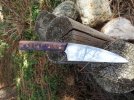
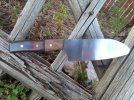
Looking to make my first kitchen knife

Joined
Jun 5, 2012
Messages
57
This will be my first kitchen knife and 4th knife over all. I like the Japanese 8" knife styles.

Few Qs.

What's the ideal steel for a knife of this type. I'd rather oil often than to be constantly sharpening so on the higher carbon end.

What thickness 1/8"? What grind?

What hardness?

I've only worked with O1 and I send the knives out for heat treatment.

The knife will be used to chop veggies hammers and bricks...Jk remember ginzu ha. No the knife will be an overall user. So veggies beef chicken fruit.

Piggy back question. What's the best material for a cutting board not to dull knives.

Thanks for all the help!
 
My opinions:

O1, A2 or 52100 (send it out for HT, which you do)

1/8" or less, flat grind, blade thickness 1mm back from edge less than .010", 0.004 is good.

Rc 61-63

Best cutting board is moderately hard wood (e.g. maple, walnut) end grain. I need to take my
own advice here :foot:
 
Quality stainless steels with proper treatment wouldn't need to be sharpened often, but given the difficulty of treating them, your familarity with 01, and kitchen knives being more difficult to make in general..I'd just stay with the 01 for the first.

Grinds are highly based on preference, but many people seems to prefer 0 edge taper grinds based on what I can tell.
 
I am making a small paring kitchen knife. I am using 1095 carbon steel, but mainly because it is what I have right now.
 
My favorite kitchen knives have that sabatier/sujihiki shape, no bolster attached to heel, and whether 60/40 or 50/50 is not important.
Carbon steel is highly prefered by me and many chefs.

ususlly carbon is best at higher rc, perhaps 61 and above.

fpr veggies you want thin, I believe chicken has its own type of knife (honesuki).
 
Get a bar of 52100 from Aldo. He has it wide and thin now. I got six bars from him this weekend. Roman Landes did a great lecture on knife steels, and 52100 is his choice for carbon steel for kitchen blades. AEBL is great for stainless. CPM-S35VN is a close second.

For a big kitchen knife use .100 - .130" stock. For smaller ones, .070" is good.

With the right HT, 52100 has a super fine grain and the carbides are tiny and well distributed.

Aldo's 52100 is super annealed from the mill, and requires a longer solution step prior to hardening. In the first cycling step, heat it to 1650F and hold for 30 minutes to put the spheroidite back into solution.


Here are some of my comments from a previous discussion:
52100 is one of those steels that gets a lot of discussion. It can make a great knife, but the HT for it is not simple. It will only make a so-so knife with a so-so HT.
I will tell you the metallurgical way to do the HT for 52100:
The steel has 1% carbon and 1.4% chromium. This means that it is hyper-eutectoid steel with a fair amount of alloy to form chromium carbides. You will have to do the HT in such a way as to allow those elements to form the proper structures. To do this you will need a HT oven or forge that can be held at a controlled temperature for ten to thirty minutes, and a quench oil that will harden the blade. The oil should be a medium speed commercial quench oil, but Canola will do if nothing else is available. Forget about motor oil and ATF, etc.

Forging - Forge 52100 HOT. It is forged between 1700°F and 2100°F, and should not be forged in the lower red colors. Cold forging is bad for this steel.
Normalize ( stress relieve) - Heat to 1650°F and air cool.
Annealing is tricky for 52100. The best way without really good equipment is to do a sub-critical anneal. Heat to 1250°F and cool to black. Then quench in oil. Do this a couple times.
Cycling the steel - This is one of the Triple Treatments often mentioned with 52100. It will get the steel ready for its final hardness and produce a fine grain. Start by heating the steel to 1650°F, hold for five minutes and quench in oil ( SEE NOTE ABOVE). Re-heat to 1350°F and quench in oil. Heat again to 1250° and cool to black, then quench in oil. Now the steel is ready to harden.
Hardening - Heat the steel to 1475-1500°F and hold for ten minutes. Quench in oil.
Tempering - Immediately temper at 400-450°F for two hours, cool in running water, and repeat the temper.
Sub-zero treatment - 52100 can benefit from sub-zero treatment if you have the ability. Do a snap temper at 300°F and them immerse in a sub-zero bath at -100F before the first temper.

If sending the steel to Peter's HT, just tell Brad that it is Aldo's 52100 ... he has a program for it.

 
Stacy: just to clarify, are you saying you think AEB-L is better than S35vn for kitchen knives? (don't mean to hijack the thread)

- Chris
 
looks like there are a few good choices for steel. From the sounds of it 52100 is the steel to try. If not ill go with O-1.

so basically a 6-8" blade. .125 thick flat ground. (do you put a secondary bevel on flat grinds?) in either 52100 or O-1 at 61+RC
Stacy thanks for the great response on 52100. If I go that route I will go with Peters for heat treatment.

Dan thanks for the cutting board response too. I have a bamboo but my knives are cutting the heck out of it.
 
He would not be the only one to think that. The big argument in favor of AEB-L would likely be that crazy abrasion resistance is not as important in kitchen knives as the ability to get a crazy thin, sharp edge that is very stable at high hardness levels and fine grain steels like 52100 and AEB-L excel at that. W2 works well also. I have been told that the old German 115W8 does the trick too and I am about to find out. For the high alloy PM stuff, some of the brethren on here have had also good luck with CPM 154 and CTS-XHP.
Stacy: just to clarify, are you saying you think AEB-L is better than S35vn for kitchen knives? (don't mean to hijack the thread)

- Chris
 
Roman Landes had micrographs to support this. AEBL is finer grained than CPM-S35VN. The edge can be made thinner, and sharper, due to the smaller carbides. 52100 makes these steels all look like coarse concrete compared to the super fine grain and tiny carbides it has. If rusting isn't the main issue, 52100 seems to be the best ( and I use that word carefully nowadays) steel for a kitchen knife.
 
Thank you for the clarification on the 52100. I was amazed at the edge I got on my first hunter with it. It is out in the field now being tested. My friend, Randy, the hunter will let me know the edge holding based on the HT I did. It was similar to what Stacy listed, but not exactly the same. I will be using more of this steel and learning the Ht sequence as posted above.
 
Thats good to know it works well as a hunter blade as well. Aldo sells this stuff in 48" bars so if i find out im a terrible kitchen knife maker I can go back to outdoor blades with the rest of the material.
 
My best and most used knife is 52100. Since I had one made in that steel, I have not felt the need to try anything else. I only work seasonally now due to my age and remote location but still have 30 years + behind the rail. All the super steels s30vn etc. are great but then one day you notice they are dull and you have to work now. 52100 is easy to sharpen without machinery and can be rapidly done. That is a big bonus in real life use.
 
Also remember that with oil hardening steels you are going to need to leave the edge thicker before heat treat. With the air hardening steels you can go much thinner before heat treat. Brad @Peters will tell you more about this.
 
I am thinking about making a chef's knife for my Old Man for christmas. I am using A2 and will send it out to Peters for heating. What would be a good medium to force a Patina with A2?
 
Stainless is great for making knives for others since the less knife nutty individuals tend to get better service from worry free / maintenance free knives. My wife generally avoids all of my knives except for my aeb-l gyuto which she leaves dirty (I said to never put in dishwasher) but is no worse for wear (I also never put a handle on so its super durable lol).
 
Good point about the handle. A Japanese oval,"D", or Wa handle can be easily knocked off and replaced. This is also a plus when the blade needs major restoration of the edge.
 
How does one go about oiling a kitchen knife. Could you just use a vegetable oil or is there a special food grade oil that's used?

Good tip about the edge thickness. I will be going the Aldo + Peters route.
 
I used 1/8" 52100 and had it heat treated by Paul Bos. I ground the knives after heat treat and I can tell you that I wish I had used 3/32. I was grinding, filing and hand sanding for what seemed like 2 days of work. In the end I was very happy with the results. Don't be afraid to post pictures and ask stupid questions and ask for opinions. Check out the two knives below. BTW I was using a craftsman 2x42 w/ 60 grit blaze belts then went a65 then a45 gator belts with a felt backing on my platen.


attachment.php


attachment.php


20130914_130053.jpg20130915_182832.jpg
 
Back
Top