Low tech anti decarb ideas?

PEU

Gaucho Knifemaker
Joined
Aug 6, 2006
Messages
1,182
Hi guys, I'm posting to ask about ideas to prevent or minimize decarb on high carbon steel, in my case O2 (Bohler K720)
I don't have the luxury of Amazon here in Argentina, so the solution, even if not ideal, should be doable at the shop. I can find chemical components, that should be no problem unless you ask for plutonium :)

I do have stainless foil, but in my experience is an obstacle more than a solution for HC steels.

Thanks in advance


Pablo
 
Just mix up a thin slurry of satanite or potters clay. Coat the blade with a wash of it and let it dry...HT as usual from there. The slurry can be kept in a dry wall bucket and used for a long time. Add water or clay as needed.
 
Another idea is Borax powder - there is an roach poison here in USA I use that's basically borax powder. Heat blade to low temperature, sprinkle borax power on, it melts to a clear coating. Then heat treat as usual. Works "pretty" good - it's the only thing I've used. Perhaps satanite will work better, but I didn't have any so just used borax powder.

Ken H>
 
My over active mind sees clay washes as something we use to keep steel from hardening fully- AKA making a hamon.

What amount or type of clay would be sufficient to keep 1075/1095/W1 from cooling quickly enough in brine to fully harden?
Or would that only be determined by testing each one?

Borax "seems" like it would be a thin enough coating that it wouldn't be an obstacle, but again....
 
A wash of clay keeps the entire blade from the air. Unless it is thick, it won't slow the quench. Most all Japanese blades get a wash of clay before HT.


I made my own "Turco" a few years back. It was yellow ochre powder, borax, boric acid, powdered charcoal, gum tragacanth, and a bit of satanite. The carrier was denatured alcohol.

It worked pretty much like Turco did. I found a wash of satanite worked nearly as well, and since I have to grind the blade after Ht anyway, there was no real need.


You might mix a pound of yellow ochre and a pound of satanite/clay to make the slurry and get a bit of color as well as coating ability. Keep it tightly sealed and add water as needed. If you only do a knife or two at a time, a much smaller batch would be a bit cheaper, but a pound of ochre is only $15.
 
I'm curious about this, I'm planning to do a video soon showing people how to make an O1 chefs knife with really minimal tools, and I would love to be able to use a homebrew anti-scale as part of that process. Doing most of the sanding before heat-treat really makes like easy... Having to re-sand a hardened blade is brutal.

Would a thin wash of something like plaster of paris have the same effect? Or is satanite the go-to? Potters clay is an interesting option... I'm trying to think of what's going to be the easiest for people to source in small quantities either from amazon or from a place like home depot.
 
Just had a look on Amazon, apparently Crayola make an 'air dry clay' intended for kids projects. It looks very similar to potters clay (and probably is) It's $4 for a decent sized tub. Going to their website shows instructions for making a slip from the clay, so it's definitely water soluble. Might be an interesting and cheap option...
 
Thanks guys, will try with the mix I made for hamon which works great but will dilute so it can be "splashed/slurried" over the blade.

The mix I use is:

1 part refractary clay
2 parts sand
1/2 part honey
1 tea spoon Sodium Silicate
2 soup spoon Kaolin

Im sure the sand will fall as it does not dissolve as the clay...

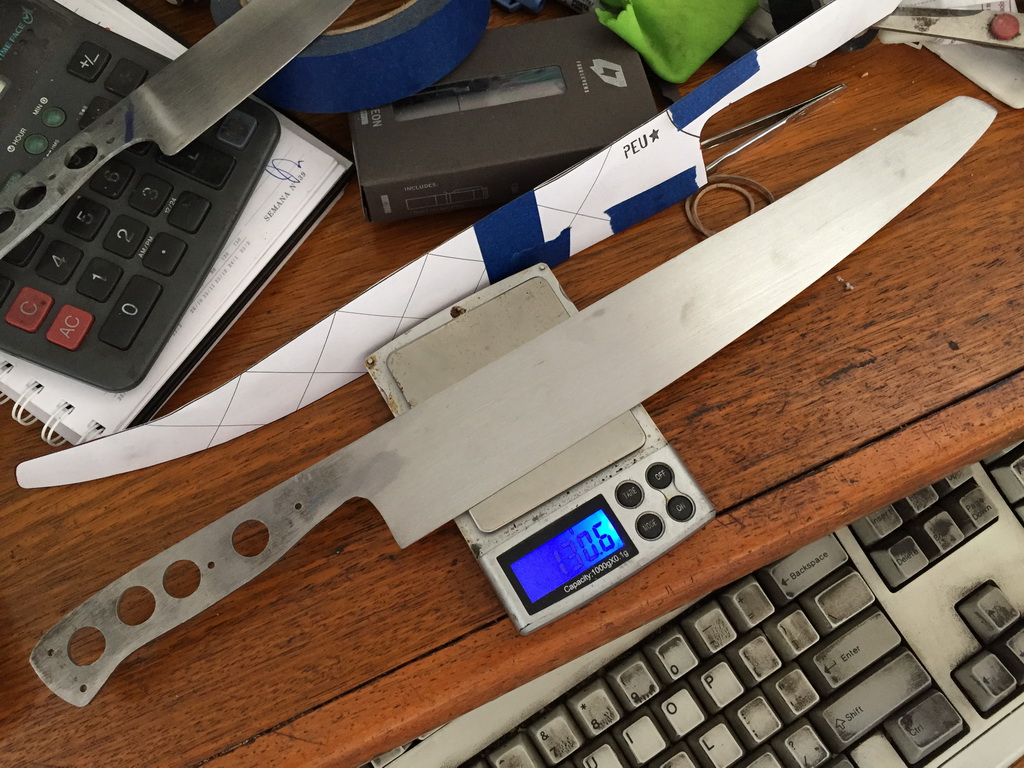
Im making this knife for a friend who is a professional pastry maker (don't know the right word sorry :) ) its 3/32" thick and the blade is 11" long so I need to activelly deter the decarb otherwise I would end with no metal...

130 grams / 4.6oz One of the specs was less than 200grams so Im on spec, the shape was decided by a 50 years old knife he uses and has the tip broken, he loves it because its lightweight and can be used as a spatula too :)

cO31M0G.jpg


Pablo
 
Certainly somewhere in Argentina there are people hardening stainless steels for all sorts of needs.
It is used quite often in the firearms industry.
I can see no reason why you should not be able to find some.
 
Another idea is Borax powder - there is an roach poison here in USA I use that's basically borax powder. Heat blade to low temperature, sprinkle borax power on, it melts to a clear coating. Then heat treat as usual. Works "pretty" good - it's the only thing I've used. Perhaps satanite will work better, but I didn't have any so just used borax powder.

Ken H>

Borax should be in most grocery stores in the cleaning aisle. 20 Mule Team Borax.
 
Stainless is no problem to me, I have foil, this thin O2 knife made me ask. You guys provided good ideas, after HT will post my comments, hopefully tomorrow.

For the long and thin blade I'm also concerned about warping, I plan to sandwich the freshly hardened blade in steel to reduce any possible warpage.


Pablo
 
Knifes were hardened succesfully, blades are tempering now, I think the slurry worked because I measured hardness and it was around 62-63 RC, when usually O2 hardens to 64-65 out of the oven. The difference I guess is a very thin layer of decarb, far less than a test piece of the same steel I hardened afterwards. On the slurried blades there was almost no scales.

I used pottery clay, purchased at a local store very very cheap.

The long blade came out fairly straight, right after quench I put it under weight on a flat surface, that helped for sure.


Pablo
 
Back
Top