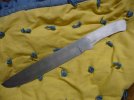
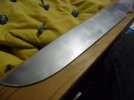
M2 goodness, its big :D

Joined
Jun 11, 2006
Messages
8,651
well yesterday i unbolted my NWG from my bench and put the KMG clone in its place. I could not resist grinding on it and this is what came out. it M2 and around like .100 thick. it is ground from a power hack saw blade. every time i grind one of these i swearer i will not grind another one. i went through 3 blaze belts grinding the profile and edge bevels. it has a full flat grind to the spine which is about 1.66" away from the edge so its kinda wide. and the blade is 10" long. but what I'm wondering is should i temper it a bit more. this thing reads 66-67 HRC and is so hard I'm worried its not keeping an edge like it should. i sharpen it and it gets a razer sharp edge but seams to loose it fast and I'm thinking the fine edge is just to brittle. i have been thinking of tempering it down to say 63 HRC or maybe 61 but i wanted some input. i made this for a fun cutting comp blade. for like watter bottles, hanging paper and rope. just a fun play blade. so here are the pictures. it is getting a rubber handle. the blade is dark because i rubbed gun bluing on it to see how it would take. it just darkens it a bit kinda like a patina. enough talking here are the pictures.

attachment.php


attachment.php
 

Attachments

  • P1020125.JPG
    P1020125.JPG
    38.1 KB · Views: 394
  • P1020126.JPG
    P1020126.JPG
    38.6 KB · Views: 394
Not an expert on this type of steel but I'll do my best within my own experience.

Looks like you did this blade without losing the original hardness.
In treating M2, the quenching temperature is quite essential as it decides what kind of purpose the steel is going to be used by controlling the carbide condition.
If it has HRC over 65, maybe hardening temperature was too high to be used for
fine chopping/slicing edge as it gets brittle in microscopic scale while gaining
more abrasion resistance (and HRC hardness), which should be an ideal treatment
for using as a hack saw.

It may keep good edge exceptionally long with more obtuse edge angle.
 
A recommended test for blades that I believe in, is to place a 1/4" brass rod in a vise and draw the edge across this with some presure on it downward. The edge should flex but return to the original straight edge position. If it cracks or chips you know it's too hard; if it does not return , it's too soft. Frank
 
A general note on rockwell tested on blades.

A blade may be tested at,say Rc62, but that is the hardness where the testing stylus can be applied. The actual edge is often much lower, and there is no simple way to get an accurate Rc of the edge. I know that we all try to be as careful as possible when grinding a hardened blade, but the physics involved in removing the hardened steel from the edge make huge stresses and can severely alter the temper, hardness, and grain structure at the edge.

In the case of localized heating ( you may not see it, but it is there), the edge is heated to high temperature by the friction of the belt grit running over the edge.This happens in a microscopic area at the edge, but the damage can carry back several millimeters on a fine edge. In rough hogging (on unhardened steel) you often see the edge turn bright red. That is often between 1200F and 1400F. Even with care in grinding the edge may heat to near 1000F on a blade with no sign that anything is happening. The heat is rapidly absorbed into the thicker blade body which gets hot...... you may think that it only got to a couple hundred degrees, but the edge is the source of much of the heat that warmed the blade up. You can grind bare handed and the blade will only get good and warm, but the edge can still momentarily attain high temps.
All this can result in a Rc62 blade with a Rc52 edge.

In the case of an embrittled edge, the same forces may create an overly work hardened and/or temper embrittled edge. This edge may seem wickedly sharp, but not last worth a hoot, due to micro-chipping. In this case a Rc62 blade may have a softer or harder, but brittle edge.

Magnified examination of the edge after sharpening, and again after testing will tell a lot about what is actually going on. Use a good 10-20 power loupe to check the edge out. Use strong light and examine the edge carefully.CAUTION: you are putting a very sharp object close to your face. Pay attention and be careful! If the edge looks good after sharpening, but looks all serrated ( microscopically) after testing, then it is either too acute, or too brittle. If it looks rolled ( microscopical) or rounded, it is too soft ( or too obtuse). The brass rod test is a non-magnified test for these conditions. Even after a brass rod test, magnified examination of the edge can reveal a lot.

I mentioned grain structure earlier. Grain growth occurs when grains grow into each other, absorbing the boundaries and becoming larger. At high heat this can happen easily. At temperatures below the Mf, it is static, and growth does not occur.However, any addition of energy to the grain boundaries can create grain growth. Heating to 1600F is one way to rapidly add energy.Even heating to above the Ms can allow slow grain growth . Adding kinetic energy in the form of friction between grains or friction between the metal surface and another surface can also cause grain growth. This creates heat energy,too, but is much more localized ( at the grain boundary) than heating the whole object. If you have ever wanted to cut a coat hanger and didn't have a pair of diagonal cutters handy - what did you do? You bent it back and forth until it suddenly broke apart in your hands. What you did was create larger and larger grains at the site of the bend, until the grains were so large that they had insufficient structural integrity to stay together. Imagine concrete made with pebble size rocks compared to concrete made with basketball sized rocks. Both are the same hardness, but the smaller grained one is many times stronger, as there are millions of times the number of grain boundaries sharing the physical load.

OK, enough physics....it will make JT's head hurt.

Stacy

 
Last edited:
A general note on rockwell tested on blades.

A blade may be tested at,say Rc62, but that is the hardness where the testing stylus can be applied. The actual edge is often much lower, and there is no simple way to get an accurate Rc of the edge. I know that we all try to be as careful as possible when grinding a hardened blade, but the physics involved in removing the hardened steel from the edge make huge stresses and can severely alter the temper, hardness, and grain structure at the edge.

In the case of localized heating ( you may not see it, but it is there), the edge is heated to high temperature by the friction of the belt grit running over the edge.This happens in a microscopic area at the edge, but the damage can carry back several millimeters on a fine edge. In rough hogging (on unhardened steel) you often see the edge turn bright red. That is often between 1200F and 1400F. Even with care in grinding the edge may heat to near 1000F on a blade with no sign that anything is happening. The heat is rapidly absorbed into the thicker blade body which gets hot...... you may think that it only got to a couple hundred degrees, but the edge is the source of much of the heat that warmed the blade up. You can grind bare handed and the blade will only get good and warm, but the edge can still momentarily attain high temps.
All this can result in a Rc62 blade with a Rc52 edge.

In the case of an embrittled edge, the same forces may create an overly work hardened and/or temper embrittled edge. This edge may seem wickedly sharp, but not last worth a hoot, due to micro-chipping. In this case a Rc62 blade may have a softer or harder, but brittle edge.

Magnified examination of the edge after sharpening, and again after testing will tell a lot about what is actually going on. Use a good 10-20 power loupe to check the edge out. Use strong light and examine the edge carefully.CAUTION: you are putting a very sharp object close to your face. Pay attention and be careful! If the edge looks good after sharpening, but looks all serrated ( microscopically) after testing, then it is either too acute, or too brittle. If it looks rolled ( microscopical) or rounded, it is too soft ( or too obtuse). The brass rod test is a non-magnified test for these conditions. Even after a brass rod test, magnified examination of the edge can reveal a lot.

I mentioned grain structure earlier. Grain growth occurs when grains grow into each other, absorbing the boundaries and becoming larger. At high heat this can happen easily. At temperatures below the Mf, it is static, and growth does not occur.However, any addition of energy to the grain boundaries can create grain growth. Heating to 1600F is one way to rapidly add energy.Even heating to above the Ms can allow slow grain growth . Adding kinetic energy in the form of friction between grains or friction between the metal surface and another surface can also cause grain growth. This creates heat energy,too, but is much more localized ( at the grain boundary) than heating the whole object. If you have ever wanted to cut a coat hanger and didn't have a pair of diagonal cutters handy - what did you do? You bent it back and forth until it suddenly broke apart in your hands. What you did was create larger and larger grains at the site of the bend, until the grains were so large that they had insufficient structural integrity to stay together. Imagine concrete made with pebble size rocks compared to concrete made with basketball sized rocks. Both are the same hardness, but the smaller grained one is many times stronger, as there are millions of times the number of grain boundaries sharing the physical load.

OK, enough physics....it will make JT's head hurt.

Stacy


OK so the question is this, can i cause grain growth by re tempering at say 1100 or around there. i was looking over crucibles pages on M2 and thy say that for higher impact strength it needs to be at 62 RC but does that also mean that if you want 62 RC you have to quench it from a lower heat then you would use to get say 66 RC. I guess I'm just wondering is thus, if i temper it down to 62-63 am i going to gain anything from it or just loose ware resistance and i will still have a brittle edge from tempering. man it would just have been easier to start with plane UN heat treated stock and do it all my self. o well, thanks man
 
The origional HT is what determines the grain size. Tempering it will reduce brittleness and increase toughness, but it won't change the grain size appreciably.

Short cuts all have trade-offs. If you try and re-grind something that was made to do one job, it will be less than optimum at another job. Re-doing the HT will start off on square one.
Stacy
 
Back
Top