Machete Sheath

Joined
Jun 5, 2006
Messages
2,718
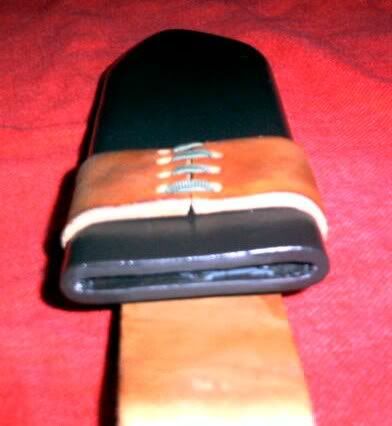
Here's a picture of a machete sheath I modified for my Tramontina:


61ur8le.jpg


I bought the Tramontina from SG about 15 years ago. At that time they came with a flimsy canvas sheath. Initially I stiffened it up with an insert made of corrugated cardboard wrapped with gaffers tape and used it that way for years.

This past winter I wanted to improve it so I re-inforced the belt loop with a scrap of horse hide and covered the canvas with papier mache. In this case, I used ripped up pieces of brown paper shopping bag, dipped and soaked in carpenters glue, and laid them over the canvas. When dry, it's hard as a rock and I coated it with polyurethane varnish. It looks and feels like smooth tree bark.

The handle came wrapped with two strand copper wire, I don't know if they do that anymore. The blade is 17", I don't find it too long. I've used it and abused it as you can see, bushwhacking through sapling and cedar thickets here in northern New York, splitting wood, cutting wooden tent pegs.

Thought you might be interested in seeing another material that can be used for making a sheath.
 
Coldwood,

They still sell that style of machete here. I bought one a few months ago. On all the ones they had in the bin all of the wire wrap was a little loose. That is a very comfortable handle though.

Innovative sheath, I never would have thougth of that as sheath material. I have used simple sleeves of cardboard and duct tape before, more a blade protector than a sheath. Leather here is cheap. I'm in the process of learning how to work leather and one of my projects will be to make a sheath for that machete. Mac
 
... I never would have thougth of that as sheath material.

I didn't either, initially. It's amazingly strong stuff. Historically, they used to build furniture out of it. I started playing with papier mache to make full-head Halloween masks and when I realized how hard and tough it was, I started thinking of other uses. Unlike fiberglass, which I have worked with, it's generally non-toxic and ridiculously cheap and easy to use.
 
Oh, well, this is a thread that's going nowhere fast! :eek: :) I don't know how this stuff would stand up to a swim in the Amazon, but as I said it feels as tough as bark and probably shoe leather. I thought it would attract more interest, because it's so easy to apply, but maybe the French name and the fact that it's "paper" put people off.
 
That looks a lot better than the cardboard and duct tape wonder that I made up for my 14" Bolo. Mine works, but it is nothing special to look at. I may try doing a paper mache sheath someday, thanks for the idea.
 
I have decided to try your idea on my new machete sheath. Those canvas sheaths stink. I was at wal-mart today and found waterproof carpenter's glue. I'll let you know how it turns out. Thanks for the idea. - Chris
 
Nice job.... Saranac?? Beautiful country up there.... Not bad beer either. always nice to see another ny'er
 
I didn't see this yesterday- wow!

I'm very curious as to long term performance. But at the very least, you've shown me a ridiculously easy way to make sheaths for ren faire props! If you knew how much wittling of slats I've done over the years to make the body.....
 
Oh, well, this is a thread that's going nowhere fast! :eek: :) I don't know how this stuff would stand up to a swim in the Amazon, but as I said it feels as tough as bark and probably shoe leather. I thought it would attract more interest, because it's so easy to apply, but maybe the French name and the fact that it's "paper" put people off.

I'm going to try it. I think I'd go with a darker color, but I think the idea is a good one. Non-toxic. Easy. Cheap. Strong. What's not to like?:)
 
This is a really good idea, I have to try it now, I have a few Knives in need of Pants that I will try it on.
 
Coldwood,
How many layers did you put on?


About three, on top of the canvas, with the cardboard/tape insert inside (and if you don't have a canvas sheath to start with, that's an easy fix). If anybody wants to email me off-forum, I can give a more detailed explanation and a few tips...unless you want me to lay it all out here. It's quite easy, a kitchen counter project that takes about 1-2 hours, then some drying time.
 
unless you want me to lay it all out here

You started, you might as well lay it all out in public. I haven't done anything with paper mache since highschool and that sorta collapsed under it own weight. Any tips from from someone who's done this and had it work well would be great.

I'm thinking that if I don't have a canvas sheath to start with for a core, corrugated cardboard and duct tape or pallet wrap?
 
You started, you might as well lay it all out in public. I haven't done anything with paper mache since highschool and that sorta collapsed under it own weight. Any tips from from someone who's done this and had it work well would be great.

I'm thinking that if I don't have a canvas sheath to start with for a core, corrugated cardboard and duct tape or pallet wrap?


The stuff you used in highschool was probably just paper pulp mixed with water, and that doesn't have much strength. What you're going to use here are ripped up pieces (about 3-4" long) of brown paper shopping bags, very tough stuff. You're going to soak these through with thinned carpenters glue (Tite Bond or Elmers). You'll need about a pint.

The glue comes out of the bottle too thick to use, so pour a fair amount into a glass bowl and thin it with water, to about the consistency of cream. If you get it too thin, just add more glue. Mix it up good.

If you have a canvas sheath to start with, make a folded cardboard insert to go inside to stiffen it up. This can be wrapped with duct tape of your choice. The belt loop on mine was flimsy cotton webbing and I beefed that up by cutting a strip of horse hide and using DAP Weldwood Contact Cement to glue the leather over the webbing; making sure that one end went well inside the sheath...and the other end went far enough down the back of the sheath to be covered over with the paper layer.

Now give the outside of the sheath a coating of the glue mix with a brush, sort of a primer. You don't have to wait for it to dry, this just gives the paper strips something to bond to.

I said this was a kitchen counter project because your hands are going to get messy with glue and your going to want to wash them in the sink. The glue is water-soluble while it's wet, but pretty hard and waterproof when it's dry. Lay down a couple of sheets of waxed paper to protect the counter.

Now that the canvas is primed, start soaking a few strips of paper in the glue mix and start laying them onto the sheath. Start at the bottom tip, wrapping around the curved edge, and start laying them up to the top. Make sure each piece overlaps the previous one. You're going to have to use your fingers to smooth them down nice and tight. Wipe off any excess glue mix.

Once the curved edge is done, start filling in the middle of the sheath, front and back. Then do the back edge. When it's covered to your satisfaction, set it aside to dry. If inside, you might have to wait overnight, setting it outside in the sun will speed it up.

Once it's dry, you can sand the rough spots lightly. If you want to add more paper, have at it. The beauty of this stuff is that you can keep building on it until it's as strong and thick as you want. When dry, it's fairly light weight.

When it's finished to your satisfaction, you can give it a sealing coat of clear polyurethane varnish and call it done. If you want to stain it, do that before you seal it, I would recommend something like leather shoe dye. Or you can get artistic and paint in a camouflage pattern, or your personal logo, or a death mask, etc :) You can do a quick and easy leaf pattern by gathering a few leaves from outside, lay them over the sheath, and spray it with black, brown or green paint. Lift the leaves off and you have a nice negative leaf pattern (I got that from watching Martha Stewart :) )

I use brown paper bags because they have a natural color; I rip the strips by hand because that gives the paper an irregular feathered edge, natural and organic looking. You can cut them with scissors, if you choose, but I think the straight edges would look funky.

IF YOU DON'T HAVE A CANVAS SHEATH: Get a good heavy duty cardboard that you like and fold it in half. (If the cardboard is coated on one side, make that the inside of the sheath...you want the natural paper side on the outside)

I haven't tried this yet, but if you want the handle of the knife or machete to go inside the sheath, I think you could wet the cardboard at this point and mold it around the handle, just like you would with leather.

Lay your blade over the cardboard and cut out the shape. I would make it about 1/2" extra large. Before you tape it up, add a leather belt loop. Cut it out of a scrap of leather or cut it from an old leather belt (find those at the Salvation Army thrift store).

Glue the belt loop to the front and back side, on the back side of the sheath, with Weldwood contact cement. Then re-inforce it with stitching or a couple of rivets, or grommets.

Then use a thin strip of duct tape to seal the front edge of the sheath. I say a thin strip because I'm not sure how well the carpenters glue will adhere to duct tape. Then proceed to prime the sheath and lay on paper strips as mentioned above.

You can get as creative with this as you want and mistakes can be easily fixed. Good luck and show us some pictures :)

 
You can make a new scabbard by taking a piece of PVC electrical conduit or water pipe, heat it up in the oven, with a heat gun, or over the barbecue grill, and then flatten it out. Stick the machete blade in it before it hardens so you get a good, snug fit. Just cut it to length, like an inch or so below the tip of the blade. No need getting fancy with shaping the tip with a machete sheath, such as with the bowie sheath shown below, and the open end will drain water really good.

Prep the scabbard for taking a frog type holder for attachment to a belt. One way to do this is to file the edges on each side for a couple of inches near the top so that a sewn piece of web belt, like a length of seat belt, can hold the new scabbard.

You can paint it with either plastic paint from Walmart or Home Depot, or get a can of plastic primer and then spray on whatever color you want, like olive drab.

Here's an example:

W49_Sheath_1.jpg

W49_Sheath_5.jpg
 
Back
Top