Machete

I think this is good golok/parang territory, especially if the wood is still green. 2" is 1-3 swings. Roughly double for each additional inch (2-6 for 3", 4-12 for 4", 8-24 for 5", etc). I think that's easily manageable with a thicker machete style but certainly a boys axe will make very quick work of it. I very kuhkri's like shorter axes, basically.

If it's dry, go the axe or saw route for sure. A big advantage to an axe in this scenario is the ability to use both arms and more of you're body to get weight into the chop. Depends on the wood, how portable you need the tool and all that. I really like machetes/goloks/choppers if there's a lot of weeds and brush around the tree's I'm working on as that's often a big spot the axe loses; much more specialized.
 
If you go with an axe, check out the Rinaldi line at FortyTwoBlades FortyTwoBlades 's website, baryonyxknife.com.

Zieg

And I second this. I will also point at the trento pattern as a nice thinner blade that bites really will into small stuff and because of the length of the cutting edge it makes a reasonable tool for clearing brush around a target if you don't want to carry a lot of tools. I can stick pretty bad like machetes do so it's a bit picky on angle of attack but it is great for taking easy swings and taking of big bites out of wood, even dry wood.
 
How about a nice little hatchet? That would be useful around the yard and campsite, and is more suited to small trees and limbs than a machete.

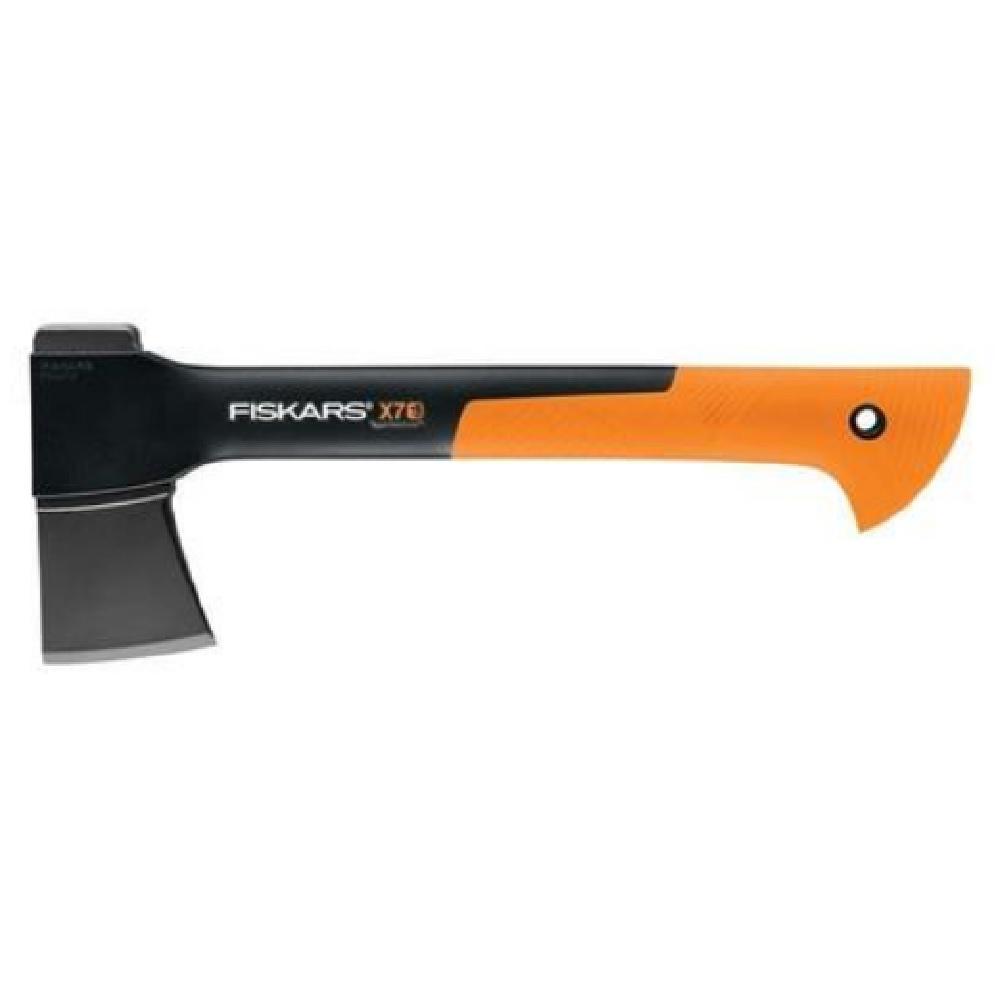
I just picked up a nice little Fiskars 14" hatchet at Home Depot today for $27. Can't wait to put it to use in the back yard this weekend:

fiskars-hatchets-378501-1004-64_1000.jpg


https://www.homedepot.com/p/Fiskars-14-in-X7-Hatchet-378501-1004/202681690

If you insist, they also have machetes.

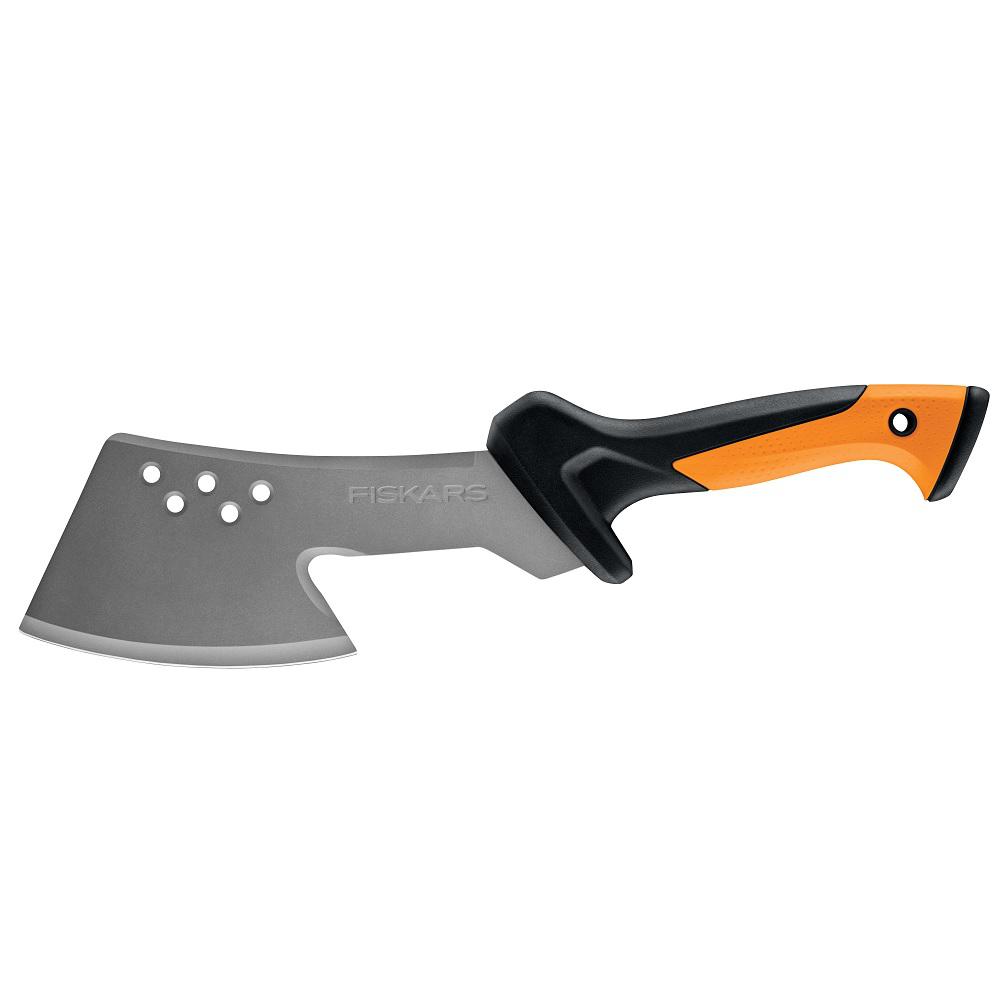
There's also this interesting hybrid, which I almost went for:
fiskars-hatchets-385081-1004-64_1000.jpg


https://www.homedepot.com/p/Fiskars...ed-Handle-18-in-Hatchet-385081-1004/302967834

Right on man, I have that hatchet too.
 
use both arms and more of you're body
I just couldn't agree more with this as a general principle for hand tools and even swords . Two handed and longer handles are much more than simply twice as powerful than one handed . :cool::thumbsup::thumbsup:

This becomes ever more evident as you become older and weaker ! ;)
 
I'm a khukuri guy...obviously.
A large khuk will take out a 5" tree no sweat. It'll weigh in around 3lbs but it will bite way deeper than you expect it would. I've taken 8+" trees apart with a 20" khukuri.

That said, I've also whittled my way through thicker than you would think possible with a machete. I tend to favor the 20" blade for all around work. However the 14" bolo style will burn through woody growth pretty easily. A 24" machete will whistle when you give it a little stank.

There is room for all blades under my loving roof. Khuks get the nod for heavy woods and general heavy camp chores. Machetes will handle springy stuff well and do a surprising amount of work given their flexible blade. Leverage is your friend.
 
Get a 4 pound huge full-tang custom-made Kukri like mine. I got mine for around $400 from Himalayan Imports.

Here it is:

FK6GVCT.jpg
 
I think you'll work too hard taking on 5" trees with your average Latin style machete. That said, I've done it with my 18" Tramontina and got a great workout. I just did it to see if it could take it and the blade held up fine against green hickory. But a boy's axe or even a hatchet (depending on how portable you need to be) would be my tool of choice for anything bigger than 3". But I suppose if I had a heavier, stouter chopping type knife like a kukri or similar I'd consider it depending on the situation. But in my back yard, I'll go with an axe.
 
I think you'll work too hard taking on 5" trees with your average Latin style machete. That said, I've done it with my 18" Tramontina and got a great workout. I just did it to see if it could take it and the blade held up fine against green hickory. But a boy's axe or even a hatchet (depending on how portable you need to be) would be my tool of choice for anything bigger than 3". But I suppose if I had a heavier, stouter chopping type knife like a kukri or similar I'd consider it depending on the situation. But in my back yard, I'll go with an axe.

There's a big difference from the heavier machetes, like the goloks and parangs. I like my latin style for grass and things... or really any situation where I have to worry about slowing the blade down myself instead of the media doing it for me. The thin machetes stick really bad, IMO, but a thicker machete with a good convex works a lot better. I think the edge works more akin to a tomahawk but with a really long edge to add some versatility. I've actually really liked my coldsteel frontier hawk for smaller trees as it's compact but just long enough to get 2 hands on the handle to really get some speed. It's not so heavy that's is tiring to swing for a long time either. Price helps too.

OP, if you're able to, buy a few cheaper options tools, put an edge on it and see how it feels. Keep in mind that the more expensive stuff might feel better in hand but the affordable stuff still works pretty well. Fiskars makes some nice, affordable axes and most machetes are inexpensive from latin America, condor being the exception. But, condor's machetes come with pretty nice sheaths.
 
A good cheap option ive been loving lately is the cold steel magnum kukri. Youll have to put your own edge on it and wrap the handle with hockey tape but for the price i cant complain.
Kershaw camp 18 is heav ie but better quality imo, i would still wrap the handle.

Or the tops .230 is straight out of the box machete magnificence. It costs a deal more though.

Pretty much any machete from condor will be gtg, and a nice leather sheath to boot.
 
Or roll, like your European forefathers, with a billhook. A brush hook if you need to cover a lot of terrain.
 
...Or the tops .230 is straight out of the box machete magnificence. It costs a deal more though.
The Tops would certainly be a good two hander. The sheath appears to be canvas which I expect would not last long in the field. Then, you're looking for another sheath unless you happen to have a suitable Condor sheath lying around that fits.

The Condor Jungolo would be a similar kind of machete.
 
Last edited:
The Tops would certainly be a good two hander. The sheath appears to be canvas which I expect would not last long in the field. Then, you're looking for another sheath unless you happen to have a suitable Condor sheath lying around that fits.

The Condor Jungolo would be a similar kind of machete.
Sheath is some kind of nylon, i think it has plastic between the layers because it is very stiff. Seems pretty sturdy.

Also, bill hooks* are way under rated imo, very capable tool. My cheap fiskars is my go to for blackberry.
 
Last edited:
Sheath is some kind of nylon, i think it has plastic between the layers because it is very stiff. Seems pretty sturdy.

Also, brush hooks are way under rated imo, very capable tool. My cheap fiskars is my go to for blackberry.

Yeah, the sheath on the .230 is quite sturdy. It's not likely to wear out unless you're pretty careless with it, in which case leather wouldn't have fared much better.

As far as brush hooks go, the Fiskars is kind of improperly labeled. It's a light (machete-like) billhook. Brush hooks (historically usually referred to by industry as bush hooks) are the two-handed axe-handled class of tool and are used pretty differently. Fiskars doesn't sell it in the USA, but they make a tool somewhat similar known as a "vesuri" which uses a socket and bolt instead of an eye and strap, and they're sort of like a half-way between bush hooks and ditch bank blades. It seems like a small semantics issue, I'm sure, but the overall behavior and appropriate contexts of use are distinctly different despite the visual similarities. The problem is that billhooks aren't well known in American vocabulary, so Fiskars used a more descriptive name that incidentally stepped on something of a classification faux pas. :p
 
Yeah, the sheath on the .230 is quite sturdy. It's not likely to wear out unless you're pretty careless with it, in which case leather wouldn't have fared much better.

As far as brush hooks go, the Fiskars is kind of improperly labeled. It's a light (machete-like) billhook. Brush hooks (historically usually referred to by industry as bush hooks) are the two-handed axe-handled class of tool and are used pretty differently. Fiskars doesn't sell it in the USA, but they make a tool somewhat similar known as a "vesuri" which uses a socket and bolt instead of an eye and strap, and they're sort of like a half-way between bush hooks and ditch bank blades. It seems like a small semantics issue, I'm sure, but the overall behavior and appropriate contexts of use are distinctly different despite the visual similarities. The problem is that billhooks aren't well known in American vocabulary, so Fiskars used a more descriptive name that incidentally stepped on something of a classification faux pas. :p

My mistake! It is important to use the proper words for what you mean. Edited lol:D
 
Back
Top