machine shop basics?

Joined
Mar 29, 2007
Messages
5,846
Due to knife and non knife related project,s I'm finding more and more need and desire to make stuff requiring (or really eased by) a lathe and a mill.

Budgets are tight but I can make a metal working lathe in a small size (takes stock up to 4.5 inches in diameter and 8 inches long) for a song- I have most of the materials on hand. I doubt I'd be able to do screw cutting, and it might be a few evolutions before I can get really decent accuracy. Or I can buy a mini lathe, which I can *maybe* get into the budget along with a mill.

I can afford to get a micromill and tooling, but if I get a mini-mill, I'm scrounging hard for tooling. I know people in here have debated the two before. I'm mostly looking at guards and small fittings for the shop.

I've gathered the combo mill/drill/lathe machines are worthless.

But.... well, I honestly am not very well educated on the use of the devices. I'm done a little slot milling on a drill press and turned a few pieces on a friend's lathe, but very simple stuff. What kind of resources would you all recommend for getting a better knowledge base?

And what equipment is most highly recommended?
 
I see used machines on craigslist quite often as well as tooling. The machine is probably going to cost less than the tooling. But if your friend has a lathe I'd get the mill. I use my mill 10 to 1 over the lathe for knifemaking. Buy tooling as your budget permits and in a few years you'll find you can do whatever operation you need to.
 
If you started with a lathe, you could use it to do simple milling-especially slotting.

I see the lathe as more useful in helping to make some other shop tools
(wheels, bearings, keyways...)

Email sent
 
You really get what you pay for when it comes to mills or lathes. There are several good ones and several bad ones. You can pay $8,000 for a lathe only to have to take it apart the second you get it, have to change all the fluids all because they did not clean all the left over molding parts/pieces/sands that stuck in the crevasses etc at the factory. But after that it can be a great machine. When you find something you can afford the best advise I can give you is research it and then research it some more. When it comes to used equipment that is a whole different story and will depend on if the current owner took care of it or not. Mills and lathes both in general can take a lot of abuse before they get messed up too badly. Find out what is wrong and what it will cost to fix, what looks like just a simple little part can be super expensive.

As for learning, machining is one of those things you have to do to learn, you can read several books on it but until you do it, it is just not the same. You have to know your equipment also. Some lathes will take .100 off when you turn the dial .050 and others will take .100 off when you move it .100. Strange huh? Don't know what genius thought of making .050=.100 but they did.

As for tooling you can get all your tooling brand new fairly cheap if you do not buy the real good stuff. As you learn you probably do not want to buy the $500 tool set over the $75 set cause when you break it you are out a lot of money if you bought the $500 set. Enco, http://www.use-enco.com/CGI/INSRHM has some good prices on tooling.

When you do get a mill or lathe find out what its specs are, some are lighter duty than others. For example some lathes should only be taking .100 for its heaviest cut, you take .200 regularly it is not going to last.

http://www.amazon.com/Machinerys-Handbook-Companion-Richard-Pohanish/dp/083113089X
Get your hands on one of these, it has all the formulas you'll need, tooling speeds vs. size/type or hardness of material, everything you need to know pretty much.

You also need to know the material you are working with, some materials can be machined using a $5 cutting tool with great results, others cannot be scratched with a $100 tool.

Once you get a machine and start playing with it you will most likely catch on very easily, machining is very easy. Learn your math and when you get close to the size you want take your time and don't make it too small, having to build up a part cause you cut it too small sucks, taking off is always easier that putting back.

If you are going to machine a lot, buy the good measuring equipment. If you buy a $10 caliper it will cost you time and aggravation and if doing something for someone else, money from your pocket.

Two safety things:

If you use a file, which I do often, make sure it has a handle on it, it catches without a handle, it will get you. Just imagine the tang of a file implanted in your hand. Has not happened to me, but I have seen pictures of it and no thanks, looks painful.

Wear a short sleeved shirt, lathe gets a hold of you and you cannot stop it, you are going to be missing limbs, broken bones, or dead. I could post a picture of a guy who got his shirt caught and could not get away but it is very very ugly. His several miles of intestines are wrapped tightly around the lathe.

There are several other safety things but those two get more people than all the rest combined.

I do not know everything about machining but I do know a lot so if you have any questions don't be shy about asking.
 
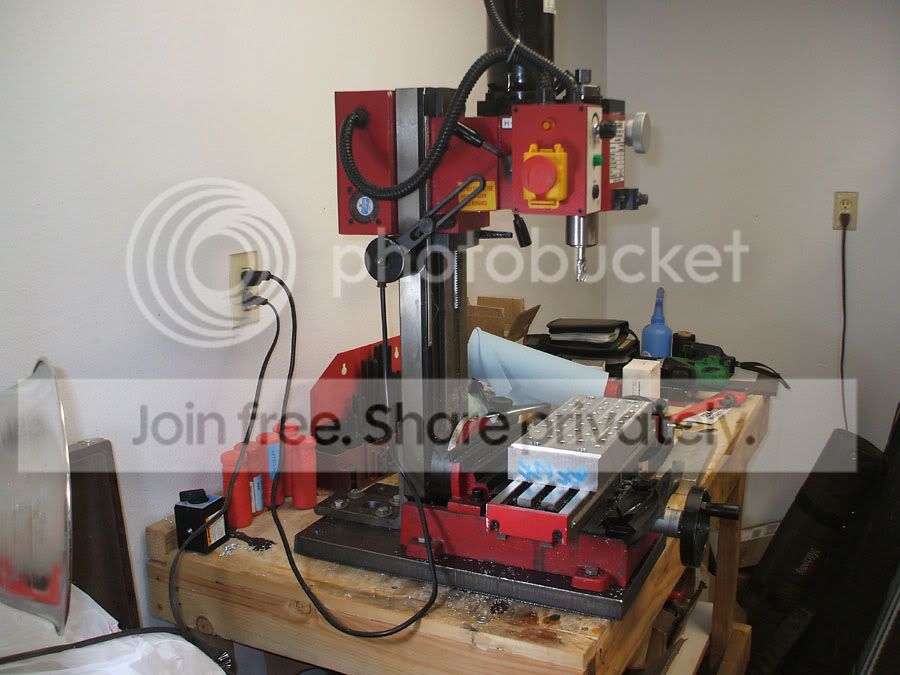
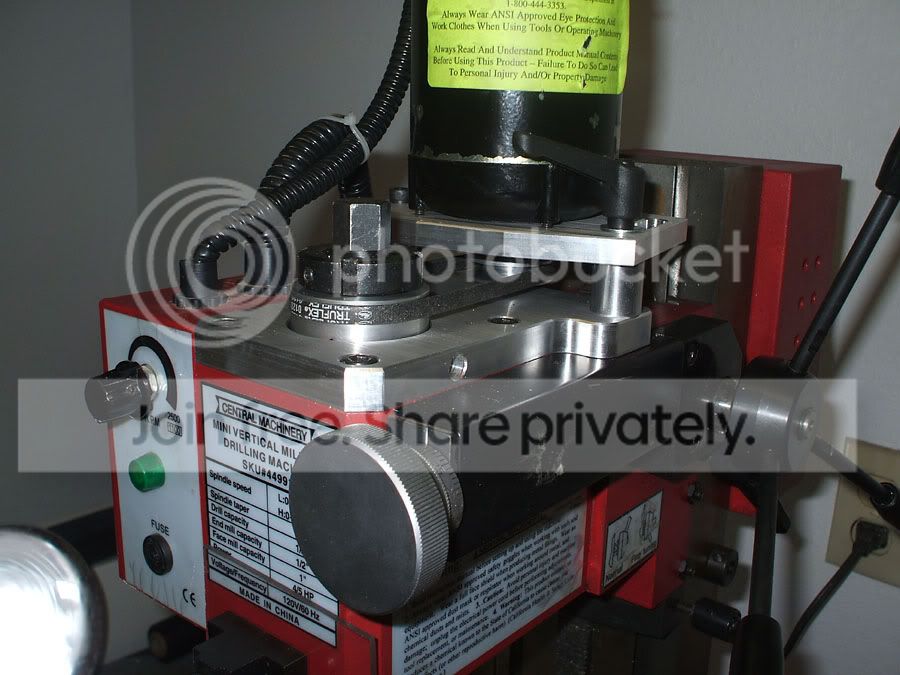
I scored a small Mini Mill off Craigslist ( HF 44991 ) recently for $250 and it had hardly been used. Not a bad little machine , but certainly has it's limitations , but being as it takes R-8 tooling , I was able to find tooling for it reasonably to get me going.

The machine is just part of the expense , the tooling , vise , clamps , etc adds up fast.

I have easily spent another $500 on end mills , dovetail cutters , keyless chuck with an R-8 arbor , 3" vise ,parallels , clamp kit , fly cutters , boring head , and recently a belt conversion made by a guy over on CNC Zone forum ( that gear head was LOUD ! ). Recently finished making the tooling plate ( from 1 1/2 thick MIC6 aluminum )...drilling and tapping 38 of those 3/8-16 holes was a pain ( next toy , tapping head ).

You can find plenty of info on various websites to teach you the basics. I have purchase accessories from Enco , Little Machine Shop , MSC and good ol e-bay.

One thing I found on the mini mills with the tilting column is they flex a good bit , modded mine by making a thick L bracket for the back , bolted to the column and bolted it and the machine to a 1" steel plate. Added quite a bit of rigidity to it. I won't need the tilt feature too often anyways.

DSCF1393.jpg


DSCF1415.jpg


So far I have just done some light machining with it , relieving some slip joint liners , making a work rest for my 9" disk grinder , etc.
 
I was looking at the mini-lathe (several brands) and both the mini and the micro mill- I know they are limited machines.

littlemachineshop has a fair selection of stuff for all of them, and I've ordered things from them in the past for the knife shop.

I did find a small lathe build up plans that's based on angle iron for the ways and... well, it's pretty simplistic, but might be something I could build for fun. I wouldn't get really good tolerances out of it, though.
 
Ive got a mini-mill and a mini-lathe. Both great tools, Definitely get the mini-mill over the micro-mill. If you use it like I do you wont regret getting the larger tool, even if you do not see why you might need it right now. I also agree getting the mill over the lathe first. Plus you can always put a lathe tool in your vise and do crude turning in the drill chuck of your mill.
Chris
 
Ive got a mini-mill and a mini-lathe. Both great tools, Definitely get the mini-mill over the micro-mill. If you use it like I do you wont regret getting the larger tool, even if you do not see why you might need it right now. I also agree getting the mill over the lathe first. Plus you can always put a lathe tool in your vise and do crude turning in the drill chuck of your mill.
Chris

I do have the cross slide vise for the big vulcan 12 speed press I picked up yesterday :D
 
So, here's a question- when looking at the mills, there's a few options - the most significant one in the models appears to be the R8 versus 3morse choice.

Which one, and why?
 
ordered a mill. yay. Managed to talk HF into giving me 25% off and everything.

Now, I still want a lathe, but I'm worried that the little 7x12 lathes will be too small.


I have a chance to buy a logan 11 inchx40something. for about the same price. Works, needs some cleaning and tooling, and a live center (has a chuck in the tailstock)..... for the same price as a new 7x12. Do I grab it?
 
Grats on the mill, can't wait til I can get my own. What year is the logan? I have worked with an old one and it was a tank, just went and went and went some more. Have any pictures of it?
 
I would pass on that one.
a few reasons.

It's a turret lathe, setup for production drilling and you have no actual tailstock on there.

11x40" ??? The 40 inches would be measured as the usable distance between live and dead centre...in the pics it doesn't look that big.?

Maybe it's the angle of the photo, but I don't see a leadscrew...meaning no auto feed
I see an oiler cup on the left side of its bearing, but no leadscrew.

I don't see a quick change gearbox.
I have used a Southbend 9" lathe of that vintage and inorder to change feed speed, you have to open that gear cover on the left and use the chart inside the door to physically change the layout of the gears to set a different speed.
(and we had the box full of gears to go with it... this doesn't ?)

If I had some production work of low tolerance where I could set it up for a single operation and never change it...and pay very very little for it...then maybe...

but not for your general and varied needs.
.

(and I have a package for you ready to hit the mail)


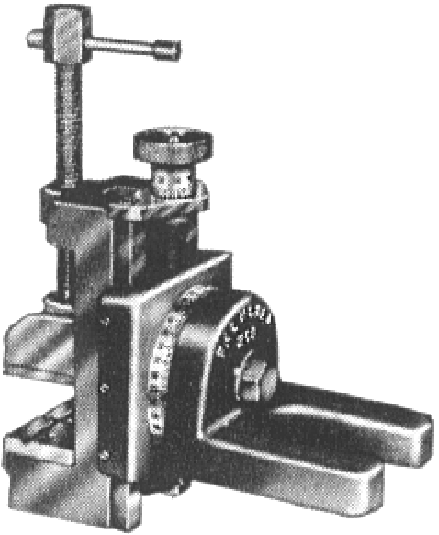
If that photo looked more like this ...then yes I would
img19.gif
 
Last edited:
okay, lacking leadscrew, probably fixable, but something to think about. I was honestly hoping I'd be able to change out for a regular tailstock and a live center, keeping the chuck, on a trade. I know the person selling it *had* the tailstock at one point from email conversations.

the quick change gearbox is something I'm not expecting in my price range, but the gears themselves are a must.

I suppose I should ask what I would reasonably pay for that as is, knowing I need to deal with the leadscrew and tailstock immediately.
 
If you started with a lathe, you could use it to do simple milling-especially slotting.

I see the lathe as more useful in helping to make some other shop tools
(wheels, bearings, keyways...)

Email sent

keyway's??? How would one go about that(endmill in chuck, stock clamped in toolpost?)??? I have a 12x36 gear head import lathe, But I bought it more for general fabrication/screwcutting/gunsmithing, but If I could slot gaurds that would be nice!

Would a milling attachment on a lathe be worth having??
 
I would have to agree with 12345678910, I'd have to pass on that one unless it is super cheap. To get that back to 100% might end up costing you more than it would be worth by a long way. Looking at the pictures there is no way I see that being a 40", maybe a 20" but it does not even look that big. I would bet you are going to have to replace almost every single bearing and who knows what else.

It might not be that bad, but looking at those pictures it looks like a money pit to me. If it was me I would save a little more money and buy something that that is not going to take a ton of work to get working, but it is up to you of course. If you do pick it up I hope it is not as bad as it looks.

John0270, you can (if you have a 4 jaw chuck) offset your work so you drill a hole that makes a keyway type hole but it would not be a true keyway because it would be round. Never used a milling attachment for a lathe so I cannot say how they are. If you have a drill press you can make keyways, build a small track that you can attach a small vise to, indicate it in and slot away. Later today I am posting a thread that will have a picture of track type piece that will show you the basic design.

Ronnie
 
koyote....
this lathe was in worse shape than that one , and my neighbor spent a great deal of time bringing it back to life , but she runs true , tight and was worth the effort. He did get it extremely cheap though. Davis 14x40

shop12.jpg
 
regarding size, there is not a 900 series made with that short a bed length. most are 30-50. That's also a BIG chuck on the headstock. The swing on that machine is 11 inches, as well.

I'm not worried about bearing so much, but it's got some immediate lacks in terms of me using it for anything. shame, I could really use an 11 inch swing eventually.
 
Back
Top