You know, MRostov, I share your appreciation for that saw on the back of these knives. Yes, as everyone knows, you have to knock the sawdust out of them once in a while.
But say you've got just your knife, and you happen across a tree with a branch a few yards up that is just the right shape and size for some survival use you have in mind--say, a stave from which to make a bow. Your branch is about an inch and a half or two inches thick. You've got to climb the tree and stay there while you harvest that branch.
If the knife you have is, say, a Mora, and you have thus committed yourself to batonning as your sole available means of cutting branches of that thickness, you are going to have trouble getting a workable bowstave. You climb the tree, hold on with one hand, bend the branch with your other hand, hold the knife with your THIRD hand, and pound the blade with your FOURTH hand--maybe it'll work if your survival scenario involved enough radiation to sprout you the extra limbs, but not easy. Also, the "bend-the-branch-and-rock-the-knife-through-it" method tends to leave many splits in the ends of the wood piece--not good for a bowstave. And it doesn't just have to be a bowstave--any piece of wood you might like of that general diameter is going to be doable with the pilot's knife sawback and a couple minutes' patient sawing, but a bit harder with some other small-to-medium-sized knives without the saw feature. And, sure, the saw teeth will chew up your baton--but have you ever met anyone who cared what his baton looked like after chopping wood?
I like these knives--got a cheap knockoff decades ago and wore it over hundreds of miles of Scout trips, back when $20 was a bit steep for one of the originals. Now, you can usually get the real thing used on eBay for $20 shipped, if you kind of look around for a week or so. I've kind of made the real thing (Camillus or Ontario) issue equipment for my family's survival kits.


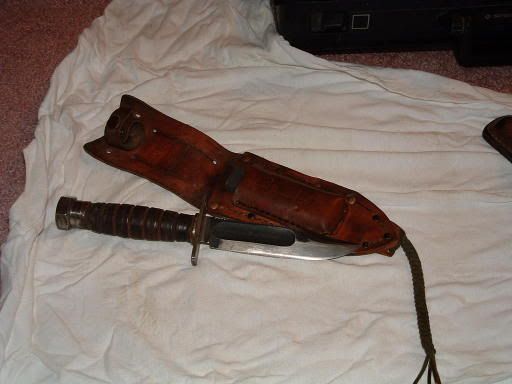


 One currently sits under my front seat, and the other is in the back of my wife's truck. Very nice sheath though.