
made first blade now i have questions

Joined
Jul 13, 2015
Messages
47
hi, i recently decided to make my own knives and purchased an angle grinder, a hacksaw, sandpaper and an oilstone and decided i'd practise on a bit of cheap galvanized steel before trying a comparitvely expensive steel blank (i was thinking of going for 1055 by the way) and i've hit a couple of snags, on the one hand i have produced a pretty decent first attempt, the handle shape and most of the blade shape came out beautifully and it's very well balanced (I can personally throw it successfully at a range of 15 feet) but i had some trouble with the bevelling, two things specifically;

1. the line between the bevel and the spine is a tad wonky in places (not that much but if oyu're going to do it, do it right you know?) and i was wondering if there was a trick to this?

2. the edge is not in the centre of the blade, i have (despite some, i thought, careful angle measuring) have managed to accidentally have the edge slightly closer to the left hand side of the blade, is there a trick to this as well or was i simply not careful enough?

i'm not discouraged by my first attempt (made of awful unusable galvanized steel as it may be) i'm actually as chuffed as can be but i'd really like to become good at this :) thank you all.
 
hi, i recently decided to make my own knives and purchased an angle grinder, a hacksaw, sandpaper and an oilstone and decided i'd practise on a bit of cheap galvanized steel before trying a comparitvely expensive steel blank (i was thinking of going for 1055 by the way) and i've hit a couple of snags, on the one hand i have produced a pretty decent first attempt, the handle shape and most of the blade shape came out beautifully and it's very well balanced (I can personally throw it successfully at a range of 15 feet) but i had some trouble with the bevelling, two things specifically;

1. the line between the bevel and the spine is a tad wonky in places (not that much but if oyu're going to do it, do it right you know?) and i was wondering if there was a trick to this?

2. the edge is not in the centre of the blade, i have (despite some, i thought, careful angle measuring) have managed to accidentally have the edge slightly closer to the left hand side of the blade, is there a trick to this as well or was i simply not careful enough?

i'm not discouraged by my first attempt (made of awful unusable galvanized steel as it may be) i'm actually as chuffed as can be but i'd really like to become good at this :) thank you all.

You will want to trade that galvanized steel in for something else. Galvanized steel contains Zinc which can be deadly to human organisms. Grinding it or welding it are both dangerous to your health. Stop what your doing.

Fred
 
i can't watch videos, i don't have internet at home and my work computer blocks them :( and yeah i read about the zinc only about 20 minutes ago, where can i buy bar blanks? preferably 1055 or 1095 but i would accept a 440 or even a 420 to start off with.
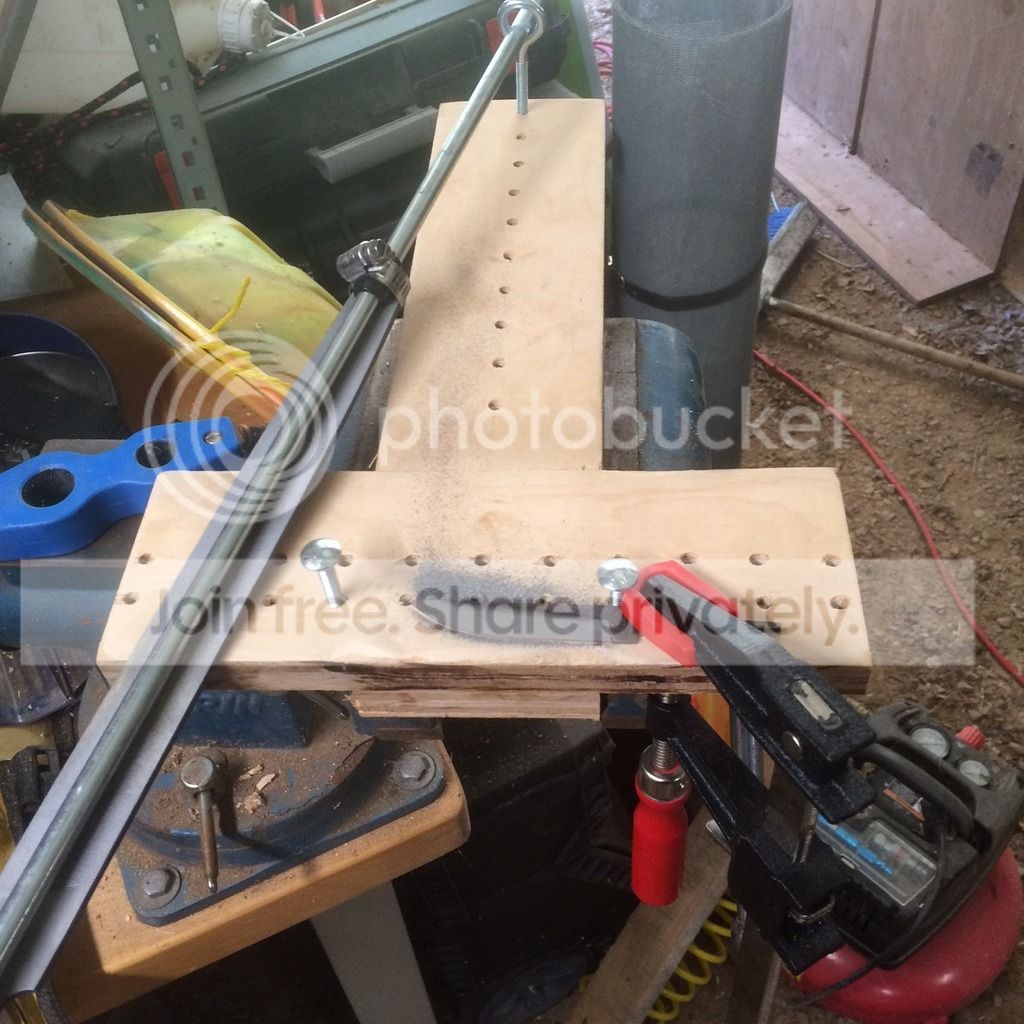
 
I use a jig to make my bevels. It is a "T" with holes drilled down the middle of both pieces one inch apart. See the picture below. As for centering, take a drill bit the same size as the width of your steel and use the tip of the bit to score a center line on the edge of the blade. If you lay the bit on the table, the point should be exactly half the thickness of the steel.
Making%20bevels_1.jpg

It is hard to see, but there is a set screw near the tip of the blade. All holes are tapped 1/4-20. I used a 12" file and a 30" steel rod.

The tools needed to construct the jig are:
- Hacksaw
- Ruler
- Pencil
- Electric drill
- Center punch
- 1/8" drill bit
- 7/32" drill bit
- Dremel, angle grinder, bench grinder or belt sander for preparing the file (needed once only)

Materials:
- 1x 11x3.5x0.75" Plywood
- 1x 14.5x3.5x0.75" Plywood
- 1x 10.5x3.5x0.75" Plywood
- 4x #8 Wood Screws
- 2x 1/4-20 Stove bolts, 1-1/2" long
- 1x 3/8" steel rod 36" long
- 1x 1/4" eye-bolt. 2-6" long (ideally get a couple of different lengths)
- 1x 12" Double cut bastard file
- 1x Roll of electrical tape
- 2x 1" diameter screw-type hose clamps

This filing jig can be used for filing full flat grinds, high flat grinds, and scandi grinds. It can also be used for doing convex grinds by doing a faceted grind and then blending the facets together.
I got the plans from Gough Customs on You Tube. It is a great jig.
 
Last edited:
Can you upload pics of your blade to here? That would help folks help you out.
 
Breathing any fumes or dust is bad, but galvanized metal gets some wrongful cautions. Cyanide will kill you. Formaldehyde will make you very sick and do serious damage to your body, galvanized metal fumes may give you a headache and upset stomach.

Below is a repeat post I have made several times:

I am going to preface this post with the warning that breathing any fumes ,even the forge exhaust, is not a good thing. Shop safety and respirators are a must if you want a long and healthy life.

I will also set the record straight about Jim paw-paw Wilson's death from "zinc poisoning" as it is often stated. Jim was burning the coating off galvanized pipe in a tightly closed up shop - with no ventilation or respirator - with a case of the flu - and totally messed his lungs up by breathing the hot fumes over several hours. It wasn't the zinc that killed him. His death is often stated as "zinc poisoning", or "complications of metal fume fever" in some posts, but to put it in graphic words, he drown in the fluid that was weeping out of his destroyed lungs. It was pneumonia that killed him. Jim was a great guy, and knew better than to do what he did....but did it anyway. His example ( bad one) should be well noted by all.

That said, I read all the time posts where someone says, "Don't use galvanized, the fumes are toxic". ( often followed by a reference to paw-paw)


Galvanized steel is just regular steel with a coating of a zinc compound. If you look up zinc, you will find all sorts of info on ZINC POISONING. Especially for animals, some of which are highly susceptible to zinc (dogs and birds).
Zinc poisoning is caused by the over absorption of metallic zinc into the body, which can play hell with your metabolism. You need zinc to live, but not too much of it. Zinc poisoning in humans is extremely rare. Taking too many "Vitamin plus Minerals" pills probably are far more likely to cause zinc poisoning than galvanized metal is.

Many metal parts in electronics and other industrial uses are CADMIUM plated, and cadmium fumes can kill you.

When you grind the zinc off of steel, you create zinc dust and may breathe fine metallic zinc. That is certainly not good. Breathing zinc dust can possibly cause zinc levels in your blood to increase.........so grinding it off must be done carefully and all dust cleaned up. A P100 filter should be worn at all times when the grinding is in progress, and kept on until all dust is removed. Even with this warning, understand that zinc is a very active metal, and readily combines with oxygen to form zinc oxide ( or other compounds) and the amount of metallic zinc absorbed by grinding a few inches of galvanizing off a weld joint is most likely going to be minute ,unless you are working in an industrial situation doing it day in and day out, zinc dust isn't a significant worry.

When you weld or heat galvanized metal it creates a white fuzzy dross and a white smoke. This is not zinc...it is zinc oxide. Zinc oxide is not absorbable in any real way.....or every life guard in California would be dead by now.
If you breath enough of it it can make you feel bad, but is not going to kill you. This is called "ZINC SICKNESS" ...not zinc poisoning. Another name is "METAL FUME FEVER".
Zinc sickness is caused by breathing too much zinc oxide fumes and makes you feel nauseous and headachy. If you were breathing smoke, grain dust, or many other airborne particulates, similar symptoms may result.
The treatment for zinc sickness is fresh air, a glass of milk, and a good nights sleep. It is not fatal.
Good ventilation with a fan blowing the fumes away prevents it, as well as wearing a P100 particulate respirator. Zinc oxide is not an organic compound, and does not require special organic filters.

The long and short of this post is that 90% of all people think that zinc welding fumes are deadly...but that is not the case. Same story goes for MOP and Abalone, which are often posted as giving off deadly cyanide gas. MOP and other shells are calcium carbonate, and similar compounds....which is probably in your toothpaste. There is no cyanide in shells. Apricot and other fruit pits have cyanide type poisons, but again, it is not a significant concern.
 
The more chemicals you use in the shop, the different types of coatings on steels and belts, welding rods, stabilized and unstabilized woods from around the globe, can by themselves and in combination be extremely dangerous to your health.

The bottom line, if you want to live a long and hopefully prosperous life in the shop, make air quality, fire safety, and good machine practices a top priority.

Stacy and I, along with every other knife maker who has been doing this for a number of years have horror stories we can share, stuff that would give you night mares. We burn down our shops or gash our bodies with sharp things, and breath things that should not be in ones lungs. We could put up a Horror Stories sticky for makers to share their scary happenings in their shops.

Good post Stacy!

Fred
 
Brisa in Finland or Dictum in Germany might be more "local". They both carry lots of knife making supplies as well as steel.
 
Back
Top